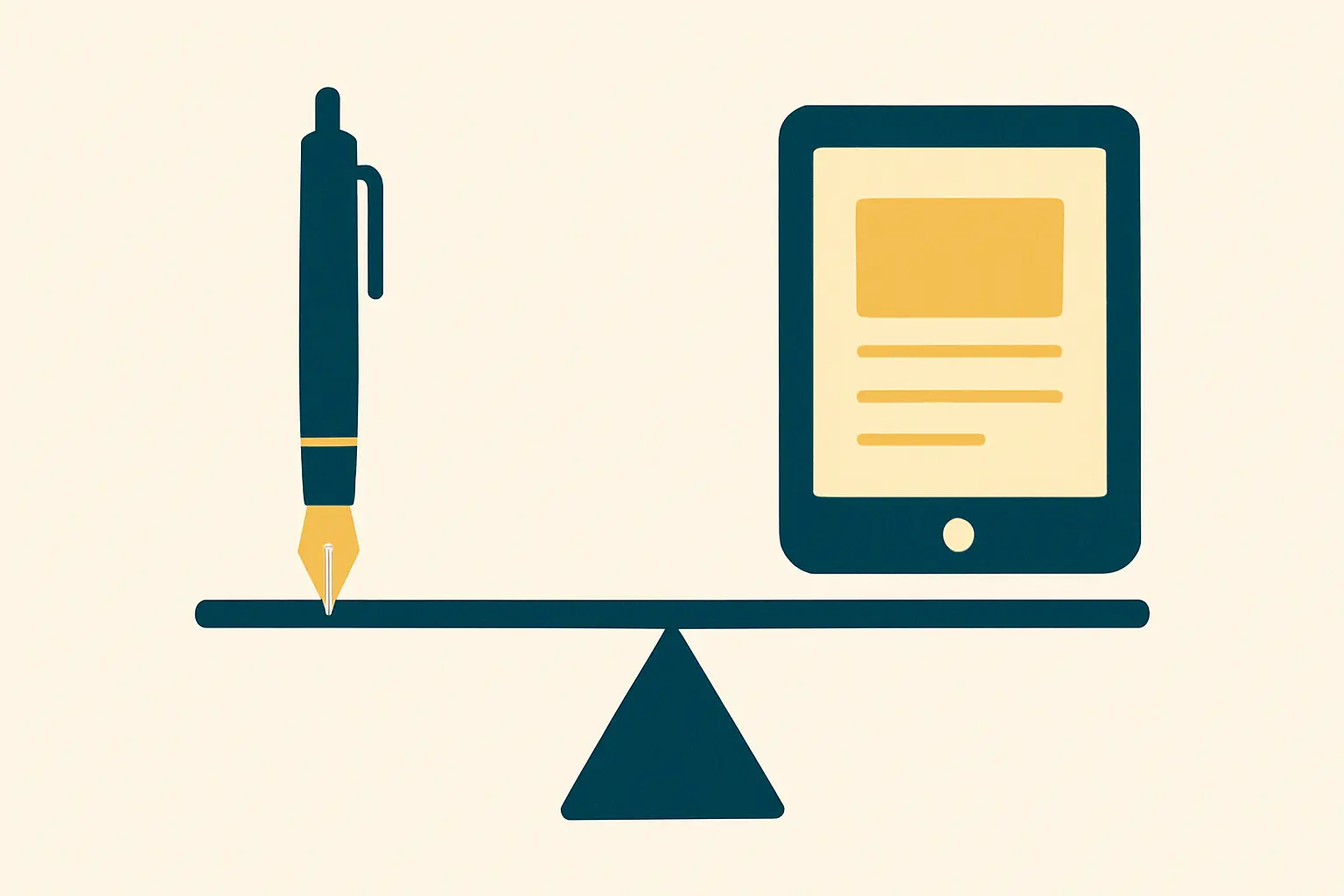
There is no single national rule we could verify that bans or permits AI assistance for Indian theses outright. What governs you is narrower and stricter than most scholars assume: under the UGC Regulations, 2018 you personally sign an undertaking that the document is your own original work and free of plagiarism, and your institution is required to publish its own integrity policy. Those two documents decide what you may do.
That framing matters, because scholars keep asking whether AI is “allowed” when the operative question is whether you can honestly sign the declaration and defend every sentence in your viva.
What the Regulations actually require of you
The UGC (Promotion of Academic Integrity and Prevention of Plagiarism in Higher Educational Institutions) Regulations, 2018 impose several obligations that bear directly on this question:
- You submit an undertaking that the document has been prepared by you, that it is your original work, and that it is free of plagiarism.
- The undertaking must also state that the document has been checked through a plagiarism detection tool approved by your institution.
- Your supervisor submits a certificate stating that the work done under their supervision is plagiarism free.
- Your institution must develop a plagiarism policy, have it approved by its statutory bodies, and place it on the homepage of its website.
Read the first of those again. You are personally certifying authorship. Any use of assistance that would make that certification untrue is out of bounds, regardless of what any tool advertises and regardless of whether detection would catch it.
The fourth point is the one to act on today: your institution’s policy is supposed to be publicly available on its own website. Find it and read what it says about AI assistance specifically. Indian universities have been issuing and revising guidance, and the version that applies to you is your own institution’s.
The line that actually matters
Frame it as authorship rather than tooling. Two questions decide almost every case:
- Are the ideas, analysis and conclusions yours? The Regulations specify that the research work must be based on original ideas, covering the abstract, summary, hypothesis, observations, results, conclusions and recommendations.
- Can you explain and defend every sentence? If a passage appears in your thesis that you cannot account for, you have a problem in the viva whatever produced it.
Assistance that helps you express your own analysis more clearly sits on one side of that line. Generating claims, findings or an argument you did not construct sits on the other. The distinction is not subtle in practice, though it is often blurred in marketing.
Uses that are difficult to defend
- Generating citations or references. This is the most damaging failure mode, because language models can produce plausible references to work that does not exist. A fabricated citation in a submitted thesis is a serious integrity finding, and it is trivially checkable by an examiner. Verify every reference against the actual source.
- Generating results or discussion. These must come from your data. Text describing findings you did not obtain is fabrication.
- Producing a literature review from prompts rather than reading. You cannot defend a synthesis of studies you have not read, and committees ask about specific studies.
- Paraphrasing source text to reduce a similarity score. This disguises rather than fixes the underlying problem, and the proper approach is set out in the recovery plan for a similarity report above the UGC limit.
Uses that are ordinarily defensible
Subject always to your institution’s policy:
- Structuring what you already know. Turning your own notes and framework into an ordered outline.
- Improving expression. Tightening sentences you wrote, particularly valuable for scholars writing in a second or third language.
- Checking consistency. Confirming that your methodology chapter and results chapter describe the same procedure.
- Explaining a concept to you so you can then read the primary sources properly and cite them yourself.
The common thread is that you supply the substance and remain able to defend it. None of these produce claims you did not make.
Should you disclose AI assistance?
Check your institution’s policy first, because some now require a declaration and specify its wording. Where a declaration is required, complete it accurately; an inaccurate declaration is a worse problem than the use it conceals.
Where your institution is silent, ask your supervisor directly and in writing. A written answer protects you if practice changes between now and your submission, which in this area it may.
What about AI detection tools?
Institutions are experimenting with detectors, and it is worth understanding their limits honestly. They produce false positives, and non-native English writing and heavily edited academic prose are both known to trigger them. A flag is not proof.
The practical protection is the same thing that makes your work genuinely yours: keep your drafts, your notes, your data files and your reading records. A scholar who can show the development of a chapter from notes through drafts is in a strong position. A scholar with only a finished document is not, whatever the truth.
A privacy point scholars overlook
Before pasting anything into any online tool, consider what is in it. Unpublished results, participant data, material under a confidentiality agreement or anything patentable should not be entered into a service whose data handling you have not checked.
This is a distinct issue from integrity and can carry separate consequences under your ethics approval or an agreement with a collaborating organisation. Check the terms, and where the data is sensitive, keep it out of external tools entirely.
Where Tesify sits
Tesify is built for the defensible side of that line, and it is worth being explicit about the limits.
It helps you develop chapters from your own framework, notes and data: structuring an argument you have formed, expressing it in academic prose, and keeping methodology and results consistent as the document grows. It does not generate your findings, decide your research gap, or select your sources, and it is not a substitute for reading the literature.
You verify every citation against the actual source, you remain the author, and you sign the undertaking. More than 9,000 students have used Tesify to produce over 15,000 chapters, and 100% of the writing stays yours.
Start writing your chapter in Tesify
Before you submit
Whatever assistance you use, the submission requirements are unchanged. The similarity thresholds and their consequences are set out in the UGC plagiarism limit for a PhD thesis, journal verification has changed materially and is covered in how to verify a journal in India in 2026, and what happens to your thesis after the award is explained in what Shodhganga is.
Frequently asked questions
Is using AI for a thesis banned in India?
We could not verify a single national prohibition. What we could verify is that you certify the work as your own original work under the UGC Regulations, 2018, and that your institution must publish its own integrity policy. Read your institution’s policy, because that is the document that binds you.
Will my university know if I used AI?
Detectors exist and are unreliable in both directions. This is the wrong question to optimise around. The question that decides your viva is whether you can explain and defend your own thesis, which is unaffected by what any detector reports.
What if a detector falsely flags my writing?
Produce your drafting history: notes, earlier drafts, data files and reading records. This is why keeping them matters even when you have done nothing wrong, particularly for scholars writing in a second language, whose prose is disproportionately flagged.
Can I use AI to improve my English?
Language editing has long been accepted in Indian academia, and many scholars use professional editing services. Confirm your institution’s position, and ensure editing does not extend into changing your claims or conclusions.
Can AI generate my references?
Do not let it. Fabricated references are the single most damaging error in this area, and every reference must be verified against the actual source. Use a reference manager for citation formatting instead.
Does my supervisor need to know?
Tell them. Your supervisor certifies that the work under their supervision is plagiarism free, so they have a direct interest, and their guidance on your institution’s expectations is the most reliable you will get.
Is it different for a synopsis than for the full thesis?
The authorship obligation is the same. Note that a synopsis is short, so any reused text produces a much higher similarity percentage than the same passage would in a full thesis.
What about using AI for data analysis?
Analysis should be performed in statistical software you can operate and explain, as discussed in the comparison of statistical tools for an Indian thesis. Examiners ask why a test was chosen and what the output means, and you must be able to answer.
Will journals ask about AI use?
Many publishers now require disclosure of AI assistance and state that such tools cannot be listed as authors. Check the specific journal’s policy when you submit, since requirements vary and are being revised.
What is the safest approach overall?
Do your own reading, form your own argument, keep your drafting history, verify every citation, use assistance only for structure and expression, disclose where required, and be able to defend every sentence. A scholar who meets that standard has nothing to fear from any policy or detector.