India produced 300,884 journal articles in 2024. The same database, queried on the same day, also reports 462,846 Indian research outputs for 2024. Both numbers are correct. They count different things, and that single fact explains almost every disagreement you will find between sources.
Every figure below was retrieved directly from the OpenAlex API on 18 August 2026, using the filter for works with at least one author affiliated to an institution in India. Nothing here is quoted from a secondary report. Where a number is unstable or an artefact of how the index is built, that is stated in the same paragraph rather than in a footnote.
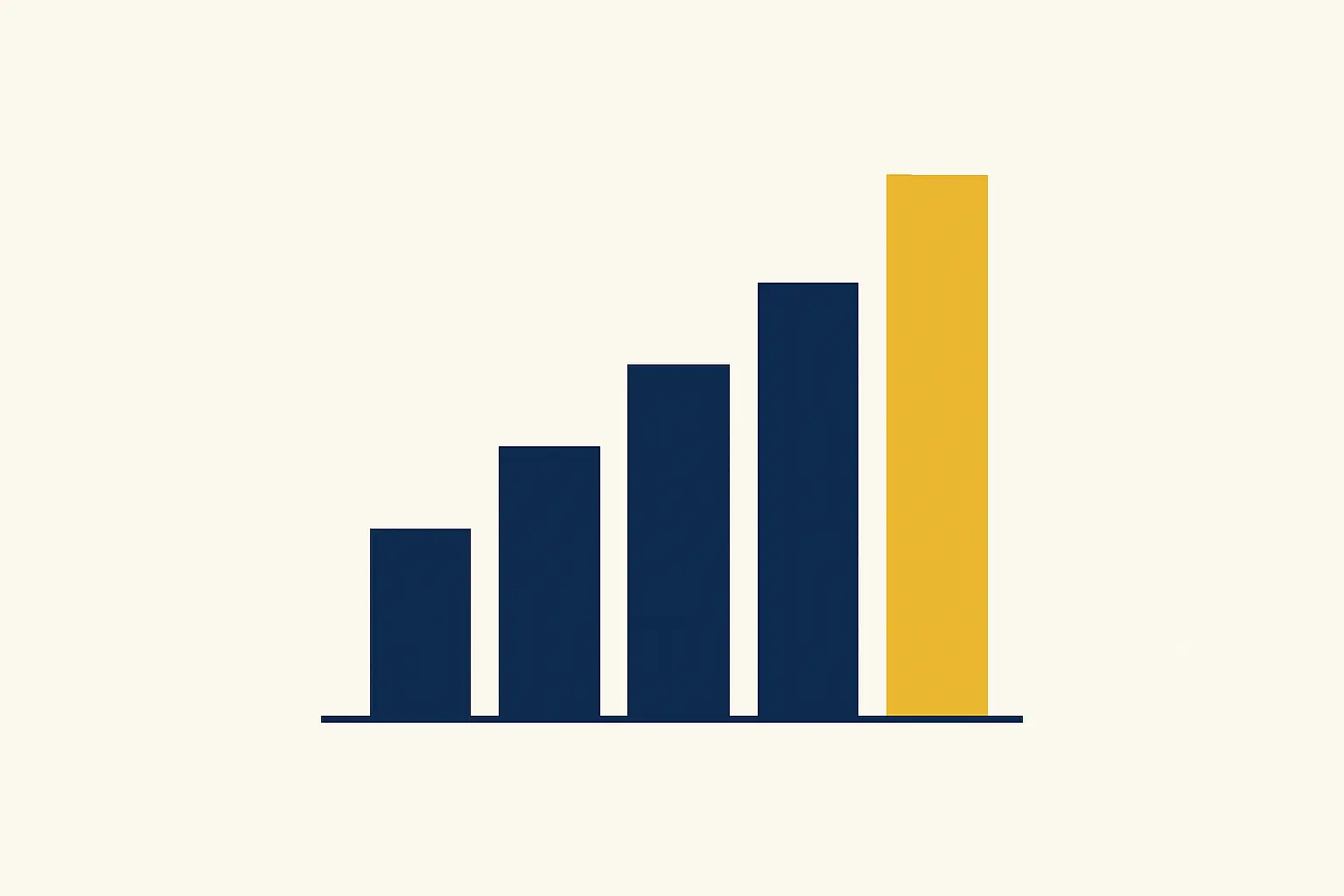
India’s journal article output, 2020 to 2025
| Publication year | Journal articles with at least one India-affiliated author | Source and retrieval |
|---|---|---|
| 2020 | 226,306 | OpenAlex API, retrieved 18 Aug 2026 |
| 2021 | 248,970 | OpenAlex API, retrieved 18 Aug 2026 |
| 2022 | 265,043 | OpenAlex API, retrieved 18 Aug 2026 |
| 2023 | 279,097 | OpenAlex API, retrieved 18 Aug 2026 |
| 2024 | 300,884 | OpenAlex API, retrieved 18 Aug 2026 |
| 2025 | 321,151 | OpenAlex API, retrieved 18 Aug 2026 |
That is a rise of 41.9% between 2020 and 2025, and 2024 was the first year India’s journal article count crossed 300,000. The 2026 figure stood at 269,142 at retrieval, but 2026 is an incomplete year and that number will keep climbing; it should not be compared with a completed year.
What the 462,846 headline figure actually contains
Filter India’s 2024 output by record type and the single number breaks into twelve, most of which are not what a reader means by “a research paper”.
| Record type | India, 2024 | Source and retrieval |
|---|---|---|
| Journal article | 300,884 | OpenAlex API, retrieved 18 Aug 2026 |
| Conference paper | 79,633 | OpenAlex API, retrieved 18 Aug 2026 |
| Book chapter | 36,100 | OpenAlex API, retrieved 18 Aug 2026 |
| Preprint | 21,335 | OpenAlex API, retrieved 18 Aug 2026 |
| Review | 4,451 | OpenAlex API, retrieved 18 Aug 2026 |
| Peer review record | 3,407 | OpenAlex API, retrieved 18 Aug 2026 |
| Conference abstract | 3,340 | OpenAlex API, retrieved 18 Aug 2026 |
| Erratum | 1,550 | OpenAlex API, retrieved 18 Aug 2026 |
| Retraction notice | 1,499 | OpenAlex API, retrieved 18 Aug 2026 |
| Reference entry | 1,417 | OpenAlex API, retrieved 18 Aug 2026 |
| Paratext | 1,294 | OpenAlex API, retrieved 18 Aug 2026 |
Errata, peer review records, reference entries and paratext are all counted in the headline, and none of them is a research paper. Conference papers and book chapters are real scholarly output, but a reader comparing India to another country on “papers published” almost always means journal articles — and conference publishing is far more central in Indian computer science and engineering than it is in many comparator systems, which inflates India’s all-types figure relative to theirs.
The practical rule: never cite a publication count without saying what record types it includes. If your source does not say, you cannot tell whether it is closer to 300,884 or 462,846.
What share of world research does India produce?
For 2024, on a like-for-like journal article basis: 300,884 Indian articles against 5,967,943 worldwide, or 5.0%.
That is the only share figure in this article, and deliberately so. The same API reports 10,790,426 world outputs of all types for 2024 and 15,073,942 for 2025 — a 40% jump in one year that reflects the index adding sources, not the world’s researchers writing 40% more. Any multi-year “share of world output” trend built on that denominator would be measuring the database’s growth, not India’s. One year, one record type, stated with its retrieval date, is what this data can honestly support.
Which Indian institutions publish the most?
The 2024 figures below count works that have at least one India-affiliated author and also list the named institution. Read them as institutional participation in Indian-authored research, not as an internal productivity score.
| Institution | Works with an India-affiliated author, 2024 | Source and retrieval |
|---|---|---|
| Saveetha University | 14,225 | OpenAlex API, retrieved 18 Aug 2026 |
| SRM Institute of Science and Technology | 11,047 | OpenAlex API, retrieved 18 Aug 2026 |
| Indian Council of Agricultural Research | 10,726 | OpenAlex API, retrieved 18 Aug 2026 |
| Council of Scientific and Industrial Research | 9,427 | OpenAlex API, retrieved 18 Aug 2026 |
| Vellore Institute of Technology | 9,089 | OpenAlex API, retrieved 18 Aug 2026 |
| Banaras Hindu University | 9,075 | OpenAlex API, retrieved 18 Aug 2026 |
| Lovely Professional University | 7,222 | OpenAlex API, retrieved 18 Aug 2026 |
| All India Institute of Medical Sciences | 7,001 | OpenAlex API, retrieved 18 Aug 2026 |
| Chandigarh University | 6,474 | OpenAlex API, retrieved 18 Aug 2026 |
| University of Delhi | 6,461 | OpenAlex API, retrieved 18 Aug 2026 |
| Indian Institute of Technology Delhi | 4,801 | OpenAlex API, retrieved 18 Aug 2026 |
| Indian Institute of Technology Kharagpur | 4,547 | OpenAlex API, retrieved 18 Aug 2026 |
| Indian Institute of Technology Madras | 4,195 | OpenAlex API, retrieved 18 Aug 2026 |
| Indian Institute of Technology Bombay | 4,067 | OpenAlex API, retrieved 18 Aug 2026 |
| Indian Institute of Science, Bangalore | 3,996 | OpenAlex API, retrieved 18 Aug 2026 |
The finding most likely to surprise a reader is the ordering: the highest-volume institutions in the list are private universities, not the IITs. Saveetha University’s 14,225 is close to three times IIT Delhi’s 4,801. This is a statement about volume of indexed records and nothing else — it says nothing about citation impact, and volume and impact are different measurements that this query does not connect.
Three entries have been left out of the table on purpose. “Government of India” (30,806), “Ministry of Science and Technology” (13,910) and “Ministry of Health and Family Welfare” (8,683) rank above every university, because OpenAlex rolls affiliation strings up through a parent lineage and a great many Indian institutions sit under a ministry. They are not research-performing bodies in the sense the list implies. A fourth oddity, King Saud University at 5,318, appears because the filter selects works with an Indian author and then counts every institution on those works — international co-authorship, not Saudi output attributed to India.

Which disciplines produce it?
| Field | India, 2024, all record types | Source and retrieval |
|---|---|---|
| Medicine | 85,925 | OpenAlex API, retrieved 18 Aug 2026 |
| Engineering | 82,888 | OpenAlex API, retrieved 18 Aug 2026 |
| Computer Science | 51,531 | OpenAlex API, retrieved 18 Aug 2026 |
| Agricultural and Biological Sciences | 36,978 | OpenAlex API, retrieved 18 Aug 2026 |
| Materials Science | 25,902 | OpenAlex API, retrieved 18 Aug 2026 |
| Biochemistry, Genetics and Molecular Biology | 23,346 | OpenAlex API, retrieved 18 Aug 2026 |
| Environmental Science | 23,313 | OpenAlex API, retrieved 18 Aug 2026 |
| Social Sciences | 19,719 | OpenAlex API, retrieved 18 Aug 2026 |
| Business, Management and Accounting | 13,277 | OpenAlex API, retrieved 18 Aug 2026 |
| Chemistry | 11,642 | OpenAlex API, retrieved 18 Aug 2026 |
| Physics and Astronomy | 9,844 | OpenAlex API, retrieved 18 Aug 2026 |
Medicine and Engineering together account for roughly 36% of India’s 2024 output. If you are writing in commerce, management or the social sciences, the field totals are a useful sanity check on how much literature you should expect a thorough search to return — and a reason to search beyond a single database, as our guide to where to find data for your Indian thesis sets out.
How much of it is open access?
| Access route, 2024 | Works | Source and retrieval |
|---|---|---|
| Closed | 234,995 | OpenAlex API, retrieved 18 Aug 2026 |
| Diamond (free to read, no author charge) | 91,784 | OpenAlex API, retrieved 18 Aug 2026 |
| Gold | 52,911 | OpenAlex API, retrieved 18 Aug 2026 |
| Green (repository copy) | 30,443 | OpenAlex API, retrieved 18 Aug 2026 |
| Hybrid | 28,615 | OpenAlex API, retrieved 18 Aug 2026 |
| Bronze | 24,098 | OpenAlex API, retrieved 18 Aug 2026 |
Roughly 49% of India’s 2024 output is open in some form, and diamond — free to read with no article processing charge to the author — is the single largest open route at 91,784 works. For a scholar without full-text subscriptions this is the most directly useful number in the article: about half the recent Indian literature is legally readable without paying anything.
Why does every source give a different number?
Four reasons, and they compound.
- Different record types. Shown above: a 162,000-record gap inside one database on one day.
- Different indexes. Scopus, Web of Science and OpenAlex cover overlapping but distinct sets of journals. Web of Science is the most selective, OpenAlex the most inclusive, and Scopus sits between them. A count is a property of the index as much as of the country.
- Different attribution rules. Whole counting credits a full paper to India if any author is Indian; fractional counting credits a share. The two produce materially different totals for a country with heavy international co-authorship.
- Retrieval date. Records keep arriving for years after publication. A 2023 count taken in 2024 is lower than the same count taken in 2026, with no change in the underlying reality.
This is also why the retraction figures in the type table should be treated with care. India’s retraction-notice records run 170 in 2019, 602 in 2020, 1,057 in 2021, 960 in 2022, 498 in 2023 and 1,499 in 2024. A threefold jump between 2023 and 2024 is not a credible description of research behaviour; it is a description of when notices were indexed. We report the numbers and decline to build a trend on them.
How to cite these figures in your thesis
Give the database, the filter, the retrieval date and the record type — all four. “India published 300,884 journal articles in 2024 (OpenAlex, works with at least one India-affiliated author, type: article, retrieved 18 August 2026)” is a citation an examiner can reproduce. “India publishes over 460,000 papers a year” is not, because nobody can tell what it counted.
The same discipline applies to the journals you cite from. Where a count comes from matters as much as what it says, which is the argument our guide to verifying a journal in India makes about indexing claims, and the argument our overview of Indian research and higher education data makes about national statistics generally. If your thesis is at the earlier stage of establishing scale, the enrolment side is covered in our figures on PhD enrolment statistics in India.
Tesify keeps every figure you draft attached to the source you took it from, so the retrieval date and the filter travel with the number instead of being reconstructed the week before submission.
Build your data chapter in Tesify
Frequently asked questions
How many research papers does India publish per year?
300,884 journal articles in 2024 and 321,151 in 2025, counting works with at least one India-affiliated author (OpenAlex, type: article, retrieved 18 August 2026). Counting all record types, the 2024 figure is 462,846.
Why do sources disagree about India’s publication count?
Four compounding reasons: which record types are counted, which index is used, whether credit is whole or fractional, and when the count was taken. A gap of 162,000 records opens inside a single database on a single day purely from record type.
What share of world research does India produce?
About 5.0% of the world’s journal articles in 2024 — 300,884 of 5,967,943. Multi-year share trends from this data are unreliable because the world denominator is affected by the index adding sources.
Which Indian university publishes the most papers?
By indexed record volume in 2024, Saveetha University at 14,225, followed by SRM Institute of Science and Technology at 11,047 and Vellore Institute of Technology at 9,089. Volume is not impact, and this ranking measures only the former.
How much do the IITs publish?
IIT Delhi 4,801, IIT Kharagpur 4,547, IIT Madras 4,195, IIT Roorkee 4,085, IIT Bombay 4,067 and the Indian Institute of Science 3,996, for 2024. Several private universities record higher volumes.
Why does “Government of India” appear above every university?
Because OpenAlex rolls institutional affiliations up through a parent lineage, so works from many bodies aggregate under a ministry or the central government. Those entries are not research-performing institutions and should be excluded from any institutional ranking.
Is Indian research output growing?
Yes. Journal articles with an India-affiliated author rose from 226,306 in 2020 to 321,151 in 2025, a 41.9% increase over five years.
How much Indian research is free to read?
About 49% of 2024 output is open in some form. Diamond open access — free to read with no charge to the author — is the largest single route at 91,784 works, ahead of gold at 52,911.
Which subject produces the most Indian research?
Medicine, at 85,925 works in 2024, narrowly ahead of Engineering at 82,888. Computer Science is third at 51,531.
Can I cite OpenAlex in my thesis?
Yes, provided you record the filter, the record type and the retrieval date, because the figures change as records are added. State the query precisely enough that an examiner could run it again.
Should I use Scopus or OpenAlex numbers?
Use whichever matches your comparison. If your comparator figures came from Scopus, take India’s from Scopus too; mixing indexes within one table produces a difference that is an artefact of coverage rather than a finding.
Why is the 2026 number lower than 2025?
Because 2026 is incomplete. The 269,142 recorded at retrieval will continue to rise as the year finishes and as records are added afterwards. Never compare a partial year with a completed one.