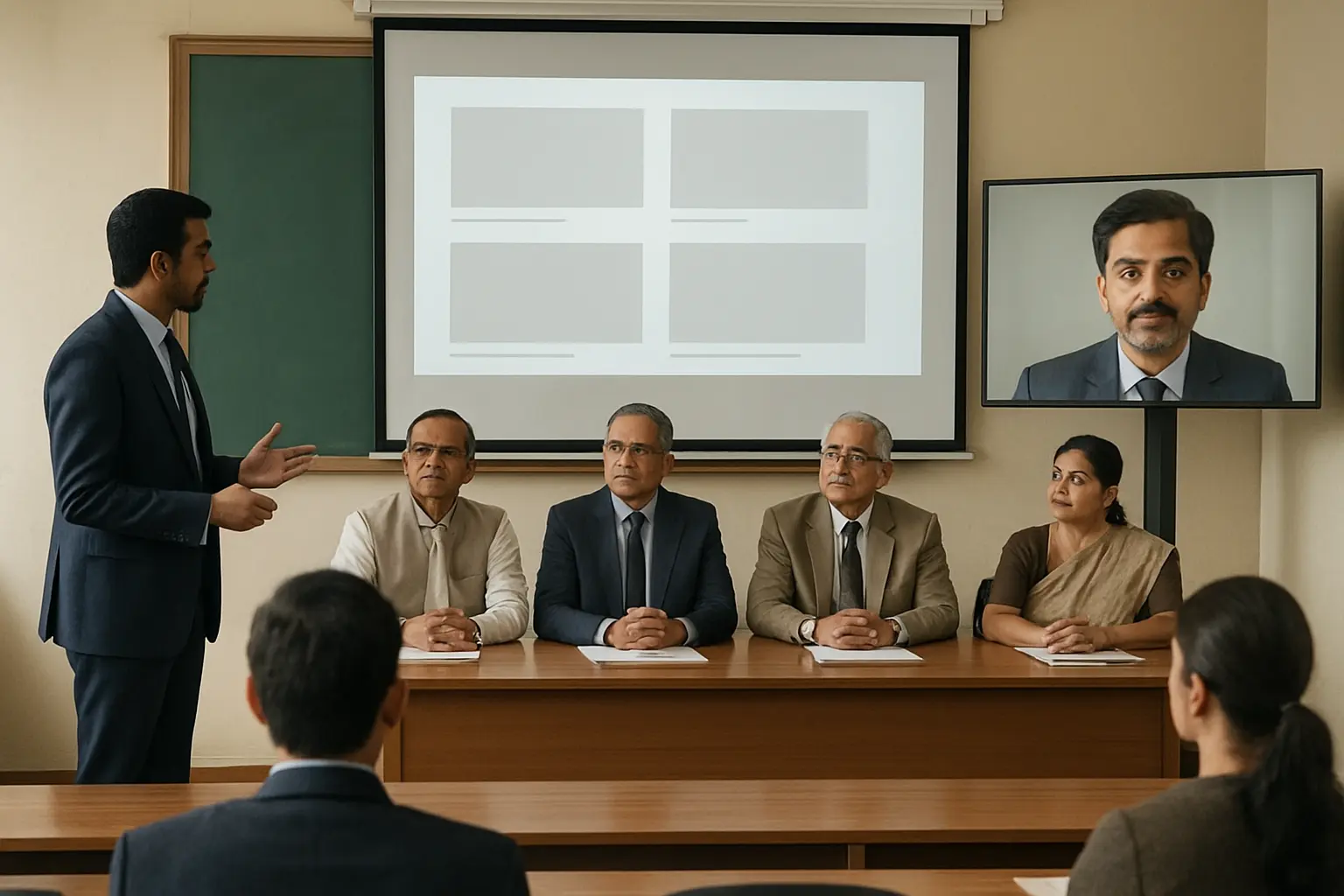
In an Indian PhD viva voce you defend your thesis orally before a board consisting of your research supervisor and at least one of the two external examiners who evaluated it — and under the UGC 2022 Regulations, the viva is scheduled only after both external examiners have already recommended acceptance of your thesis. That single fact reframes the entire day: by the time you enter the room, the thesis has passed its hardest gate. The viva may be conducted online, is open to faculty and research scholars, and the whole evaluation — viva result included — must be completed within six months of submission. Here is the full process, stage by stage, from the gazette text we read directly on ugc.gov.in.
What Happens Before the Viva Is Even Scheduled?
The 2022 Regulations lay out a fixed pipeline. First, before you may submit at all, you make a pre-submission presentation before your Research Advisory Committee, open to all faculty members and research scholars — feedback from this presentation is the last structured chance to fix weaknesses. Second, your submission goes in with two signed instruments: your own undertaking that the thesis contains no plagiarism, and your supervisor’s certificate attesting to originality and that the thesis has not been submitted elsewhere; the institution also screens the thesis through plagiarism-detection software (the threshold framework is covered in the UGC plagiarism limit explainer).
Third — the heart of the process — the thesis is evaluated by your supervisor and at least two external examiners who are experts in the field, not employed by your institution, and, wherever possible, one of them from outside India. These examiners read the full thesis and submit reports recommending acceptance, acceptance with corrections, or rejection. Everything about your viva flows from those reports.
Who Sits on the Viva Board, and What Do They Ask?
The board consists of your research supervisor and at least one of the two external examiners, and the regulations explicitly allow the viva to be conducted online — which is how a foreign external examiner usually attends. The session is open: members of your Research Advisory Committee, faculty and research scholars may sit in. In practice the structure at most institutions is a presentation of the work followed by questioning, and the questions cluster predictably: the corrections the examiners suggested in their reports (expect every one of them to come up — the regulations say the viva happens “after incorporating any corrections suggested”), the choices you made (why this method, this sample, this framework), the boundaries of your claims, and where the work goes next.
The composition tells you how to prepare. Your questioners are people who have already read every page — one of whom wrote a formal report on it. This is not an audience to impress with breadth; it is an audience that wants to see you own the specifics. The single best preparation exercise: take the examiners’ reports (your institution shares the substance of required corrections), write a one-paragraph response to every point, and rehearse defending each response aloud. The scholar who arrives with a corrections-response sheet controls the first half of most vivas.
What If an Examiner Rejects the Thesis?
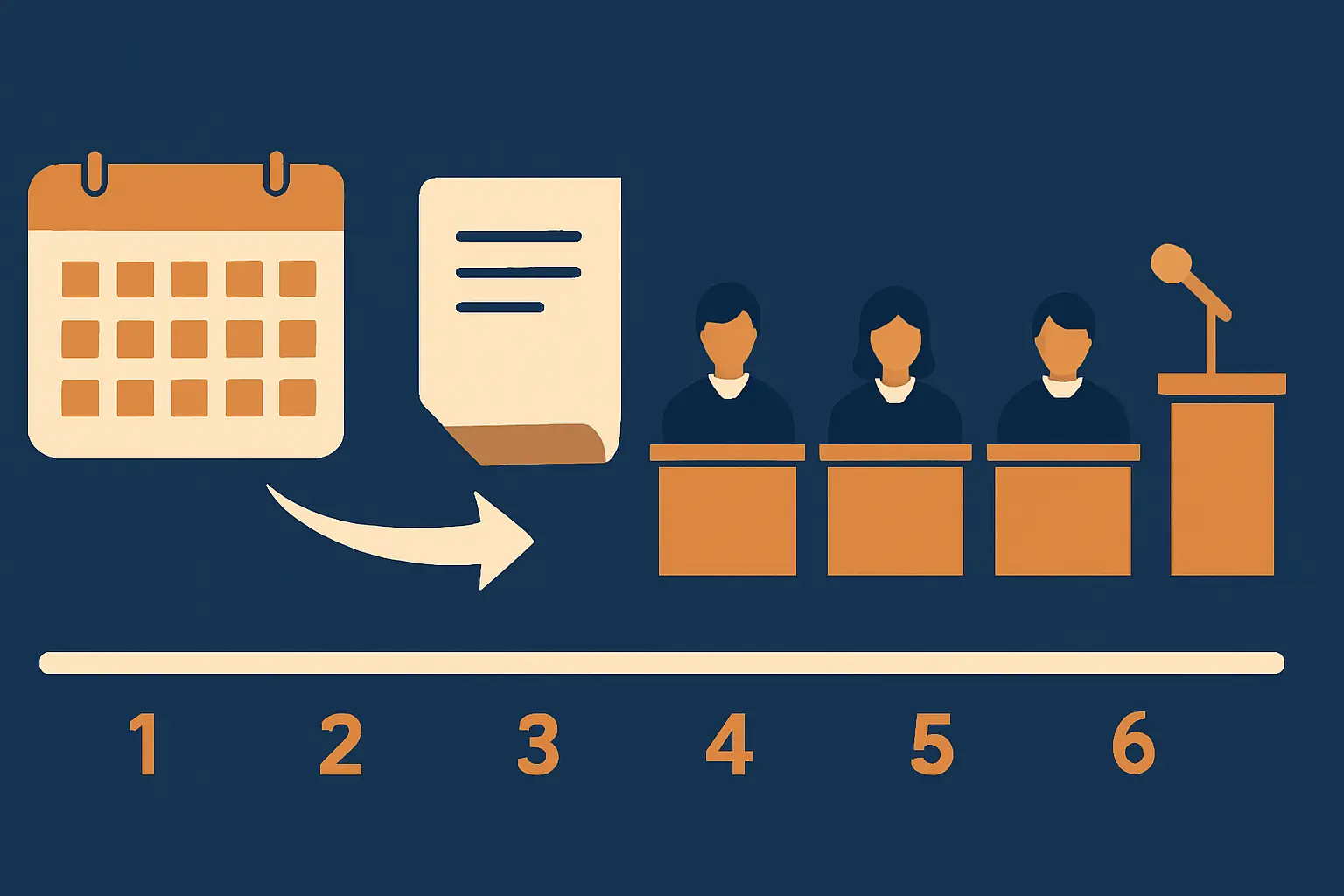
Here the 2022 text is precise, and worth knowing cold because folklore exaggerates it in both directions. If one of the two external examiners recommends rejection, the thesis is not dead: the institution sends it to an alternate external examiner from the approved panel. If the alternate recommends acceptance, the viva proceeds. If the alternate also rejects it, the thesis is rejected and the scholar is declared ineligible for the award of a PhD. Two consequences follow. The first is sobering: a genuine rejection path exists, and it runs through the written evaluation, not the viva. The second is reassuring: the process gives a rejected-once thesis a genuine second reading, and by the time a viva is scheduled, the acceptance question has been settled — the viva tests your defence of work already accepted.
How Long Does the Whole Process Take?
The regulations set a hard clock: the institution must complete the entire evaluation process, including declaration of the viva result, within six months of thesis submission. That number is worth knowing for planning (fellowship end dates, job start dates, postdoc applications) and worth knowing as a right: if your evaluation is drifting past six months, the regulation gives you standing to ask your research section, politely and in writing, where things stand. In the same spirit, the deposit of your thesis with INFLIBNET — making it accessible through Shodhganga — is required following successful completion of evaluation, before the award of the degree.
How Should You Actually Prepare?
Three moves cover most of the ground. First, master your own document: re-read the full thesis in the week before, and prepare a one-sentence answer to “what does this chapter contribute?” for every chapter — vivas are lost on paragraph-level questions (“why did you exclude X on page 84?”) by scholars who wrote page 84 eighteen months ago. Second, prepare the corrections sheet described above; it converts the least predictable part of the session into the most rehearsed. Third, rehearse the opening presentation to a hostile-but-fair audience — lab mates, your RAC, anyone who will interrupt with “why?” — because fluency under interruption, not slide polish, is the skill the day tests. If your synopsis long ago promised things the thesis later dropped, prepare that answer too; the synopsis-to-thesis drift question is a viva classic, and the honest answer (“the pilot results redirected the design, approved by my RAC in year two”) is a good answer — as long as you have it ready. The structure of a committee-proof synopsis is covered in the PhD synopsis guide, and the current national requirements around submission itself in the publications-before-submission explainer.
One preparation trap deserves its own warning: memorised scripts. Scholars who script answers word-for-word freeze when a question arrives in unexpected form, because they are searching memory instead of thinking. Prepare positions, not paragraphs — know what you would concede, what you would defend, and what evidence backs each defence — and let the sentences form on the day. The board is examining a researcher, not a recitation; hesitant-but-genuine reasoning consistently outperforms fluent recall of someone else’s phrasing, including your own from six months ago.
A defensible viva starts with a thesis you know line by line — because you wrote every line. Tesify keeps your chapters structured, your citations attached to real sources, and your writing process documented, so the defence is of work that is genuinely yours. Used by 9,000+ students. Write your thesis with Tesify.
FAQ: The Indian PhD Viva Voce
What happens in a PhD viva voce in India?
You present and defend your thesis before a board of your supervisor and at least one external examiner, in a session open to faculty and scholars. Under UGC 2022 rules it is scheduled only after both external examiners recommend acceptance.
Who conducts the viva voce?
The viva-voce board: your research supervisor plus at least one of the two external examiners who evaluated the thesis. External examiners must be field experts not employed by your institution, one preferably from outside India.
Can the viva be conducted online?
Yes — the 2022 Regulations state the viva may be conducted online, which is standard when an examiner is abroad. The format does not change the content of the examination.
Can a thesis be rejected at the viva?
The rejection gate sits earlier, in the written evaluation: one rejection sends the thesis to an alternate examiner; if the alternate also rejects, the thesis is rejected and the scholar becomes ineligible. A scheduled viva means the acceptance question is already settled.
How long does thesis evaluation take?
The institution must complete the entire process — including the viva result — within six months of submission, per the 2022 Regulations. If yours is drifting past that, you have standing to ask in writing.
Is the viva open to the public?
It is open to members of your Research Advisory Committee, faculty members, research scholars and students. Expect a familiar audience of lab mates and juniors scouting their own future vivas.
What questions are asked most?
The corrections your examiners listed, your methodological choices, the limits of your claims, and future directions. The examiners have read every page — prepare for specifics, not generalities.
What documents accompany the thesis at submission?
Your signed undertaking that the thesis contains no plagiarism and your supervisor’s certificate of originality, plus the institution’s own plagiarism screening. These are national requirements under the 2022 Regulations.
What happens after a successful viva?
The result is declared within the six-month evaluation window, corrections (if any) are finalised, and an electronic copy of the thesis goes to INFLIBNET for open access before the degree is awarded — the Shodhganga deposit.
Do M.Tech or M.Phil defences follow the same rules?
No — the 2022 Regulations govern the PhD. Masters-level defences follow programme-specific ordinances, which are usually lighter processes. Check your own programme’s rules rather than assuming the doctoral framework applies.