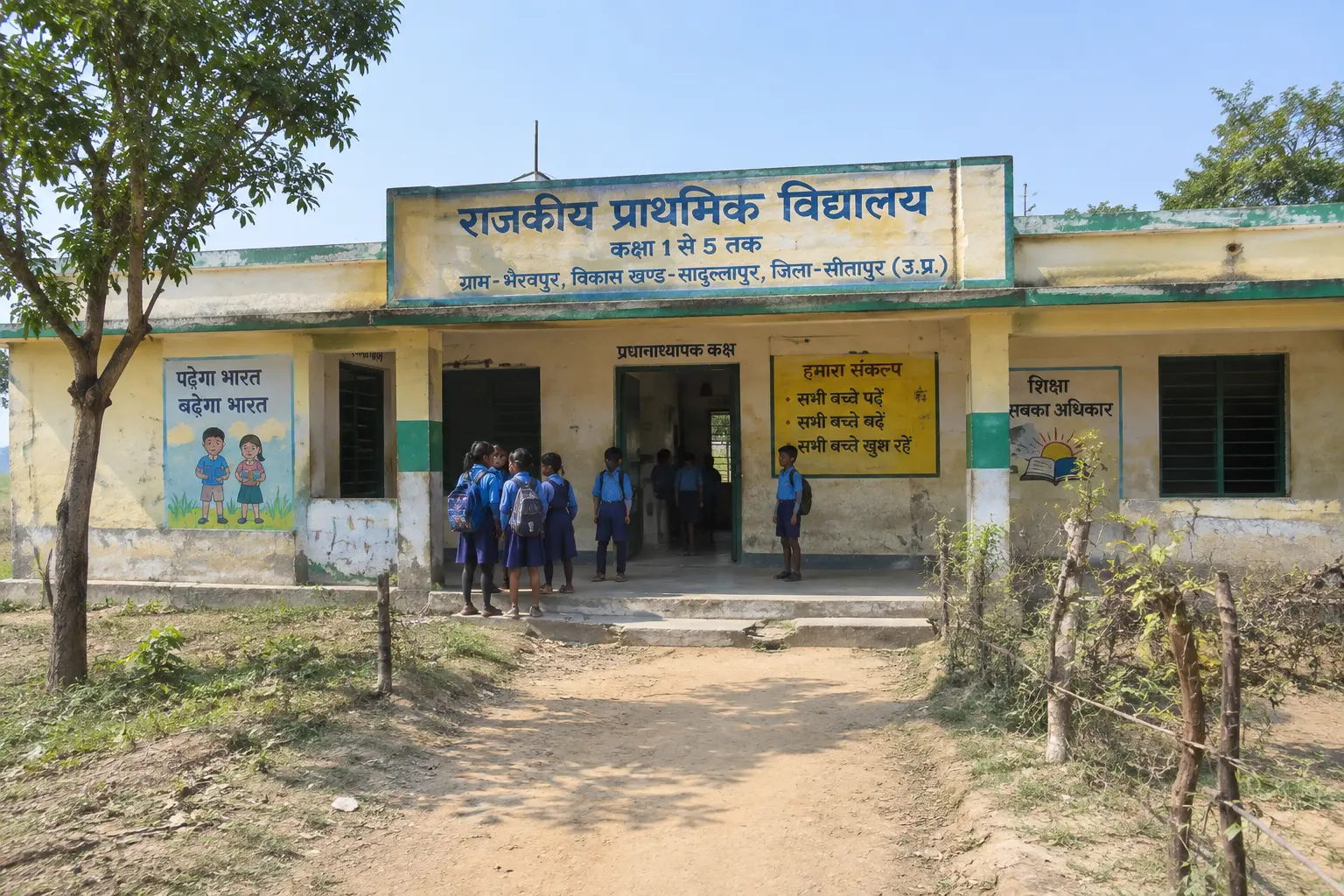
An M.Ed thesis on rural government schools needs a defined researchable question (not just “rural education”), a clear access-and-permission chain through the Block/District Education Officer and the headmaster, a sampling plan that states how many schools and why, and instruments matched to what UDISE+ and ASER already measure so your own data collection adds something neither already covers. Rural government schools make up a very large share of Indian school education — most M.Ed dissertations that choose them fail not because the setting is wrong, but because the study never narrows past “rural” to a specific, answerable question.
Why Choose Rural Government Schools as Your Study Population?
Rural government schools are accessible, numerous, and under-studied at the district level even though national datasets on them are large. A thesis population is not just “who you will survey” — it is a scoping decision that determines what permission you need, what instruments make sense, and what your findings can and cannot generalise to. “Rural government schools” is still too broad for a single dissertation: it spans primary, upper primary, secondary and senior secondary stages, single-teacher schools and larger ones, and states with very different Right to Education (RTE) Act, 2009 implementation records. A defensible M.Ed thesis narrows this to one stage (say, upper primary), one or two districts, and one specific phenomenon — teacher availability, digital-learning access, mid-day meal implementation, dropout at a transition point, or classroom practice under a specific policy.
What Researchable Questions Does This Population Actually Support?
Four question types recur in Indian M.Ed work on this population, each with a different design implication:
The bracketed terms below are fill-ins — replace each one with your own chosen district, block or state before you use the question in a proposal; none of these four is a real, submitted research question.
| Question type | Example (illustrative — fill in your own district/block/state) | Typical design |
|---|---|---|
| Teacher-side | How do single-teacher or two-teacher rural schools in [your district] organise multigrade instruction? | Qualitative — classroom observation, teacher interviews |
| Learner-side | What factors are associated with foundational literacy gaps among Class 3 students in rural government schools of [your block]? | Descriptive survey, possibly with an assessment tool |
| Systems/infrastructure | How does school infrastructure (toilets, electricity, library) relate to attendance in rural government upper-primary schools of [your district]? | Mixed methods, cross-referencing UDISE+ indicators with your own attendance data |
| Policy implementation | How is the Samagra Shiksha digital-learning component actually being used in rural government schools of [your state]? | Case study, small number of schools, deep access |
Every one of these is answerable inside a Master’s timeline with a handful of schools. “Rural education in India” or “problems of rural government schools” is not — it has no boundary an examiner can check against your method chapter.
How Do You Get Access to a Rural Government School for Fieldwork?
Access to a government school is administrative, not informal. The practical sequence used across most Indian states:
- Institutional ethics/research clearance first. Your own university’s research committee approves the proposal before you approach any school.
- A formal request letter to the District Education Officer (DEO) or Block Education Officer (BEO), on your institution’s letterhead, stating the study’s purpose, the schools you propose to visit, the duration, and what you will and will not disturb (classroom time, examinations).
- Written permission from the DEO/BEO’s office, which is often required before a headmaster will let you inside the school gate, let alone into a classroom.
- Headmaster’s consent at each individual school, even after district-level permission — this is the actual gatekeeper for day-to-day access, timing, and which classes you can observe.
- Parental/guardian consent if you are working with minors directly (surveys, assessments, interviews) rather than only observing teachers or reviewing school records.
Build at least four to six weeks into your timeline for steps 2–3 alone; state education departments do not move at university speed, and a rejected or delayed request is one of the most common reasons M.Ed fieldwork plans slip a semester.
What Does the Sampling Look Like for Rural Government Schools?
State your accessible population precisely: not “rural government schools in India” but “rural government upper-primary schools in [named block/district], as listed in the current UDISE+ school directory for that district.” From that list, a purposive or stratified sample (by school size, or by distance from the block headquarters) is more defensible than convenience sampling of whichever schools happen to be nearby — and it is the difference examiners look for between a thesis that generalises responsibly and one that does not. For a qualitative case-study design, 3–6 schools with deep access is normal; for a descriptive survey feeding a quantitative analysis, aim for enough schools that your smallest sub-group (say, single-teacher schools) still has a workable number of respondents — a sample-size calculation, not a round number chosen for convenience.
Which Instruments and National Data Sources Fit This Population?
Two national instruments already measure rural schooling at scale, and a strong M.Ed thesis uses them to frame or triangulate its own primary data rather than duplicating what they already publish:
| Source | Custodian | What it gives you | How to use it in your thesis |
|---|---|---|---|
| UDISE+ (Unified District Information System for Education Plus) | Department of School Education & Literacy, Ministry of Education, since 2018-19 (UDISE itself ran from 2012-13) | School-level administrative data: infrastructure (toilets, electricity, library), enrolment, teacher counts, student-teacher ratio, dropout rates — reported annually; the Ministry’s 2024-25 release recorded India crossing one crore school teachers for the first time and falling dropout rates at the Preparatory, Middle and Secondary stages | Use it to describe your district/block’s baseline (school count, teacher availability, infrastructure) in Chapter 1, and to justify why your chosen schools are or are not typical of the district |
| ASER (Annual Status of Education Report) | ASER Centre (Pratham); most recent full report is ASER 2024, a nationwide rural household survey that reached 649,491 children in 17,997 villages across 605 rural districts | Household-level (not school-based) learning-outcome data — basic reading and arithmetic levels by grade, tracked over years | Use it to frame the learning-outcome context your own field data sits inside, and to distinguish your own smaller, deeper study from the national household picture |
Neither source replaces your own data collection — UDISE+ is administrative counts, not classroom process, and ASER is a household sample, not your specific schools. State clearly in your methodology which of the two you are drawing on for context and which gap your own fieldwork fills. If your own design also needs a psychological or achievement instrument — an attitude scale, a learning-outcome test — the choice between buying a standardised tool, adapting one, or constructing your own is covered separately in our guide to standardised tools for an M.Ed dissertation.
What Permission and Ethics Documentation Do You Actually Need on File?
Keep a paper trail: the DEO/BEO’s written permission, each headmaster’s signed consent, a parental consent form template if minors are directly involved, and your own institution’s ethics/research-committee approval letter. Indian M.Ed programmes vary in whether they route this through a formal Institutional Ethics Committee or through the research supervisor and departmental research committee — check your own ordinance rather than assuming a biomedical-style IEC process applies. What does not vary: no data collection begins before written access is secured, and every consent document is retained for your viva.
What Do Research Committees Push Back On?
- An undefined population. “Rural schools” without a stage, state, or number of schools named.
- No stated access plan. Committees have seen proposals stall for a full semester because the DEO letter was never sent.
- Confusing UDISE+/ASER figures with your own findings. National statistics describe the system; they are not evidence about your specific schools until you collect it yourself.
- Sample size with no justification. “Five schools” needs a reason (case-study depth, or the total in your accessible population), not just a number that fit the timeline.
- No fallback plan. If one school withdraws consent mid-study — which happens — your proposal should already state what you do next.
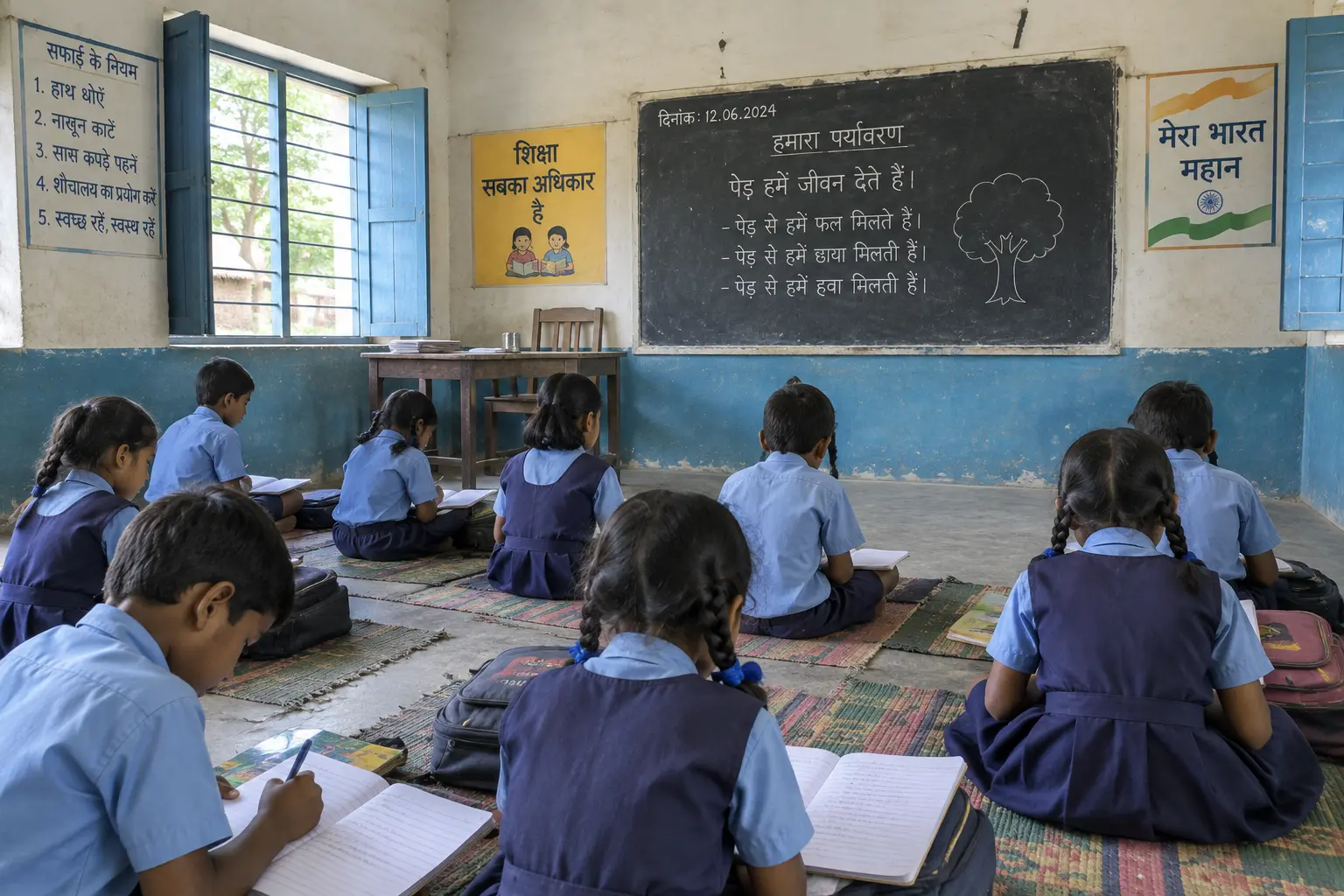
A worked illustrative framing, to show how the pieces fit together: a fictional M.Ed student narrows “rural education” to “How does school infrastructure relate to attendance in rural government upper-primary schools of a named block?” She pulls the block’s current UDISE+ school list, purposively samples six schools varying in size and distance from the block headquarters, secures BEO permission and headmaster consent at each, and collects her own attendance-register data over one term — cross-referencing it against UDISE+’s published infrastructure indicators for the same schools rather than re-measuring infrastructure herself. The national ASER picture frames her introduction; it is not her data.
How Does This Differ From Choosing an M.Ed Topic or Writing the Proposal Itself?
Choosing among dozens of M.Ed topics by setting and permission is covered topic-by-topic in our 40-topic M.Ed guide, and the twelve-section proposal structure itself — with a fully worked draft — is in our M.Ed research proposal guide. This article does one narrower job: it treats the population itself (rural government schools) as the design decision, because that decision shapes everything downstream — access timeline, sample, instruments and what a committee will accept as a defensible boundary. If you are still at the B.Ed stage rather than M.Ed, the same access-and-measurement logic — one setting, a defined pre/post measurement — is what examiners look for in a B.Ed action research project, though the scale and instrument expectations differ.
Narrowing a population like “rural government schools” into a defensible, approvable research question is exactly the kind of structuring work that stalls M.Ed proposals. Tesify helps you turn a broad setting into a scoped thesis — population, access plan, instruments and all — written by you, not generated for you. Used by 9,000+ students. Write your thesis with Tesify.
Frequently asked questions
Is “rural government schools” too broad a population for an M.Ed thesis?
On its own, yes. It becomes workable once you add a stage (primary/upper-primary/secondary), a named district or block, and one specific phenomenon — infrastructure, teacher practice, a policy’s implementation, or a learning outcome.
Do I need Institutional Ethics Committee (IEC) approval to study a government school?
Requirements vary by university; some route M.Ed proposals through a departmental research committee rather than a formal biomedical-style IEC. Check your own ordinance. What is constant everywhere is that you need written permission from the education department and the school before you collect any data.
Who do I actually need permission from to enter a rural government school?
Typically the District or Block Education Officer in writing, and separately the headmaster of each individual school — district-level permission alone usually does not get you into a classroom without the headmaster’s own consent.
How many rural schools should I sample?
There is no fixed national number. For a qualitative case study, three to six schools with deep access is typical; for a descriptive survey, base the count on a sample-size calculation against your accessible population, not on convenience.
Can I just use UDISE+ data instead of visiting schools myself?
Only if your research question is genuinely about the administrative picture UDISE+ measures (infrastructure counts, enrolment, teacher numbers). Most M.Ed questions about classroom practice, teaching quality or lived experience need your own fieldwork — UDISE+ frames the context.
What is the difference between UDISE+ and ASER for my thesis?
UDISE+ is school-level administrative data collected by the Ministry of Education from every recognised school. ASER is an independent household survey of children’s learning levels, run by the ASER Centre, that does not come from the schools themselves. Use UDISE+ for infrastructure/enrolment context and ASER for learning-outcome context — neither substitutes for your own primary data.
How long should I budget for getting permission?
Four to six weeks is a realistic minimum for the DEO/BEO approval step alone, before you even approach individual headmasters. Build this into your proposal timeline explicitly rather than assuming access will be immediate.
What if a school withdraws consent partway through my fieldwork?
State a fallback in your proposal — a reserve school from the same sampling frame, or a plan to proceed with a smaller sample and note the limitation. Committees respond well to a stated contingency; they respond badly to a plan with no fallback.
Can I compare a rural school to an urban one in the same thesis?
You can, but it changes your design to a comparative one, which needs urban access permission too and roughly doubles your fieldwork logistics. Many M.Ed theses are stronger scoped to rural schools alone, with the urban comparison left as a “further research” note.
Is parental consent needed if I only observe teachers, not students?
If your data collection does not involve students directly — no surveys, assessments or recorded interactions with them — teacher and headmaster consent is usually sufficient, but confirm this against your own university’s research-ethics guidance rather than assuming.