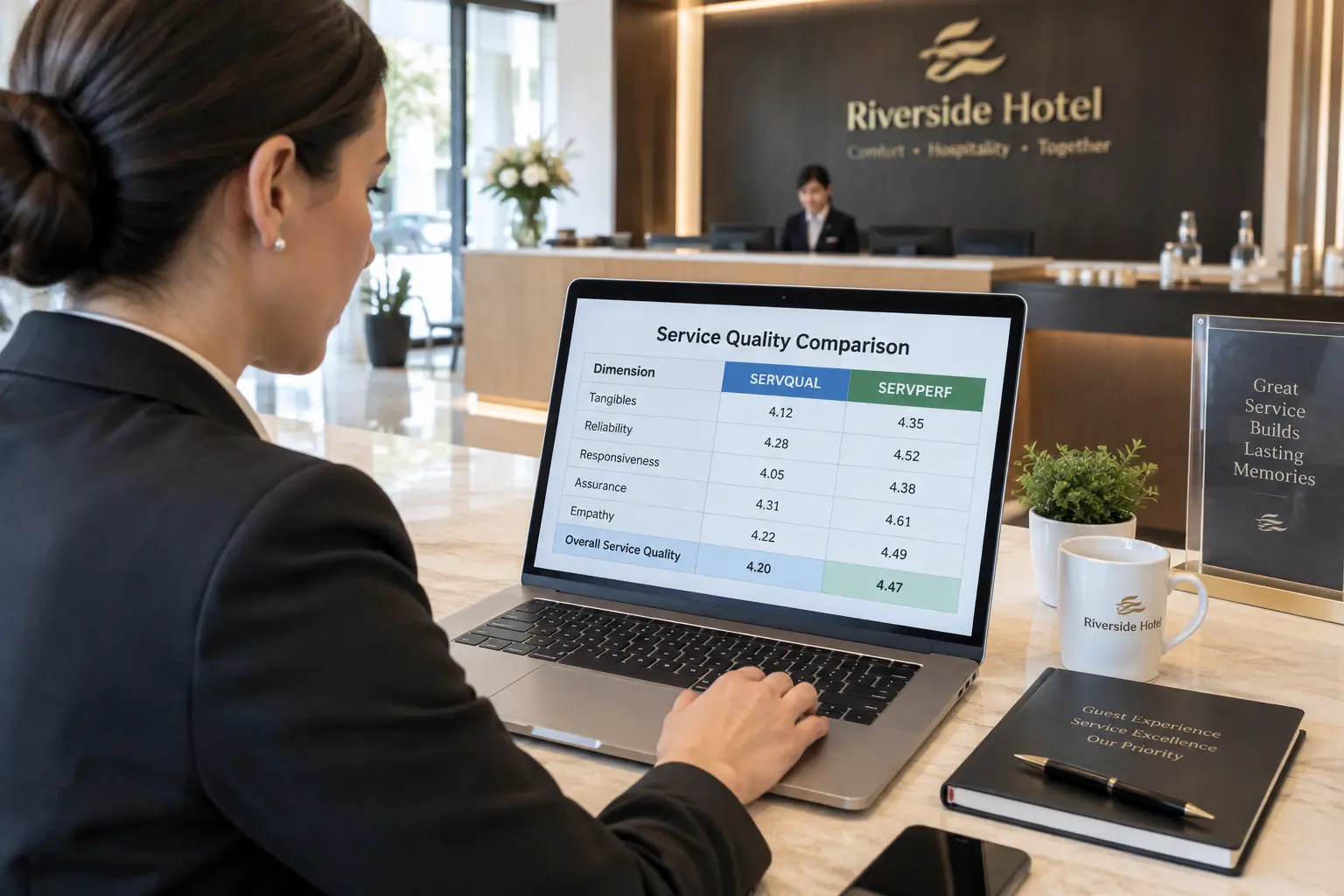
Two rival instruments dominate service-quality measurement for a BHM or BHMCT dissertation: SERVQUAL, which measures the gap between what a guest expected and what they actually experienced, and SERVPERF, which measures only the guest’s rating of actual performance. Both trace back to the same 22 items and five dimensions; the difference is entirely in whether you also ask guests what they expected.
| Feature | SERVQUAL | SERVPERF |
|---|---|---|
| Source | Parasuraman, Zeithaml & Berry (1988), Journal of Retailing | Cronin & Taylor (1992), Journal of Marketing |
| What it asks | Two ratings per item: expected service and perceived service; the gap (perceived minus expected) is the score | One rating per item: perceived (actual) performance only |
| Items / burden on respondent | 22 items rated twice each (44 ratings total in the two-column format), 7-point scale | The same 22 items, rated once each — half the respondent burden of SERVQUAL’s two-column format |
| Dimensions | Tangibles, Reliability, Responsiveness, Assurance, Empathy (five dimensions, same as SERVPERF) | Same five dimensions, since SERVPERF reuses the SERVQUAL item pool |
| Theoretical basis | Disconfirmation model — quality is the gap between expectation and experience | Performance-only — Cronin and Taylor argued the gap operationalisation confounds satisfaction and attitude, and that a performance-based measure may capture service quality better |
| Best suited to | Studies specifically interested in the expectation-experience gap itself (for example, comparing guest expectations before and after a renovation) | Studies mainly interested in current satisfaction and its link to outcomes like repeat-stay intention or word-of-mouth |
| Common criticism | Asking guests to recall a pre-stay expectation after the stay is over is itself an unreliable measurement; the two-column format roughly doubles survey length and respondent fatigue | Loses the diagnostic power of seeing exactly where a hotel under- or over-delivers relative to what guests expected |
What Each Instrument Actually Measures
Both instruments organise service quality into the same five dimensions: tangibles (physical facilities, equipment, staff appearance), reliability (ability to perform the promised service dependably and accurately), responsiveness (willingness to help guests and provide prompt service), assurance (staff knowledge and courtesy, and their ability to inspire trust) and empathy (individualised attention to each guest). SERVQUAL’s original design asks respondents to rate each of the 22 items twice — once for what they expected from an excellent hotel or restaurant in general, and once for what they actually experienced at the specific property — and the score for each item is the perceived rating minus the expected rating. A positive gap means the property exceeded expectations on that item; a negative gap means it fell short.
Cronin and Taylor’s SERVPERF keeps the same 22 items and five dimensions but drops the expectation half entirely, asking guests to rate only their actual experience. Their argument, published in the Journal of Marketing, was that the gap-based operationalisation of service quality confounds satisfaction and attitude; their results suggested that a performance-based measure may be an improved way of measuring the construct, that service quality is an antecedent of satisfaction, and that satisfaction has the stronger effect on purchase intentions — all while cutting respondent burden roughly in half.
Which Should You Use for a BHM/BHMCT Dissertation?
Three questions decide it for most Indian BHM/BHMCT studies:
- Is your research question specifically about the expectation gap? If you are asking whether guests’ expectations differ from what a property delivers — for example, comparing a budget and a premium property, or measuring the gap before and after a service-recovery intervention — SERVQUAL’s gap score is the more direct fit, since SERVPERF has no expectation component to compare against.
- How long can your survey realistically be? Hotel and restaurant guests completing a survey during or just after their stay are a notoriously low-patience population. SERVPERF’s single-rating format is easier to get completed in full, which matters more for response-rate-sensitive settings like a front-desk intercept survey than for a mailed or emailed follow-up survey with more time to complete.
- What does your literature review already lean on? If the hospitality-specific studies you are building on (in India or internationally) predominantly used one instrument, matching it makes your findings directly comparable — a genuine methodological reason to prefer SERVPERF or SERVQUAL beyond convenience.
For most Indian BHM/BHMCT dissertations measuring guest satisfaction or its link to repeat-stay intention, word-of-mouth or loyalty, SERVPERF is the more commonly recommended default: it is shorter, several published comparisons report it explaining satisfaction and behavioural-intention outcomes at least as well as SERVQUAL, and it avoids asking respondents to reconstruct a pre-stay expectation from memory. Choose SERVQUAL specifically when your objective is the gap itself, not general satisfaction.
A Worked, Illustrative Scoring Example
The table below is a fictional, illustrative example of how three items might score under each instrument — it is not data from a real study, and the numbers exist only to show how scoring works.
| Item (Reliability dimension) | SERVQUAL expected (1-7) | SERVQUAL perceived (1-7) | SERVQUAL gap score | SERVPERF perceived-only score (1-7) |
|---|---|---|---|---|
| The hotel delivers the service it promises on time. | 6.2 (illustrative) | 5.4 (illustrative) | -0.8 | 5.4 (illustrative) |
| Staff resolve guest problems sincerely. | 6.0 (illustrative) | 6.1 (illustrative) | +0.1 | 6.1 (illustrative) |
| Records (bookings, billing) are kept accurately. | 6.5 (illustrative) | 5.9 (illustrative) | -0.6 | 5.9 (illustrative) |
Notice that SERVPERF’s score for each item is identical to SERVQUAL’s perceived-service rating — it simply never collects the expected-service half. This is why the two instruments correlate highly with each other in practice even though the gap score itself (SERVQUAL’s distinctive contribution) tells you something SERVPERF cannot: whether the property is under-delivering, over-delivering, or matching what guests expected on that specific item, not just how satisfied they are overall.
Reliability and Validity Checks Before You Report Your Results
Whichever instrument you choose, run the same two checks before treating your dimension scores as usable. First, check internal consistency for each dimension (not just the overall scale) using Cronbach’s alpha — a dimension with too few items or poorly worded items will show up as a low alpha before you get to your substantive analysis; our guide to what counts as an acceptable Cronbach’s alpha for a thesis covers the interpretation ranges. Second, if your sample is large enough, a confirmatory factor analysis checks whether your data actually supports the five-dimension structure in your specific hospitality setting, rather than assuming it transfers unchanged from the original non-hospitality settings (SERVQUAL’s development work drew on retail banking, credit-card, securities-brokerage and product repair-and-maintenance services). Report both checks in your methodology chapter, not just in an appendix, since a tools-section paragraph without a reliability check is one of the more common committee comments on hospitality dissertations using either scale.
Adapting Either Scale for a Hotel, Restaurant or Travel Setting
Neither instrument was written with hospitality wording out of the box — the original items use generic service-firm language rather than hotel or restaurant wording. Adapting either scale for your own dissertation means: rewording each item to name your specific setting (a hotel, a restaurant, a travel agency), pilot-testing the adapted items on a small group before the main survey, and reporting Cronin’s or Parasuraman’s original dimension structure honestly rather than inventing new dimensions unless your own factor analysis genuinely supports a different structure. Do not present a modified item wording as if it were the exact original instrument — state clearly in your methodology chapter which items you adapted and why, since an examiner checking your instrument section against the cited source is a routine part of the viva. The general build discipline — a blueprint table, expert validation, and a pilot try-out before the main survey — is the same whether you adapt a published scale or construct your own; see our worked walkthrough on tool construction and validation for an Indian dissertation for the full sequence.

Frequently Asked Questions
Is SERVQUAL free to use for a student dissertation?
Both instruments were published in academic journals and their items are widely reproduced in student and academic research worldwide; always cite the original source (Parasuraman, Zeithaml and Berry, 1988 for SERVQUAL; Cronin and Taylor, 1992 for SERVPERF) rather than a secondary source that reprinted the items. If you intend any use of the instrument beyond your dissertation, such as commercial consulting, check current terms directly with the publisher, since commercial and academic use are not always treated identically.
Can I use both SERVQUAL and SERVPERF in the same study?
Yes — some Indian hospitality dissertations deliberately administer both to the same sample and compare which one better predicts an outcome like repeat-stay intention, which is itself a legitimate and reasonably common dissertation design, though it roughly doubles your survey length.
Do I need all five dimensions, or can I use only some?
Most published hospitality applications use all five dimensions, since dropping one changes the instrument’s validated structure. If your literature review genuinely justifies dropping or merging a dimension for your specific setting, say so explicitly and cite the justification rather than silently omitting items.
How many respondents do I need for a SERVQUAL or SERVPERF study?
There is no single fixed number specified by either original paper; sample size depends on your intended analysis (a simple gap-score comparison needs less than a factor-analytic validation of the dimension structure). See our guide to calculating sample size for a thesis for the standard approaches, and confirm your own department’s minimum expectation.
Which instrument is more common in published Indian hospitality research?
Both appear regularly in Indian hospitality and tourism journals; neither has fully displaced the other. Check the specific sub-area you are studying (hotels, restaurants, travel agencies, budget versus luxury segments) for which instrument dominates that literature, since the balance shifts by sub-area and by which is more recent in your specific niche.
Is a 5-point Likert scale acceptable instead of the original 7-point scale?
A 5-point scale is commonly used in Indian student adaptations and is defensible, but state clearly that you changed the scale from the original 7-point format and why (respondent familiarity, consistency with other instruments in the same questionnaire), since it is a genuine deviation from the published instrument.
Do I need ethics committee approval to survey hotel guests?
Follow your own institute’s ethics-clearance requirement for surveying human respondents, which typically applies regardless of whether the respondents are hotel guests, students or the general public. Obtain the property’s permission to survey its guests on-site in addition to any institutional ethics clearance.
What if the hotel or restaurant will not let me survey its actual guests?
A common workaround is surveying recent guests via an online panel or a review-site-recruited sample rather than intercepting guests on the property itself — state this substitution honestly as a limitation on generalisability to the specific property’s guest population.
Should I report the gap score or the raw perceived score in my results chapter?
If you used SERVQUAL, report both the raw perceived scores and the gap scores, since the gap is the instrument’s distinctive contribution and readers will expect to see where it is largest. If you used SERVPERF, there is no gap to report — present the perceived scores by dimension and, where relevant, their correlation with your outcome variable.
Can I compare my results directly against a published international SERVQUAL study?
Direct numerical comparison is weaker than it looks, since sample, property type, culture and even the scale point-format can differ between studies. It is more defensible to compare the pattern (which dimension scored weakest, whether the overall gap was positive or negative) than to claim your mean score is directly comparable to a study run in a different country or hotel segment.
Build your instrument section with confidence
Tesify helps you adapt SERVQUAL or SERVPERF items to your specific hospitality setting, checks your citation of the original source, and writes the tools-section paragraph an examiner expects — dimension by dimension, item by item.
Build your hospitality dissertation instrument section in Tesify