Your guide has just said the same thing every hospitality dissertation guide says at this stage: “Your topic is fine, but where are your hypotheses?” You have a genuine interest in guest satisfaction, or housekeeping efficiency, or food and beverage cost control, and no idea how to turn that interest into a testable research question by tomorrow’s meeting. Here is how, with worked examples across the sub-fields BHM and BHMCT dissertations actually cover.
Build your research questions and hypotheses with Tesify — free to start
Research Question, Then Hypothesis: The Order Matters
A research question is open — it names what you want to find out. A hypothesis is a testable statement derived from that question — it commits you to a specific, checkable claim. Write the question first, in plain language, then convert it into a hypothesis only if your objective is genuinely analytical (testing a relationship or a difference) rather than descriptive (measuring a current level or practice). Forcing a hypothesis onto a purely descriptive objective — “what is the current housekeeping turnaround time in this hotel” needs no hypothesis — is one of the most common reasons a Chapter 1 gets sent back. The verbs your objectives use decide this for you, the same way they do in any Indian dissertation — see our cross-discipline guide to objectives of the study and the design each verb commits you to.

Worked Examples by Sub-Field
Front Office and Guest Experience
Research question: Does the speed of check-in affect guests’ overall satisfaction rating at a mid-scale hotel?
H1: There is a significant relationship between perceived check-in speed and overall guest satisfaction.
H2: Guest satisfaction differs significantly between guests who used a self-service check-in kiosk and guests who used a staffed front desk.
Variables: Independent — perceived check-in speed (scale item), check-in method (categorical: kiosk/staffed). Dependent — overall guest satisfaction (composite scale score).
Housekeeping
Research question: What factors predict room-turnaround time in a full-service hotel’s housekeeping department?
H1: Room type (standard, suite) significantly predicts room-turnaround time.
H2: Staff experience level (years of service, grouped) significantly predicts room-turnaround time.
Variables: Independent — room type, staff experience (grouped). Dependent — room-turnaround time (minutes, logged).
Food and Beverage
Research question: Does menu engineering classification relate to actual dish profitability in a hotel’s à la carte restaurant?
H1: There is a significant relationship between a dish’s menu engineering classification (star, plow-horse, puzzle, dog) and its contribution margin.
Variables: Independent — menu engineering classification (categorical, from a matrix you construct using the restaurant’s own sales-mix and cost data). Dependent — contribution margin per dish (calculated).
Note: this is a descriptive-then-analytical design — first you build the classification (descriptive), then test whether it relates to actual margin (analytical) — a two-stage structure worth stating explicitly in your objectives so the hypothesis matches only the second stage.
Human Resources in Hospitality
Research question: What is the relationship between shift-work patterns and reported burnout among hotel food and beverage staff?
H1: There is a significant relationship between the number of night shifts worked per month and burnout scores.
Variables: Independent — night shifts per month (count, from roster records or self-report). Dependent — burnout (composite score on a validated burnout scale).
Sustainability and Green Practices
Research question: Does a hotel’s adoption of green practices (water/energy conservation, waste segregation) relate to guests’ willingness to pay a premium?
H1: Awareness of a hotel’s green practices is significantly associated with guests’ stated willingness to pay a premium for a stay.
Variables: Independent — awareness of green practices (scale item or index). Dependent — willingness to pay a premium (stated intention, scale item).
Travel and Tourism Management
Research question: What factors influence destination choice among domestic leisure travellers in a defined age group?
H1: Perceived safety significantly predicts destination preference among domestic leisure travellers.
H2: Destination preference differs significantly across age groups.
Variables: Independent — perceived safety (scale item), age group (categorical). Dependent — destination preference (ranked or scale-scored across a defined set of destinations).
Note: a travel-and-tourism topic like this one typically needs a broader, reachable population (travellers, not staff or guests of one property) rather than a single-property internship setting — plan your recruitment route accordingly, since it differs from the front-office, housekeeping and F&B examples above, which are naturally scoped to one property.
Turning “I’m Interested In X” Into a Testable Statement
- Name the outcome you actually care about — satisfaction, turnaround time, margin, burnout, willingness to pay — in one word or short phrase.
- Name what you think affects it — one or two candidate predictors, not five, for a first-time BHM/BHMCT dissertation.
- State the relationship as a question: “Does [predictor] relate to [outcome] among [population] at [setting]?”
- Convert to a hypothesis only if the objective is analytical: “There is a significant relationship between [predictor] and [outcome]” (non-directional, unless your reading of prior hospitality research genuinely supports a direction).
- Name how each variable will actually be measured before you consider the hypothesis finished — a hypothesis with an unmeasurable variable is not yet ready for a methodology chapter.
Matching the Hypothesis to the Analysis You Can Actually Run
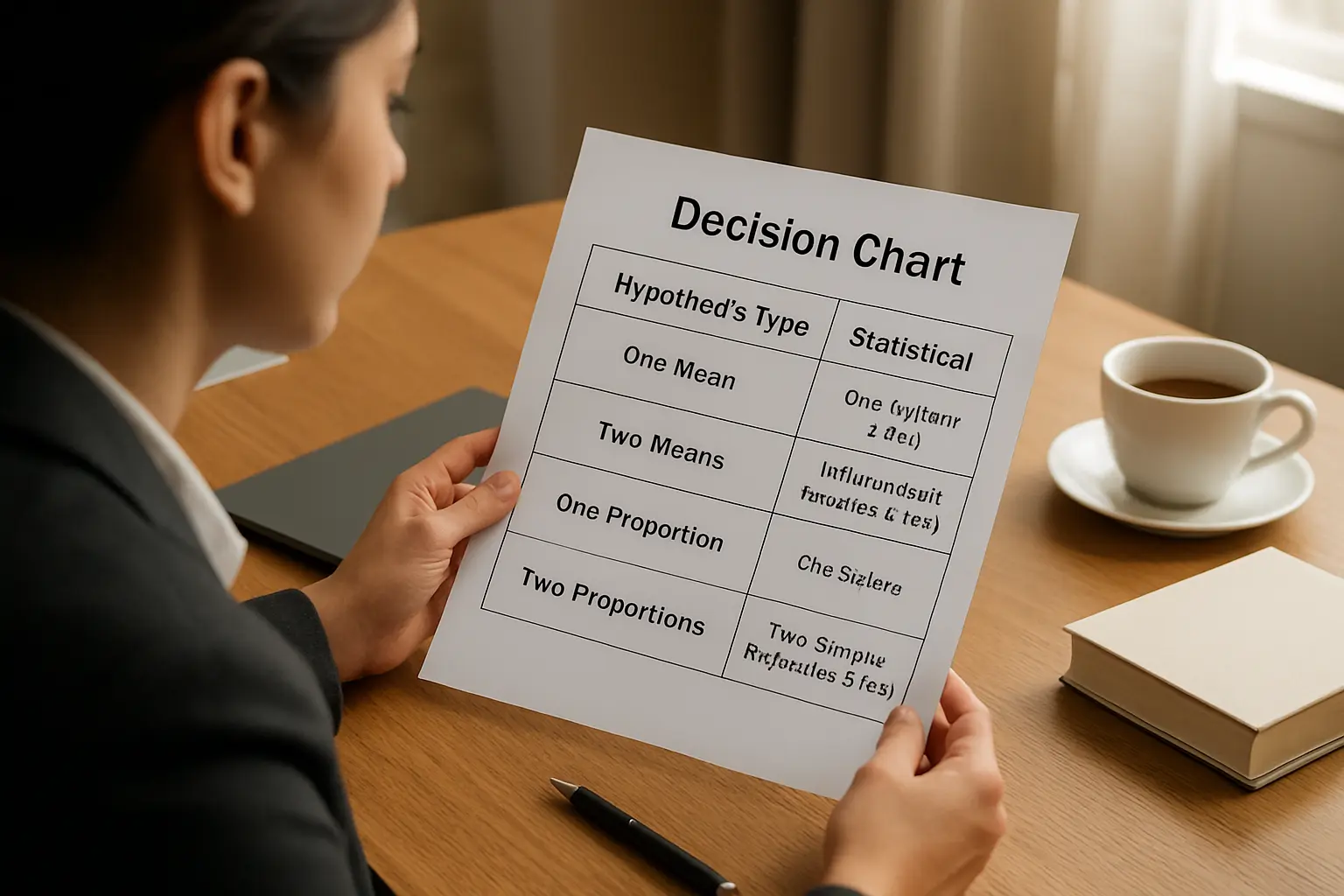
A hypothesis that sounds right in Chapter 1 sometimes turns out to be untestable with the analysis you are equipped to run by Chapter 4, and catching the mismatch early saves a rewrite later. The general pairing to check against: a hypothesis about a relationship between two continuous variables (check-in speed and a satisfaction score) implies correlation or regression; a hypothesis about a difference between two or more groups (kiosk versus staffed check-in, room type A versus room type B) implies a t-test or ANOVA; a hypothesis about an association between two categorical variables (green-practice awareness level and willingness-to-pay category) implies a chi-square test. Before finalising any hypothesis from the worked examples above, say the analysis technique out loud to yourself — if you cannot name it in one sentence, the hypothesis is not yet precise enough to test.
Sample Size for a Single-Property, Internship-Window Study
Most BHM/BHMCT dissertations are constrained by a fixed internship or attachment period at one property, which genuinely limits how large a sample you can realistically recruit — this is a real constraint, not a design flaw, provided you plan around it rather than ignore it. For a guest-survey design, a hundred or more responses is a reasonable working target for a single-property study using a simple comparison (two groups, or a correlation between two variables), though the exact number your specific analysis needs is a separate calculation your guide can help you check once your hypothesis and test are finalised. For a staff-based design (housekeeping turnaround, burnout among F&B staff), your sample is naturally capped by the property’s actual staff count, which may be small — state this limitation explicitly in your proposal rather than presenting a small staff sample as though it were unconstrained, and consider whether a case-study framing (rich description of one property) suits the data better than a hypothesis-testing framing that needs more statistical power than a small staff roster can provide. This follows the same feasibility discipline covered in our guide to turning a BHM industrial training placement into a dissertation.
Where the National Picture Gets Complicated
Unlike most Indian academic fields on this site, hospitality education has no single national curricular authority that governs every programme the way the UGC governs most postgraduate research. NCHMCT-affiliated Institutes of Hotel Management run one set of BHM/BHMCT structures, while state universities running their own hospitality-management degrees follow a separate format — the dissertation or project-report requirement, its weight, and even whether hypotheses are expected at all can differ between the two routes. Confirm which structure governs your own programme with your department before assuming either the NCHMCT-affiliated pattern or a general university pattern applies to you; the worked examples above are field-general and adapt to either route, but the formal requirement for hypotheses versus research questions alone is a local, not national, decision.
Common Mistakes in BHM/BHMCT Hypotheses
- A hypothesis with no measurable variable behind it. “Guest experience will improve” is not testable; “guest satisfaction score will differ significantly between X and Y” is.
- Confusing a business recommendation with a hypothesis. “Hotels should adopt kiosks” is a recommendation your findings might support — it is not itself a hypothesis to test.
- Too many predictors for the sample size available in a single-property, short-internship-window study — two or three well-measured variables beat six poorly measured ones.
- No baseline or comparison group where the research question implies one — a “does X affect Y” question usually needs either a before/after measure or two comparable groups, not a single snapshot.
Get Your Hypotheses Sorted Before the Next Meeting
The gap between “I have a topic” and “I have hypotheses my guide will accept” is usually a single missing step: naming the variables precisely enough that someone else could measure them the same way. Tesify turns your topic and your rough sense of what predicts what into properly stated research questions, non-directional hypotheses, and the variable definitions that make them measurable — so tomorrow’s meeting is a conversation about your findings, not a repeat of today’s.
Draft your hypotheses in Tesify
Frequently Asked Questions
Do all BHM/BHMCT dissertations need formal hypotheses?
Not all — a purely descriptive project (documenting current practice, building a training manual) may need only research questions, not hypotheses. An analytical project testing a relationship or difference needs hypotheses. Confirm which your department expects for your specific project type.
Can I test a hypothesis with data from just one hotel?
Yes, for a case-study design, provided you state that limitation honestly — findings from one property are illustrative of that property, not automatically generalisable to the whole industry, and your discussion chapter should say so.
How many hypotheses should a BHM/BHMCT dissertation have?
There is no fixed number in any national regulation; two to four is a common range for a project of this scope, each tied to one objective and one clearly measurable relationship.
What if my data does not support my hypothesis?
A non-significant or contrary result is a legitimate finding, not a failure — report it honestly and discuss possible reasons (sample size, setting-specific factors, measurement limitations) rather than searching for a way to force significance.
Is a directional hypothesis ever appropriate?
Only when existing literature you have actually read supports a specific direction — for example, if multiple prior hospitality studies consistently find faster check-in improves satisfaction, a directional H1 stating “significantly improves” rather than “is related to” is defensible; otherwise, state it non-directionally.
Can I combine a quantitative hypothesis with a qualitative component, such as staff interviews?
Yes — a mixed-methods BHM/BHMCT dissertation might test a hypothesis quantitatively (turnaround time by room type) while using staff interviews to explain why the pattern exists, provided both components are planned from the start and your methodology chapter states how the two are integrated, not just placed side by side.
What is the difference between a research question and an objective?
An objective is a stated aim, phrased as a verb (“to examine,” “to compare”); a research question is the same aim phrased as a question. Most Indian formats expect both, with the objectives listed first and the research questions or hypotheses following directly from them, in the same order.
Does my dissertation need a control group to test a hypothesis?
Not always — a comparison group (two groups within the same setting, such as two check-in methods) or a before/after measure within one group can both support a legitimate test, depending on your design. A true experimental control group is rarely feasible within a single internship window and is not expected for most BHM/BHMCT-level projects.