
Your industrial training is ending in a few weeks, your department wants a bound project report, and what you actually have is a stack of duty rosters and a logbook signed by four different department heads. That gap — a real, months-long training placement with nothing yet shaped into a report — is a very common panic point in a BHM or BHMCT final year, and it is entirely fixable if you start converting the training now rather than the week before submission.
What actually governs your project report
BHM and BHMCT programmes in India run through two different routes, and they do not share one national format. The National Council for Hotel Management and Catering Technology (NCHMCT), an autonomous body under the Ministry of Tourism, administers the B.Sc. in Hospitality and Hotel Administration as a three-year, six-semester programme delivered through the network of NCHMCT-affiliated Institutes of Hotel Management (IHMs); several IHM and hospitality-programme pages describe an “Industrial Exposure Training” component within that curriculum, though the exact semester placement and duration are set by the current syllabus cycle rather than a single figure that holds for every institute and every year — check your own institute’s current syllabus document for the binding number, since NCHMCT revises its curriculum periodically. Outside the NCHMCT-affiliated IHM network, many BHM and BHMCT degrees run through state universities and private hospitality colleges with their own project-report guidelines, credit structure and submission format. Neither route is more “correct” than the other; what matters is that you follow your own institute’s guideline exactly, because the report format genuinely differs between an NCHMCT-affiliated IHM and a state-university-run BHM programme.
The five things your training already gave you
Before worrying about structure, take stock of what your months of rotations already produced, because every one of these becomes a section of the report:
- A training completion certificate from the property, usually signed by HR or the training manager.
- A logbook or daily record signed off by the department head at each rotation (Front Office, Housekeeping, Food Production, Food and Beverage Service, and any specialised rotation such as banquets or stores).
- Departmental SOPs and formats you were shown or used — check-in/check-out procedures, a housekeeping inspection checklist, a kitchen requisition format — that become worked examples in your report rather than being described from memory.
- At least one operational problem you actually noticed — a recurring guest complaint pattern, a wastage issue in a specific department, an inefficiency in a handover process — even if you never called it “research” at the time.
- A property profile you can write from the hotel’s own published materials, star category, room and outlet count, and organisational structure, rather than reconstructing it from a brochure months later.
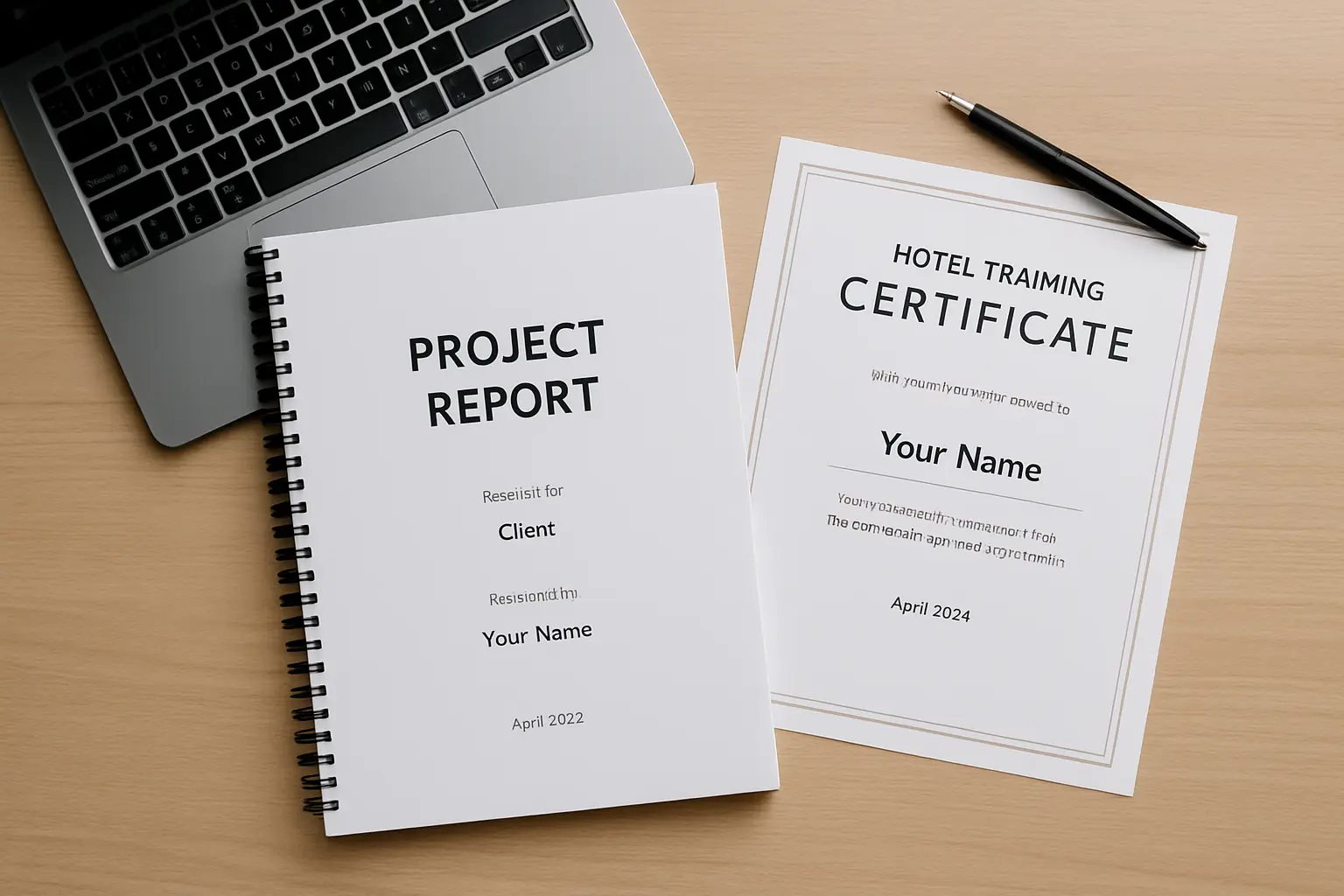
The structure that turns a logbook into a report
Confirm your own institute’s exact chapter scheme, but the shape that recurs across NCHMCT-affiliated and university-run BHM reports alike has five parts:
- Introduction and property profile. The hospitality industry context, the specific property (category, ownership, room and outlet inventory, organisational chart), and the objectives of the training report.
- Department-wise training experience. One section per rotation, each covering the department’s structure, the SOPs and formats you observed or used, and the skills the rotation built — written from your logbook, not from memory.
- The analytical component. This is the section that separates a project report from a diary: one specific operational observation, written up with what you saw, why it matters to the property, and a reasoned recommendation. A guest-complaint pattern in Front Office, a wastage or portion-control issue in Food Production, an inventory discrepancy in Housekeeping — pick the one rotation where you noticed something worth analysing, not the one that was easiest.
- Learning outcomes. What the training achieved against your programme’s own stated competencies, honestly assessed rather than uniformly glowing.
- Conclusion and recommendations. A short closing chapter, with recommendations addressed to the property in terms it could actually act on.
The word “project” in “industrial training project report” is doing real work: a report that is purely descriptive — “I worked in Front Office, then Housekeeping, then F&B” — without the analytical chapter reads as a diary, and it is the single most common reason these reports come back for revision.

A worked example of the analytical chapter
Observation: During the [n]-week Front Office rotation, [n] guest complaints were logged in the department’s complaint register, of which [n] related to check-in wait time during the 2 pm–4 pm arrival peak.
Analysis: Cross-referencing the register against the duty roster showed only [n] agents scheduled during this window against an average arrival rate of [n] guests per hour, compared to [n] agents during the comparatively quieter late-evening period.
Recommendation: Realigning one agent’s shift from the late-evening slot to the 2 pm–4 pm peak, without increasing total headcount, would address the mismatch observed in the register during the training period.
Notice the shape: a specific, countable observation from the property’s own records (not an outside statistic), a plain cross-reference that explains it, and a recommendation the property could actually implement without new investment. That is what an examiner reads as “analysis” rather than description, at undergraduate hospitality-management level.
Front matter: what most reports are returned for
Reports are returned for missing or misordered front matter more often than for weak content, because it is the part students leave until the last night. Confirm your institute’s exact running order, but the pieces almost every BHM/BHMCT report needs are the same: a title page naming the property, the training dates and your registration number; a bonafide or completion certificate from the property (the original the training manager signed, not a photocopy of a screenshot); a declaration that the report is your own work; an acknowledgement; and a table of contents with department sections listed by name. Assemble these first, in the order your institute’s format specifies, because a report with strong analysis and a missing certificate is returned just as fast as one with no analysis at all.
A realistic timeline for the weeks you have left
With training ending soon, the report does not need to wait until the last week if it is broken into pieces that can each be finished from material you already have:
- This week: Assemble front matter and the property profile from published materials — neither needs the training to be finished.
- While the final rotation is still running: Write up the completed department sections from your logbook while the details are still fresh, rather than waiting to write all of them at once at the end.
- As soon as training ends: Collect the completion certificate and any final sign-offs immediately, before staff you worked with rotate to a different shift or property.
- The week after: Write the analytical chapter and conclusion, since these need the full picture of what you observed across the placement.
- Before submission: Check the front-matter order, the citation style, and that every department section matches what your logbook actually shows — a mismatch between the logbook and the report is the first thing a faculty guide checks.
Permissions and property data
Whatever operational data you use — complaint logs, occupancy figures, wastage records — confirm with your training manager what the property is comfortable having reproduced in a submitted academic report, since hotels vary in how they treat operational figures. Where a property asks you not to publish specific numbers, present the same pattern in relative terms (a percentage or a ranked comparison) rather than the raw figures, and note in your report that this was done at the property’s request; that is a normal accommodation, not a weakness in the analysis.
Frequently asked questions
Is a BHM training report the same as a thesis or dissertation?
No. In Indian usage these are different documents with different expectations, and the difference matters for how you write it; the distinction is set out in full in our guide to thesis vs dissertation vs project report in India. A training project report is closer in spirit to the MBA internship-report-to-project-report conversion covered in our guide to structuring an MBA project report, though the department-rotation structure and the hospitality-specific analytical chapter are particular to BHM/BHMCT.
What if my institute does not require an analytical chapter, just a training log?
Follow your institute’s own requirement, since it is the binding one. Where a choice exists, an analytical section still strengthens the report and is worth including even beyond the minimum, because it is what most readers, and most future employers reviewing your portfolio, actually find useful.
Can I use AI tools to help write the report?
The same academic-integrity reasoning that applies to any Indian dissertation applies here: assistance with structuring and expressing your own observations is generally defensible, while generating findings or an analysis you did not yourself observe during training is not. The fuller reasoning, and what to disclose, is in our guide to AI and thesis writing in India.
How should I cite the property’s own materials, like its website or brochure?
Cite the property’s website or published material with the organisation as author, following your institute’s required style; the mechanics for citing an organisational or company source are set out in our guide to citing in APA style for an Indian university thesis.
What if I was rotated through fewer departments than the report format expects?
Report honestly what you were actually rotated through, and state briefly why (a shorter placement, a property with fewer outlets, a scheduling constraint). An honest, shorter rotation list is defensible; padding a report with a department you were never actually placed in is not.
Do I need the property’s permission to submit the report to my institute?
Most institutes require the property’s training completion certificate as a mandatory attachment, which functions as consent to the training having taken place; check whether your specific institute additionally requires separate written consent to reproduce operational data, and follow whichever your own submission checklist states.
My training was cut short or I was moved between properties. What do I do?
Document what actually happened and discuss it with your faculty guide before the deadline, not after. Institutes have seen this before, and an honest account with whatever documentation you do have (partial logbook, a letter explaining the change) is far better than presenting a training record that does not match what actually occurred.
How long should the training report be?
There is no single figure across BHM and BHMCT programmes; page and word expectations are set by your institute’s own format guideline and vary between NCHMCT-affiliated IHMs and university-run programmes. Confirm the expected length against your own submission checklist rather than assuming a figure from another institute applies to you.
Should I include photographs from the property in my report?
Many institutes accept a small number of photographs (the property exterior, a department you were placed in) where the property has no objection, placed as figures with captions in the relevant department section. Confirm your institute allows this and that the property is comfortable with it before including guest-facing or interior operational photographs specifically.
Turn your months of rotations into a report before the deadline
The training is the hard part, and it is already done. Tesify takes your logbook entries, department rotations and the operational observation you noticed, and structures them into the report format your institute expects — department sections, the analytical chapter, learning outcomes and conclusion — while every observation and recommendation stays yours.