
Two instruments dominate burnout research for a nursing thesis: the Maslach Burnout Inventory (MBI), the original and most cited burnout scale, and the Copenhagen Burnout Inventory (CBI), a newer, openly available alternative built specifically to separate personal, work-related and client-related burnout. The comparison below covers what each measures, what each costs, and which fits an M.Sc Nursing thesis on nurse burnout. If you are still choosing your specialty and topic rather than settling an instrument question, our graded list of M.Sc Nursing dissertation topics for 2026 includes several burnout-adjacent directions sorted by ethics and access difficulty.
| Feature | Maslach Burnout Inventory (MBI) | Copenhagen Burnout Inventory (CBI) |
|---|---|---|
| Source | Maslach & Jackson (1981), “The Measurement of Experienced Burnout”, in the journal now titled Journal of Organizational Behavior | Kristensen, Borritz, Villadsen & Christensen (2005), Work & Stress, “The Copenhagen Burnout Inventory: A New Tool for the Assessment of Burnout” |
| Items | 22 items (Human Services and Medical Personnel forms) | 19 items |
| Subscales | Emotional Exhaustion (9 items), Depersonalization (5 items), Personal Accomplishment (8 items) | Personal burnout (6 items), work-related burnout (7 items), client-related burnout (6 items) |
| Response format | 7-point frequency scale (0 = never to 6 = every day) | Five response options — frequency anchors for some items, degree anchors for others — converted to a 0-100 scale in 25-point steps |
| Cost / licence | Commercial — distributed by Mind Garden, which sells the licence to administer it; do not reproduce the full item set in your thesis appendix without Mind Garden’s permission | Freely available — developed with public funds at Denmark’s National Research Centre for the Working Environment (NFA), with no licensing fee |
| Framing of items | Originally developed on a wide range of human-services professionals; Mind Garden now sells separate forms for human services (MBI-HSS), medical personnel (MBI-HSS (MP)), educators (MBI-ES) and a general survey (MBI-GS) | Explicitly separates burnout from its source (personal life, work generally, client contact specifically), which the MBI’s three subscales do not do in the same way |
| Best suited to | Studies that want the most widely cited, most comparable-to-other-studies burnout measure and can budget for the licence | Studies on a limited budget, or specifically interested in separating client-contact burnout (relevant to bedside nursing) from general work burnout |

What the MBI’s Three Subscales Actually Measure
The MBI treats burnout as three related but separable experiences. Emotional exhaustion (9 items) captures feeling emotionally overextended and depleted by work — the dimension most nursing burnout studies treat as the core symptom. Depersonalization (5 items) captures an impersonal, detached response toward patients. Personal accomplishment (8 items) captures a nurse’s sense of competence and successful achievement in their work — read so that a lower score indicates more burnout, the reverse direction of the other two subscales, which is a common source of scoring errors in student dissertations if not checked carefully. All three subscales are reported separately; the MBI does not produce one combined “burnout score,” and a thesis that reports only a single averaged number across all 22 items is not using the instrument as it was validated.
What the CBI’s Three Subscales Actually Measure
The CBI was built specifically to separate burnout by its source rather than by symptom type. Personal burnout (6 items) measures general physical and psychological fatigue, regardless of occupation. Work-related burnout (7 items) attributes that fatigue specifically to work. Client-related burnout (6 items) attributes it specifically to working with clients — patients, in a nursing context — making this subscale particularly relevant to bedside and direct-care nursing roles where patient contact, not administrative workload, is the presumed driver of exhaustion. A nursing thesis interested specifically in whether patient-contact intensity (ICU versus general ward, for example) predicts burnout has a more direct instrument fit with the CBI’s client-related subscale than with any single MBI subscale.
Which Should You Use for an M.Sc Nursing Thesis on Burnout?
- Budget and permissions: If your department or you personally cannot cover a Mind Garden licence fee, the CBI is the practical choice — it is freely available and usable without a separate purchase.
- Comparability with prior literature: If your literature review is built mostly on MBI-based nursing burnout studies (the CBI’s own authors note that the large majority of burnout studies have used the MBI), using the MBI keeps your findings directly comparable to that body of work.
- Research question specificity: If your question is specifically about patient-contact-driven burnout rather than burnout in general, the CBI’s client-related subscale is a closer conceptual fit than the MBI’s more general depersonalization dimension.
Neither instrument is inherently “better” — the CBI was developed partly as a critique of the MBI, and the choice mainly comes down to budget, the specific research question, and which instrument your cited literature predominantly uses.
One further practical consideration: if your dissertation is examining burnout alongside a second construct — organisational support, coping style, shift pattern, years of clinical experience — check that your chosen burnout instrument’s subscale structure genuinely maps onto the hypotheses you plan to test before committing. A study hypothesising that night-shift nurses show more client-related exhaustion than day-shift nurses has a cleaner test with the CBI’s client-related subscale than with the MBI’s more general emotional-exhaustion measure, since the CBI isolates the client-contact source explicitly rather than leaving it implicit.
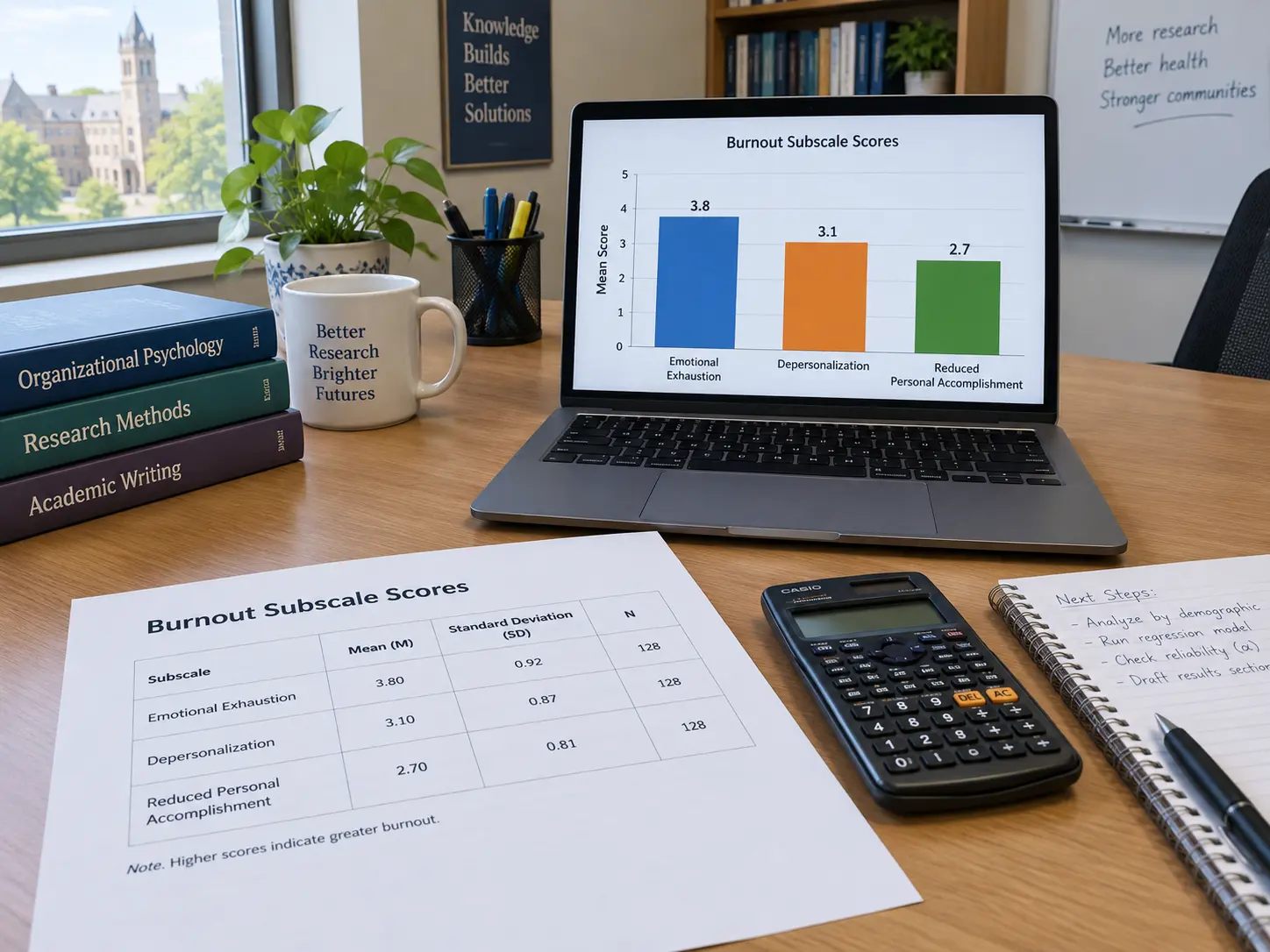
A Worked, Illustrative Interpretation Example
The figures below are entirely fictional and illustrative — built only to show how the two instruments’ outputs differ, not data from a real study.
| Instrument / subscale | Illustrative mean score | What it would suggest |
|---|---|---|
| MBI — Emotional Exhaustion (0-6 scale, 9 items) | 4.1 (illustrative) | High exhaustion, in the range typically read as elevated burnout risk on this subscale |
| MBI — Depersonalization (0-6 scale, 5 items) | 1.8 (illustrative) | Comparatively low detachment from patients despite high exhaustion — a pattern worth discussing, not averaging away |
| MBI — Personal Accomplishment (0-6 scale, 8 items, read in reverse) | 3.2 (illustrative) | Moderate; remember low scores on this subscale specifically indicate more burnout, the opposite direction from the other two |
| CBI — Client-related burnout (6 items, one of three subscales) | 62 (illustrative, 0-100 scale) | Would point specifically to patient-contact exhaustion, distinguishing it from general work-related burnout in the same fictional sample |
Notice the MBI example shows a nurse profile with high exhaustion but comparatively preserved empathy (low depersonalization) — a pattern a single averaged “burnout score” would flatten into a misleading middle value. This is the core reason both instruments report subscales separately rather than one composite number.
Reporting Your Results Correctly
Whichever instrument you choose, three reporting habits keep your results chapter defensible. First, report each subscale separately with its own descriptive statistics — never collapse the MBI’s three subscales, or the CBI’s three subscales, into one combined mean unless a specific, cited methodological justification supports doing so. Second, check the scoring direction carefully before interpreting: the MBI’s Personal Accomplishment subscale runs in the opposite direction from its other two subscales, and inverting this by mistake is one of the more common errors examiners catch in a nursing thesis using the MBI. Third, run and report a reliability check (Cronbach’s alpha) for each subscale in your own sample, since a subscale’s reliability in the original validation sample does not guarantee the same reliability among Indian nursing staff in your specific setting — see our guide on what counts as an acceptable Cronbach’s alpha for a thesis for the interpretation ranges.
Frequently Asked Questions
Can I use the Maslach Burnout Inventory without paying for a licence?
Not legitimately. The MBI is a commercial instrument sold by Mind Garden, which sells the licence to administer and reproduce it. Check Mind Garden’s current options for student researchers and budget for the licence before committing to the MBI, or choose the freely available Copenhagen Burnout Inventory instead if licensing cost is a constraint.
Is the Copenhagen Burnout Inventory validated for use in India?
The CBI has been used and translated in multiple countries, but check whether a validated Indian-context or Hindi-language version exists for your specific population before assuming the original Danish validation transfers unchanged; if none exists, note this as a limitation and consider a pilot reliability check in your own sample.
Which MBI version should I use for a nursing thesis?
Mind Garden offers the MBI-Human Services Survey (MBI-HSS) for professionals who work directly with people and a Medical Personnel form, MBI-HSS (MP); both have 22 items, and nursing burnout studies typically use one of these — confirm with Mind Garden’s current catalogue which exact form and licence you need for your population.
Can I compare MBI scores from my study to a published CBI study?
Not directly — the two instruments use different items, different subscale structures and, often, different response-scale formats, so raw scores are not interchangeable. Compare patterns (which occupational group scored higher, which subscale was most affected) rather than raw numerical scores across the two instruments.
Do I need to translate the instrument into a regional Indian language?
If your respondents are more comfortable in a regional language than English, a translated and back-translated version is standard practice — document the translation and back-translation process in your methodology chapter and, where possible, pilot-test the translated items before the main survey.
Is a cross-sectional survey design acceptable for a burnout study, or do I need a longitudinal design?
A cross-sectional design (measuring burnout at one point in time) is standard and acceptable for a one-year M.Sc Nursing dissertation; a longitudinal design tracking burnout over time is stronger for establishing change but is rarely feasible within a typical dissertation timeline — state your design choice and its limitation honestly rather than implying causal change from a single time point.
How many nurses do I need to survey for a burnout study to be meaningful?
There is no single number fixed by either instrument’s original validation paper; sample size depends on your intended analysis (a simple descriptive comparison needs less than a regression model with several predictors). See our guide to calculating sample size for a thesis and confirm your own department’s expectation.
Should I get ethics approval before surveying nurses about burnout?
Yes — surveying nurses about their psychological wellbeing is human-subjects research and needs your institution’s ethics-committee clearance regardless of which instrument you use; do not begin data collection before that clearance is granted.
Is there a shorter version of either instrument for a tighter survey?
Mind Garden’s MBI page mentions a 9-item version of the General Survey (MBI-GS9) described in the MBI Manual, but it cautions against abbreviated versions because of reduced reliability and validity; for a nursing study using the 22-item human-services forms, plan to administer the full instrument. The CBI, at 19 items across three shorter subscales, is already comparatively brief and is not typically further shortened in nursing research.
Can I survey nurses about burnout anonymously?
Anonymous or confidential administration is standard practice for burnout research, since nurses may under-report symptoms if they fear the results could reach their supervisor. State your confidentiality protocol explicitly in your methodology chapter and get your ethics committee’s sign-off on exactly how responses will be stored and reported.
What if my hospital’s administration wants to see individual results?
Report only aggregated, de-identified findings to any hospital administration, and clarify this boundary with the property or hospital before data collection begins — sharing individually identifiable burnout scores with an employer without the nurse’s separate, explicit consent is both an ethical and a confidentiality problem distinct from your academic ethics clearance.
Can I use a burnout instrument alongside a coping or resilience scale in the same questionnaire?
Yes, this is a common design for a nursing dissertation examining what buffers burnout, provided the combined questionnaire is not so long that respondent fatigue compromises data quality on either scale. Pilot-test the combined instrument’s total completion time before the main survey, and report both instruments’ reliability separately in your results chapter.
Build a defensible tools section
Tesify helps you write the tools-section paragraph for whichever burnout instrument you choose — dimension by dimension, citation-checked, with the reliability reporting your methodology chapter needs.
Build your nursing dissertation instrument section in Tesify