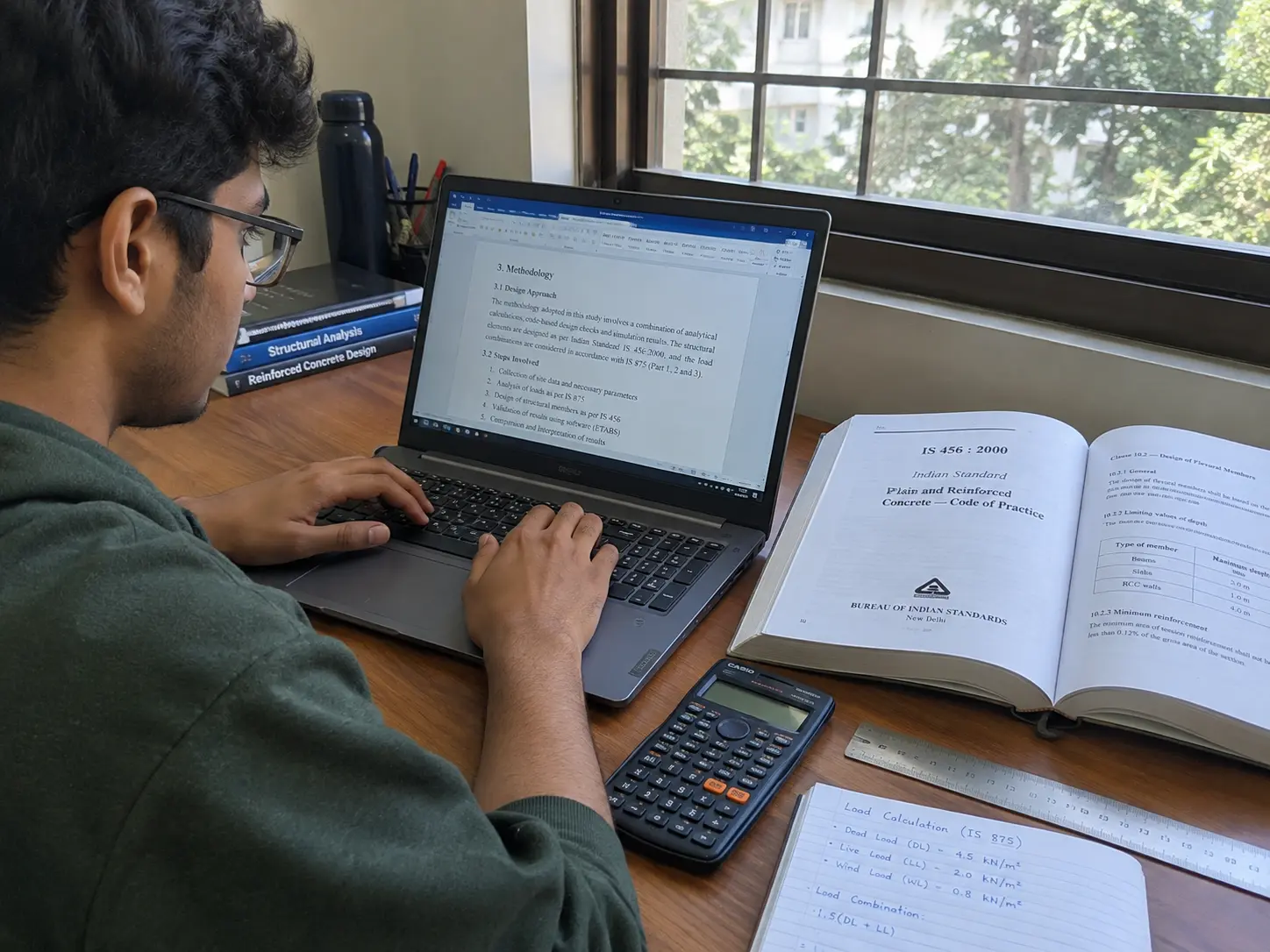
How to write in engineering register for a Civil Engineering dissertation: use past tense for what you actually did and present tense for established facts and code provisions, follow your department’s stated voice convention for methods (many Indian civil engineering departments still expect passive voice, though this varies — check your own guide), report every quantity in SI units with a precision that matches your instrument, and cite Indian Standards in the Bureau of Indian Standards’ own format, “IS <number> : <year>”. Civil engineering writing has its own register — not because engineers write badly in general prose, but because a dissertation chapter that mixes conversational hedging with structural claims reads as imprecise exactly where precision is being examined.
Step 1: Match Tense to What You Are Actually Claiming
Use past tense for anything you did — “the beam was tested under three-point loading,” “twelve cube specimens were cast” — because these are completed, specific actions in your own study. Use present tense for established facts, code provisions and general engineering principles that remain true regardless of when you write about them — “IS 456:2000 specifies a minimum grade of M20 for reinforced concrete under mild exposure, and M25 under moderate exposure,” not “IS 456:2000 specified.” Mixing the two the wrong way round is a common, examiner-visible slip: describing your own test results in the present tense implies they are a standing, repeatable fact rather than a specific finding from your specific specimens, while describing an IS code provision in the past tense implies it has been superseded when it has not (unless it genuinely has — check the current version before citing).
Step 2: Follow (or State) Your Department’s Voice Convention
Civil engineering technical writing in India, particularly in older departmental format manuals, has traditionally favoured passive voice for methods and procedures — “the specimens were cured for 28 days” rather than “we cured the specimens for 28 days” — on the reasoning that the method matters more than who performed it. Many journals and some departments have moved toward permitting active voice (“we tested,” “the authors measured”) for clarity, particularly in results and discussion sections. There is no single national rule here: check your own department’s format manual or your guide’s stated preference, and apply it consistently across the whole dissertation rather than switching voice section by section without reason.
Step 3: Report Every Quantity in SI Units, With Honest Precision
Report all measurements in SI units. Where a source, an older code edition, or an imported dataset uses non-SI units, convert and state the conversion factor used — Bureau of Indian Standards publication IS 786:1967 (with its later SI supplement) is the national reference for conversion factors and conversion tables between older and SI units. Precision matters as much as the unit itself: a load-cell reading precise to 0.1 kN reported as “45.234 kN” claims false precision the instrument never delivered; report it to the precision the instrument actually supports, and state that precision explicitly in your methodology (instrument make, model, and stated accuracy) rather than let the reader infer it from how many decimal places happen to appear in a table.
| Convention | What it means in practice | Common error |
|---|---|---|
| Tense | Past for your own actions/findings; present for established facts and current code provisions | Reporting your own results in the present tense, implying a general law rather than a specific finding |
| Voice | Follow your department’s stated preference (often passive for methods); apply consistently | Switching voice mid-chapter with no stated reason |
| Units | SI throughout; state conversion factor if converting from an older/non-SI source | Mixing SI and non-SI units in the same table without conversion |
| Precision | Match reported decimal places to instrument accuracy, stated explicitly | False precision — more decimal places than the instrument can actually resolve |
| Code citation | “IS <number> : <year>” — the Bureau of Indian Standards’ own format | Citing a code by number alone with no year, leaving the specific edition ambiguous |
Step 4: Cite Indian Standards in the Bureau’s Own Format
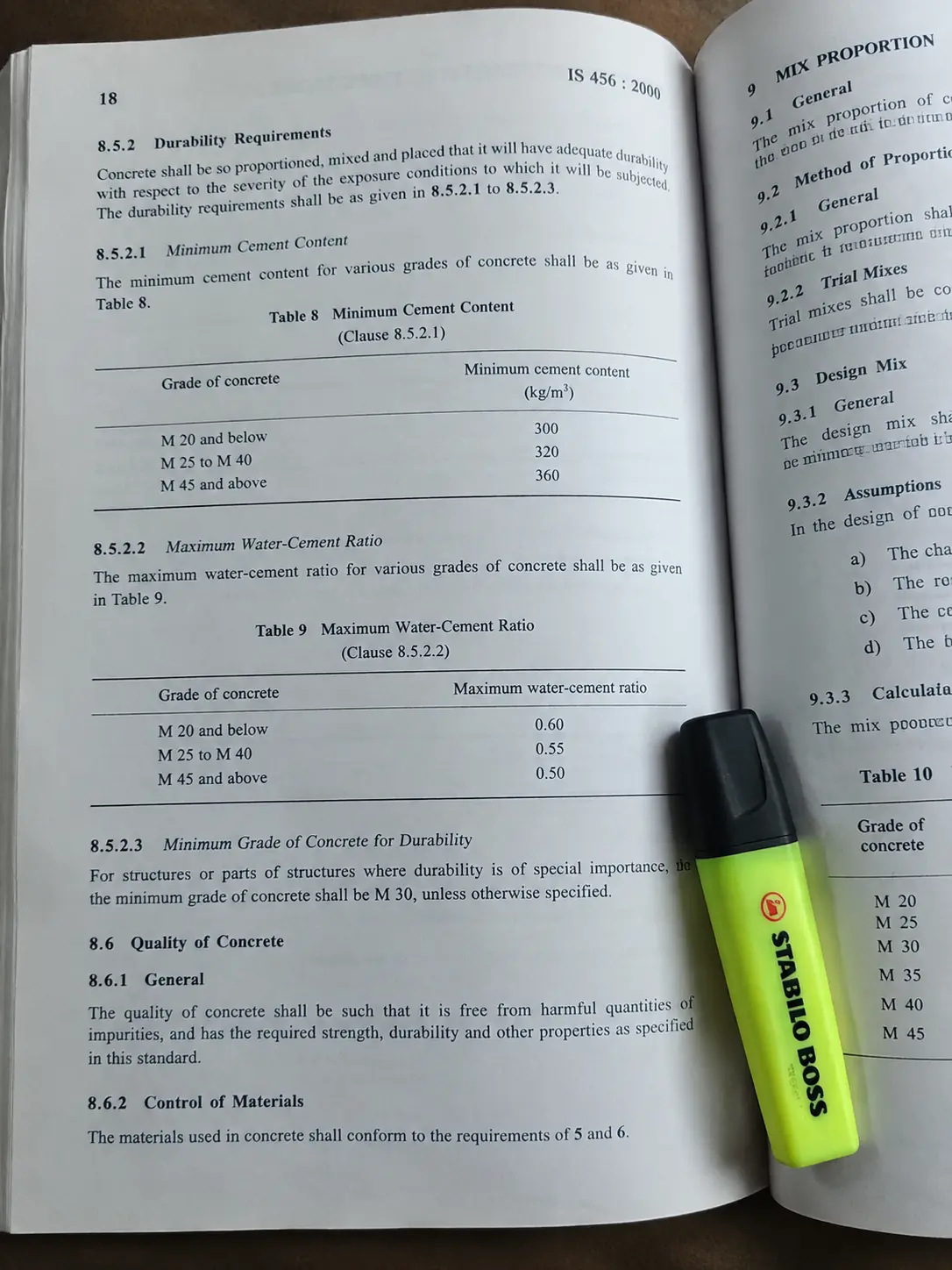
The Bureau of Indian Standards cites its own codes as “IS <number> : <year>” — for example, IS 456 : 2000 for the code of practice for plain and reinforced concrete, the format used on the standard’s own cover page and in BIS’s own publication listings. Use this exact format consistently in your text and reference list: the code number, a colon, and the year of the specific edition or revision you actually used. The year is not decorative — IS 456 itself has been through several revisions (the current edition is its fourth revision, 2000, reaffirmed since), and a dissertation that cites “IS 456” with no year leaves an examiner unable to check whether you used the current provisions or an older, superseded edition. If you are drawing on a revision or amendment to a code, state that explicitly (“IS 456 : 2000, as amended”) rather than let the ambiguity stand.
Step 5: Keep Technical Terms Precise, Not Interchangeable
Civil engineering has terms that are routinely confused in casual usage but mean distinct things in a dissertation: load (the applied force) is not stress (force per unit area) is not strain (deformation per unit length) — using them interchangeably in a results chapter is exactly the kind of loose usage an examiner probing your understanding will target first. The same discipline applies to design versus ultimate versus working loads/stresses, characteristic versus design values (in limit-state design, per IS 456’s own terminology), and short-term versus long-term deflection or settlement. Define your terms precisely at first use if there is any risk of ambiguity in how your department or a cited source uses them, and hold that definition consistently for the rest of the dissertation. The same care applies to hedging language: “the beam appears to have failed near the support” is vague about what actually happened, while “the beam failed in shear near the support, at a load of 42 kN” states the failure mode, location and load explicitly — precision costs nothing extra in word count and directly answers the question an examiner would otherwise have to ask.
Step 6: Equations, Figures and Tables — the Numbering Convention
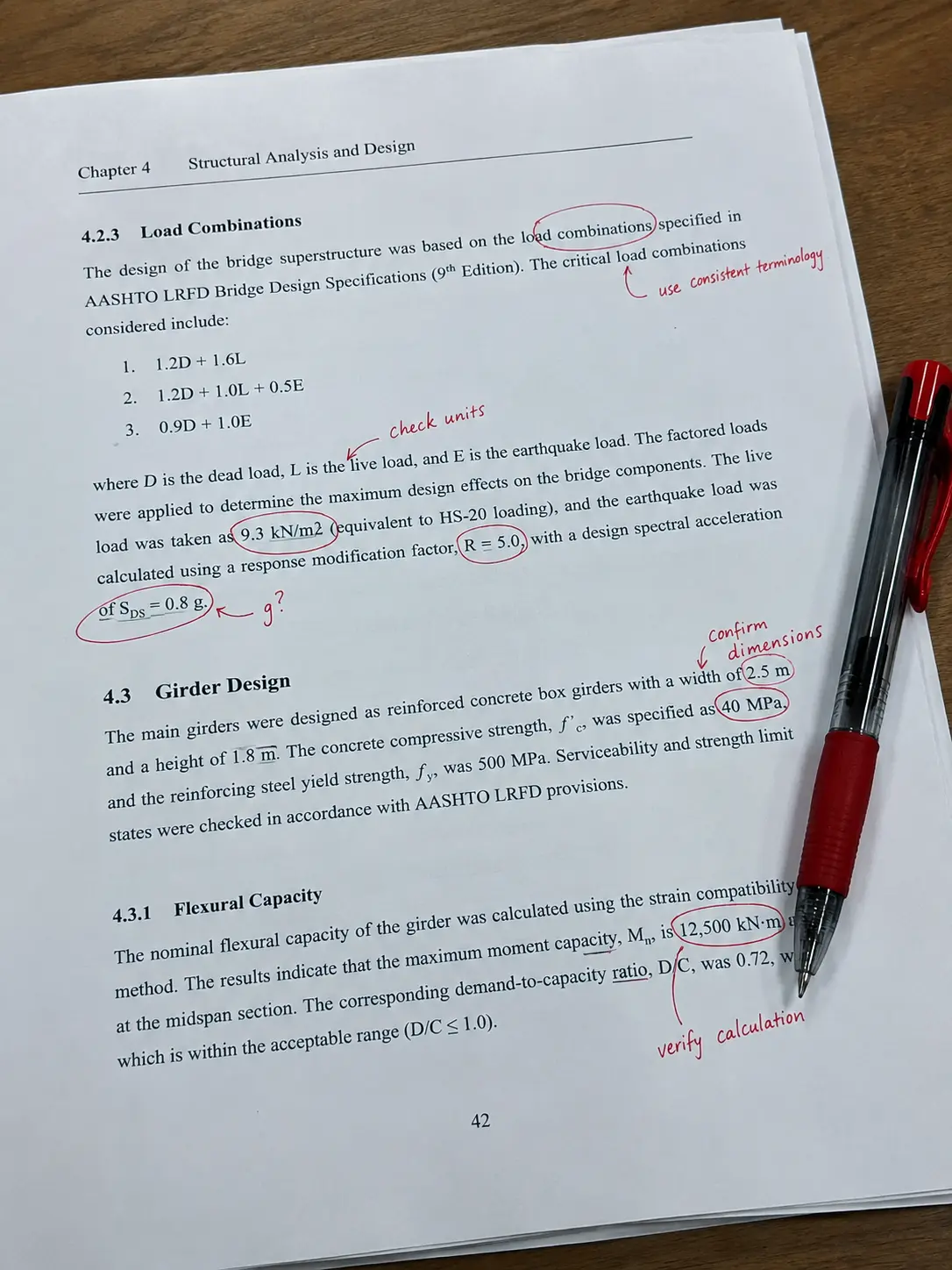
Number equations sequentially, usually by chapter (Equation 3.1, 3.2 for the first and second equations in Chapter 3), with the equation number in parentheses at the right margin — the convention most Indian engineering department format manuals follow. Every symbol used in an equation should be defined the first time it appears, either inline or in a nomenclature list at the start of the dissertation. Figures and tables follow the same chapter-based numbering (Figure 3.1, Table 3.1), usually captioned below figures and above tables, with the caption stating what is shown and, where relevant, the source if the figure or table is adapted from elsewhere rather than original to your own work. General conventions for laying out results tables and figures are covered in our guide to writing the results chapter; your department’s manual overrides it wherever the two differ.
A Worked Before/After: Turning Loose Prose Into Engineering Register
A worked illustrative example, labelled fictional. A weak sentence reads: “We tested the concrete cubes and they were pretty strong, getting about 35 MPa or so after a month, which is good according to the code.” A version in proper engineering register reads: “Twelve 150 mm concrete cube specimens were cast and tested for compressive strength per IS 516 (Part 1/Section 1) : 2021, after 28 days of standard curing. The mean 28-day compressive strength was 35.4 MPa (standard deviation 1.8 MPa, n = 12), exceeding the M30 grade’s characteristic strength requirement specified in IS 456 : 2000.” The second version states the exact number of specimens, the current edition of the standard governing the testing procedure, past tense for what was done, a precise mean and standard deviation rather than “about,” and the specific code provision the result is being checked against — every claim in it is independently verifiable by an examiner who wants to check the arithmetic or the procedure, including that IS 516 (Part 1/Section 1):2021 is the current edition, having superseded the older IS 516:1959.
What Sends a Civil Engineering Dissertation Back for Language, Not Content
- Undated code citations — “as per IS 456” with no year, leaving the edition ambiguous.
- Tense mismatches — your own findings described as standing facts, or current code provisions described as past/historical.
- Mixed units in one table without a stated conversion, forcing the reader to guess which system a figure is in.
- False precision — decimal places beyond what the instrument or method could actually resolve.
- Interchangeable use of load/stress/strain or design/characteristic/working values, without the precision the terms require.
How Does This Differ From the Viva-Preparation and General Report-Structure Guides?
The specific questions examiners ask at a Civil Engineering M.Tech viva — code-and-load questions, software-validation questions, sub-discipline-specific lines of questioning — are covered separately in our guide to what examiners ask at a Civil Engineering viva. The overall chapter-by-chapter structure and a worked IEEE citation example for an M.Tech report are in our M.Tech dissertation report guide. This article covers a different, earlier layer: not what you cite or what you are asked, but how the sentences themselves should read.
Getting tense, voice, units and code-citation format consistent across two hundred pages is exactly the kind of discipline that slips under deadline pressure. Tesify helps you hold engineering register consistent chapter to chapter, with IS-code citations kept in the Bureau’s format from the first draft. Used by 9,000+ students. Write your thesis with Tesify.
Frequently asked questions
Should a Civil Engineering dissertation be written in passive or active voice?
There is no single national rule — many Indian departments have traditionally preferred passive voice for methods sections, but this varies and some now accept active voice. Check your own department’s format manual and apply your choice consistently throughout.
How do I cite an Indian Standard code correctly?
In the Bureau of Indian Standards’ own format: “IS <number> : <year>” — for example, IS 456 : 2000. Always include the year, since codes are revised and an undated citation leaves the specific edition ambiguous.
What tense should I use for my own test results?
Past tense — “the specimens were tested,” “the beam failed at 45 kN” — because these are specific, completed actions from your own study, not standing general facts.
What tense should I use when citing a code provision?
Present tense — “IS 456:2000 specifies,” not “specified” — unless the provision has genuinely been superseded by a later revision, in which case say so explicitly.
How many decimal places should I report for a measured quantity?
Only as many as your instrument’s stated accuracy actually supports. Report the instrument’s precision explicitly in your methodology so the reader can judge whether your reported decimal places are honest.
Where do I find the SI conversion factors for an older code that uses imperial or CGS units?
IS 786:1967 and its later SI supplement are the Bureau of Indian Standards’ national reference for conversion factors and conversion tables between older unit systems and SI.
Do load, stress and strain mean the same thing?
No — load is the applied force, stress is force per unit area, and strain is deformation per unit length. Using them interchangeably is a common, examiner-visible error in results and discussion chapters.
Where should figure and table captions go?
Usually figure captions go below the figure and table captions above the table, with numbering by chapter (Figure 3.1, Table 3.1) — confirm against your own department’s format manual.