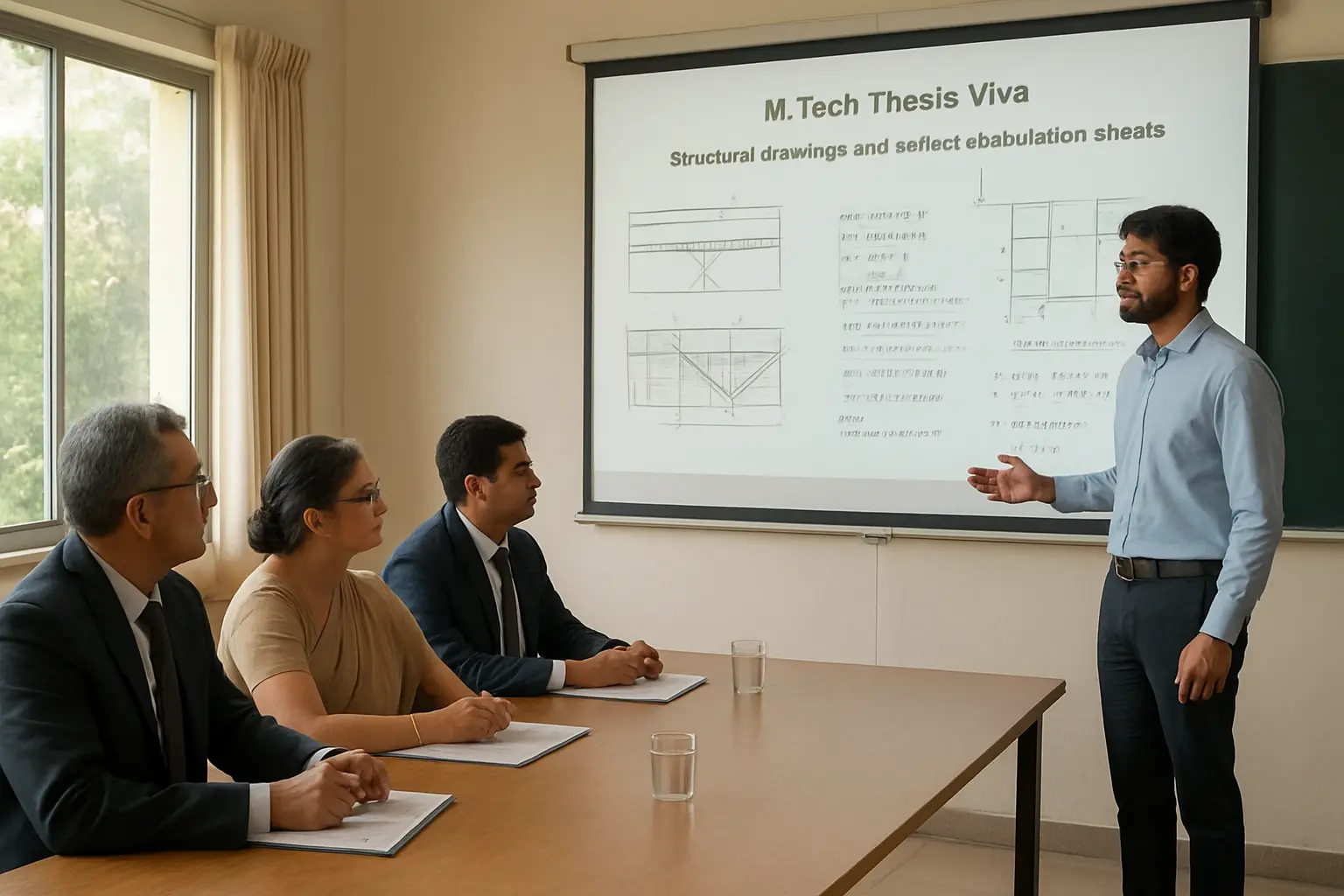
A Civil Engineering M.Tech thesis viva in India tests whether you can defend your design assumptions, not whether you can recite them. Expect questions on why you chose the loads, codes and software you used, how you validated the software output by hand, what happens if one assumption changes, and where your design would actually fail first. The panel — your guide, an internal examiner and usually one external examiner from another institution — has your report in front of them and asks from it directly.
What do examiners ask about your design loads and code provisions?
Almost every Civil Engineering M.Tech thesis in India — structural, geotechnical, transportation or water resources — rests on an Indian Standard (IS) code, and the first line of questioning tests whether you actually applied it or just cited it. Typical questions:
- “Which load combinations from IS 875 did you use, and why did you not include [a load type the examiner names, such as wind or seismic]?” — be ready to justify an omission, not just a choice
- “What seismic zone is your site in, and how did that change your design per IS 1893?” — even a non-seismic thesis is asked this, to test whether you understand the code applies nationally
- “Why IS 456 limit state design and not working stress design?” for an RCC structural thesis, or the equivalent IS 800 question for a steel thesis
- “What partial safety factors did you use for materials and loads, and where do they come from?” — the examiner wants the code clause, not “standard practice”
- For a geotechnical thesis: “What factor of safety did you target for the slope or foundation, and is that adequate for the consequence class of this structure?”
The defensible answer pattern is the same across sub-disciplines: name the code and clause, state the value you used, and explain the one case where a different value would change your result.

What do examiners ask about your STAAD Pro, ETABS or SAP2000 model?
Software-based analysis is near-universal in Indian M.Tech civil theses, and it draws a specific, predictable line of questioning because examiners have seen too many reports that trust the software output without checking it:
- “Did you validate your software model against a hand calculation for at least one member or case?” — a thesis with no hand-check anywhere is a common examiner objection, not because the software is wrong but because you cannot show you would catch it if it were
- “What boundary conditions did you assume at the supports, and why?” — fixed versus pinned versus a partial-restraint spring is a classic follow-up, especially in a foundation or connection-design thesis
- “Why this element type — plate, shell, solid, or beam — for this part of the model?” in a finite-element thesis
- “What was your mesh convergence check?” for an FEM-based thesis (ANSYS, ABAQUS) — expect this even if your discussion chapter does not explicitly report one; have a defensible answer for why the mesh size chosen was adequate
- “If you doubled [a specific input] would your conclusion still hold?” — a sensitivity question aimed directly at whether your finding is robust or an artefact of one input set
What questions are specific to your civil engineering sub-discipline?
Beyond the shared code-and-software questions above, each sub-discipline draws its own predictable set:
- Structural: “What governs your design — strength, deflection, or a serviceability limit — and how do you know?”; “How does your result compare with a conventional design for the same span/load, and is the gain worth the added complexity or cost?”
- Geotechnical: “What soil parameters did you use, and are they from your own testing or assumed from literature?” — a thesis using assumed rather than tested parameters must say so and justify the source; “How sensitive is your result to the friction angle or cohesion value?”
- Transportation: “What traffic data did you use, and how current is it?”; “How did you handle peak-hour versus average flow in your design?”
- Water resources / environmental: “What return period did you design for, and why that period for this structure?”; “What happens to your design under a longer return period?”
- Construction materials (fly ash, GGBS, recycled aggregate, alternative binders): “What is your control mix, and how many replicate specimens per test?”; “Is your improvement statistically meaningful or within normal scatter for this test?”
What do examiners ask about cost, sustainability and practical applicability?
A civil engineering thesis that stops at “this design is technically feasible” without addressing whether anyone would actually build it invites a pointed question. Common lines:
- “Is your proposed design or material cheaper, and by how much, than the conventional alternative — and does that account for [a cost the student often forgets, such as testing, curing time, or a specialised contractor]?”
- “What is the practical barrier to adopting this — code approval, contractor familiarity, material availability — and have you addressed it?”
- For sustainability-framed theses: “Is your environmental claim measured or assumed?” — a claim of reduced carbon or embodied energy needs a stated basis (a specific emission factor and its source), not a general statement
What do examiners ask about your literature review and method choice?
Before the design questions, most panels open with why-questions aimed at your Chapter 2 and Chapter 3 rather than your results:
- “What gap in the existing literature does your thesis actually close?” — a vague answer such as “not much research has been done on this” invites a harder follow-up naming a study the panel expects you to have read
- “Why did you choose [your method] over [an alternative method the examiner names]?” — for a numerical-modelling thesis, expect “why FEM and not a simplified analytical method” or the reverse; for an experimental thesis, “why this test standard and not another”
- “How many specimens, models or trials did you run, and how did you decide that number was enough?” — for an experimental civil engineering thesis this is close to the sample-size question asked in other disciplines, but framed around replicate testing rather than a survey population
- “What would you have done differently with more time or budget?” — a question that tests whether you understand your own study’s boundaries, not a trap
A structural or geotechnical thesis is also commonly asked to place its own result against a named textbook or IS-code method as a sanity check — “does your finite-element result fall within a reasonable range of what a simplified hand method would predict for the same case?” — so have that comparison ready even if it is not the headline result of your report.
How is a Civil Engineering M.Tech viva different from a PhD viva voce?
The two are structured differently in India and it is worth knowing which one you are walking into. The general PhD process — external-examiner report first, then an open viva voce once both examiners accept the thesis — is covered in what happens in a PhD viva voce in India. An M.Tech thesis viva is usually a single internal event: your guide, one or two internal examiners and sometimes an external examiner from industry or another institution, held in one sitting rather than after a separate written-report stage, and closer in format to a project defence than a doctoral examination. The content expectation is narrower too — an M.Tech thesis is judged as sound engineering work, not as an original contribution to the field the way a PhD thesis is.
How should you prepare in the final week?
Three things move the needle more than re-reading your own report cover to cover:
- Rebuild the calculation for your two or three most load-bearing (no pun necessary) design decisions from scratch, without your report open, so you can reproduce the number under pressure
- Write down, for every assumption in your methodology chapter, the one alternative value an examiner could propose and what would change if they were right
- Prepare a two-minute verbal summary of your objective, method and finding — most panels open with “tell us about your thesis” before the specific questions start, and a rehearsed, confident two minutes sets the tone for the rest
Structuring your dissertation itself so these questions are already anticipated in the text is covered step by step in how to write an M.Tech dissertation report, and if your results chapter is where you are stuck right now, how to write the results chapter covers the table and reporting conventions examiners expect to see reflected back at them in the viva. Tesify’s AI thesis assistant can generate a mock question bank from your own methodology chapter — the assumptions, code references and software choices you actually made — so your rehearsal targets what your panel will actually ask rather than a generic list; see how to choose a research topic by discipline for how the same specificity applies from the very first proposal stage. If your own thesis leans on a statistical comparison of test results rather than a purely deterministic design, which statistical test should you use covers the decision table an examiner expects your Chapter 3 to reflect.
Frequently asked questions
How long does a Civil Engineering M.Tech thesis viva last?
Typically 30 to 60 minutes including your presentation, though this varies by university and by how many follow-up questions your specific results draw. Budget for a 10 to 15 minute presentation followed by open questioning.
Can the panel fail an M.Tech thesis at the viva even if the written report was accepted?
Yes. Written acceptance for evaluation is not the same as passing the viva; a panel that finds you cannot defend your own assumptions and results can require revisions or, in rarer cases, fail the defence outright, sending you back for a resubmission.
Should I bring my raw data or calculation sheets to the viva?
Yes — a physical or digital folder of the calculations, software input files and any test data behind your key figures is standard preparation, and being unable to produce the working behind a number in your report is a common, avoidable stumble.
What if I do not know the answer to a code-based question?
Say so directly and reason from what you do know rather than guessing a number. “I used [value] based on [source]; I would need to check the exact clause for [specific edge case], but the governing principle is [X]” reads far better to a panel than an invented citation.
Do transportation and water-resources theses face the same software-validation questions as structural theses?
Yes, in equivalent form — a traffic-simulation model (VISSIM, PTV) or a hydraulic model (HEC-RAS, SWMM) draws the same “how did you validate this against a known case or hand calculation” question that a STAAD or ETABS model does.
Is it acceptable to say my thesis has limitations at the viva?
Expected, in fact. A panel is generally more satisfied by a candidate who states the boundary conditions of their own work clearly — what the design does not cover, what assumption would need revisiting for a different site — than one who claims the work has none.
What is the most common reason an M.Tech civil thesis is sent back for revision after the viva?
An unvalidated software result — a model output presented as the finding with no hand-check, sensitivity check or comparison to a known solution anywhere in the report — is one of the most frequently cited reasons, alongside a design conclusion not clearly tied back to the stated objective.
Does the external examiner get to see my thesis before the viva day?
In most Indian M.Tech programmes, yes — the report is circulated to the internal and external examiners in advance so they can prepare specific questions, which is exactly why generic, unprepared answers stand out; assume every page has been read closely rather than skimmed on the day.
Is it a problem if my result contradicts a published study I cited in my literature review?
Not by itself — panels are generally more interested in whether you can explain the contradiction (a different soil type, a different loading condition, a different code edition) than in whether your number matches the literature exactly. State the discrepancy and your explanation in the discussion chapter before the viva forces you to improvise one.