| Source | Type | Cost | Best for a CS/DS dissertation |
|---|---|---|---|
| IEEE Xplore | Journals, conferences, standards | Subscription (institutional) | Core computer science, electrical engineering and systems literature; the index most CS examiners expect |
| ACM Digital Library | Journals, conference proceedings | Subscription, with growing open-access via ACM Open | Software engineering, HCI, theory, and ACM-flagship conference proceedings |
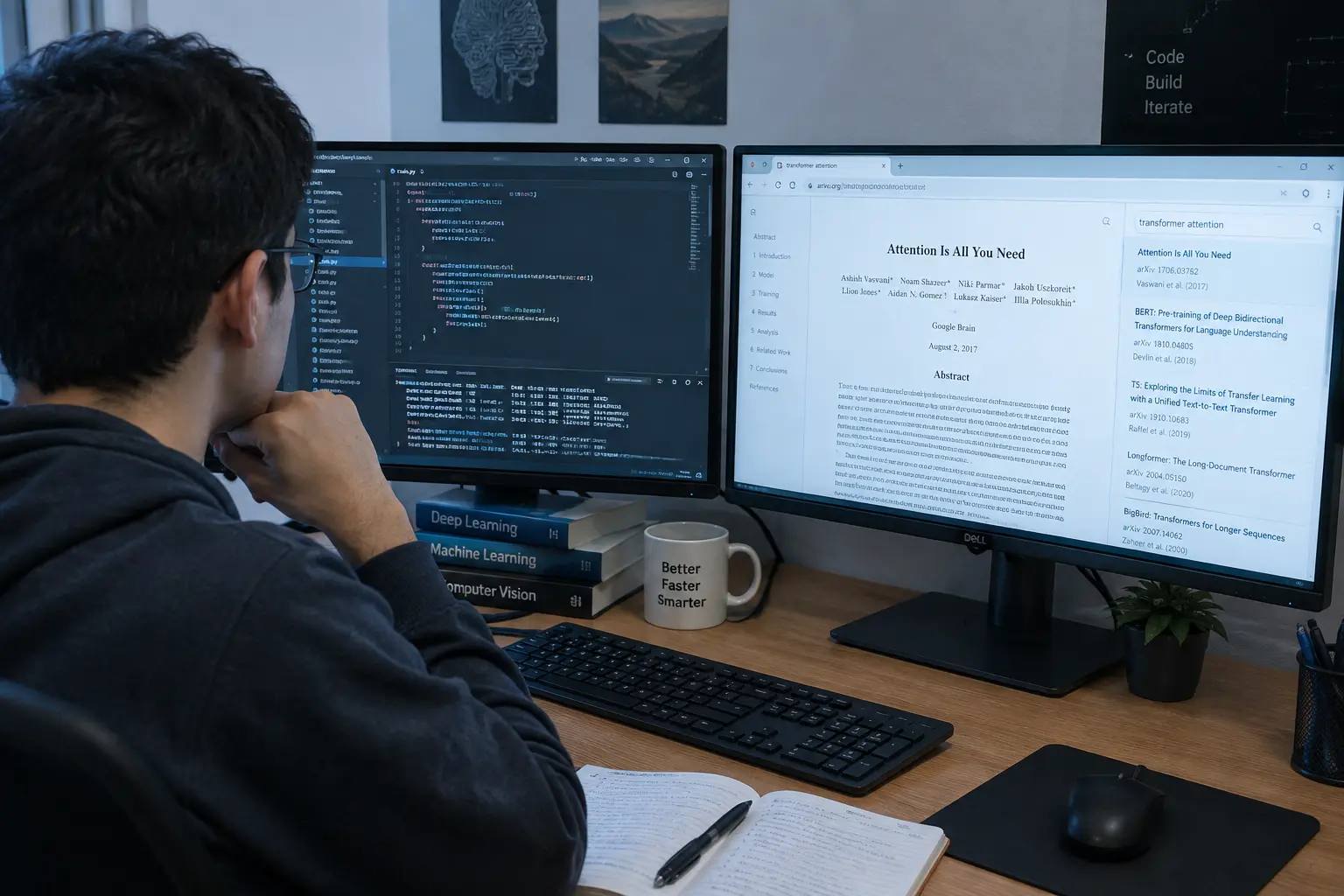
| arXiv | Free open-access preprint repository | Free | The newest ML/AI/systems work, often months before formal publication |
| DBLP | Free CS bibliography index | Free | Finding what a named author or venue has published, disambiguating names |
| Semantic Scholar | Free AI-assisted discovery tool | Free | Citation graphs, paper summaries, discovering related work — never paywalled full text |
| Google Scholar | Free search engine | Free | Fast first-pass search, citation counts, grey literature |
| Shodhganga (INFLIBNET) | National thesis repository | Free | Prior Indian M.Tech/Ph.D. theses in your sub-field |
For most M.Tech and MCA computer science dissertations in India, the working combination is IEEE Xplore or ACM Digital Library (whichever your institution subscribes to) for peer-reviewed literature, arXiv for the newest unreviewed work in fast-moving sub-fields, and DBLP to check an author’s or venue’s publication record — with Google Scholar as a free fallback when neither subscription database is available. None of these is the same job as the dataset roundup in our M.Tech CS topics-with-datasets guide: that article is about where your own analysis data comes from, this one is about where the papers you cite come from.
IEEE Xplore — the default index for CS and EE
IEEE Xplore is a research database of material published mainly by the Institute of Electrical and Electronics Engineers (IEEE) and partner publishers, covering more than 300 peer-reviewed journals, over 1,900 conferences, more than 11,000 technical standards and close to 5,000 ebooks — over 5 million documents in total, with roughly 20,000 new items added monthly. It is subscription-based: anyone can search bibliographic records and abstracts freely, but full-text access requires an individual or institutional subscription. For an Indian M.Tech or MCA dissertation, IEEE Xplore is the default first stop, because it is the index IEEE-style citation conventions (already standard in most Indian engineering departments) assume you have used, and it also hosts the technical standards a systems or networking dissertation may need to cite directly.
ACM Digital Library — strongest for software engineering, HCI and theory
The ACM Digital Library, launched by the Association for Computing Machinery in October 1997, is the full-text archive of ACM’s own journals, magazines, newsletters and conference proceedings, with a comprehensive archive back to the 1950s. All metadata (abstracts, citations, references) is open to everyone, publications from 1951 to 2000 were made openly available from April 2022, and in 2020 ACM set out to become a fully open-access publisher by 2026 through its ACM Open institutional model — as of May 2024 over 1,340 institutions had signed on. Whether a specific paper’s full text is open or still behind your institution’s subscription is therefore worth checking paper by paper. If your topic is software engineering, human-computer interaction, programming languages, or theoretical computer science, ACM’s flagship conference proceedings (many of which are the primary publication venue in these sub-fields, unlike journal-first areas) make this database at least as important as IEEE Xplore, sometimes more so.
arXiv — free, fast, but not peer-reviewed
arXiv is a free, open-access research-sharing platform hosting over three million scholarly articles across eight subject areas including computer science, physics, mathematics and statistics. It became an independent nonprofit organisation in 2026 after decades of partnership with Cornell University, and is funded by Simons Foundation International, member institutions and donors. Submissions are moderated for topical relevance but explicitly not peer-reviewed — arXiv states plainly that material is presented “as is,” the submitter’s own responsibility. In machine learning, AI and some systems sub-fields, arXiv is where the newest work appears months before (or instead of) a peer-reviewed venue, so ignoring it means missing the current frontier of your own topic. The discipline required: cite an arXiv preprint as a preprint, never imply peer-review status it does not have, and where a later peer-reviewed version exists, prefer citing that version once you have checked it is the same work.
DBLP — for checking who published what, not for reading papers
DBLP (the Digital Bibliography & Library Project) is a free, non-commercial computer-science bibliography, requiring no registration, currently operated by Schloss Dagstuhl – Leibniz-Zentrum für Informatik since November 2018 (created by Michael Ley, originally at Universität Trier in 1993). It indexed more than 5.4 million journal articles, conference papers and other CS publications as of December 2020. DBLP does not host full text or abstracts in most cases — its value is authoritative bibliographic metadata: confirming exactly what a named researcher has published, disambiguating two authors with similar names, or checking a conference’s full accepted-paper list for a given year. Use it to verify a citation’s bibliographic details (venue, year, co-authors) before you rely on a possibly-garbled entry from another tool.
Semantic Scholar — free, AI-assisted discovery worth adding to the rotation
Semantic Scholar, built and maintained by the Allen Institute for AI since its public launch in November 2015, is a free literature-discovery tool that in 2026 reports indexing 214 million papers across scientific fields — it started with a much smaller corpus in computer science and biomedicine before expanding further. Unlike Google Scholar, it does not surface paywalled full text you cannot actually access; it focuses on discovery features instead — AI-generated one-sentence summaries, citation graphs showing how papers connect, and an adaptive recommendation feed. Treat it as a discovery and citation-mapping layer on top of IEEE Xplore, ACM and arXiv, not a replacement for reading the actual paper: its automatically generated summaries are a starting point for deciding what to read next, never a substitute for reading the source yourself before citing a specific claim from it.
Google Scholar and institutional access — the fallback
Google Scholar indexes journal articles, conference papers, theses, patents and grey literature broadly and freely, with no login, making it useful for a fast first pass and for citation-count cross-checking. It does not distinguish peer-reviewed from non-peer-reviewed sources, so treat a Scholar hit as a lead to verify, not a citation-ready source in itself. Before assuming you must pay for IEEE Xplore or ACM Digital Library personally, check what your institution already provides — its own subscriptions, and since 1 January 2025 the national One Nation One Subscription scheme, coordinated by INFLIBNET, which gives more than 6,300 government higher-education and R&D institutions access to over 13,000 journals from 30 international publishers. Ask your library which of IEEE Xplore and the ACM Digital Library that access actually covers before paying anything out of pocket.
Shodhganga — what prior Indian CS/DS theses have already covered
Shodhganga, the free, open-access national thesis repository run by INFLIBNET, holds a large and continuously growing collection of full-text Indian theses across all disciplines. A quick search of your sub-field and technique (say, “federated learning” or “graph neural network” plus your application domain) before finalising your topic shows what prior Indian M.Tech and Ph.D. work already exists — it will not close a gap on its own, but “no thesis indexed in Shodhganga at the time of searching addressed X” is a precise, checkable claim your literature review can actually use.
A Worked Example: Where Three Different Claims Actually Come From
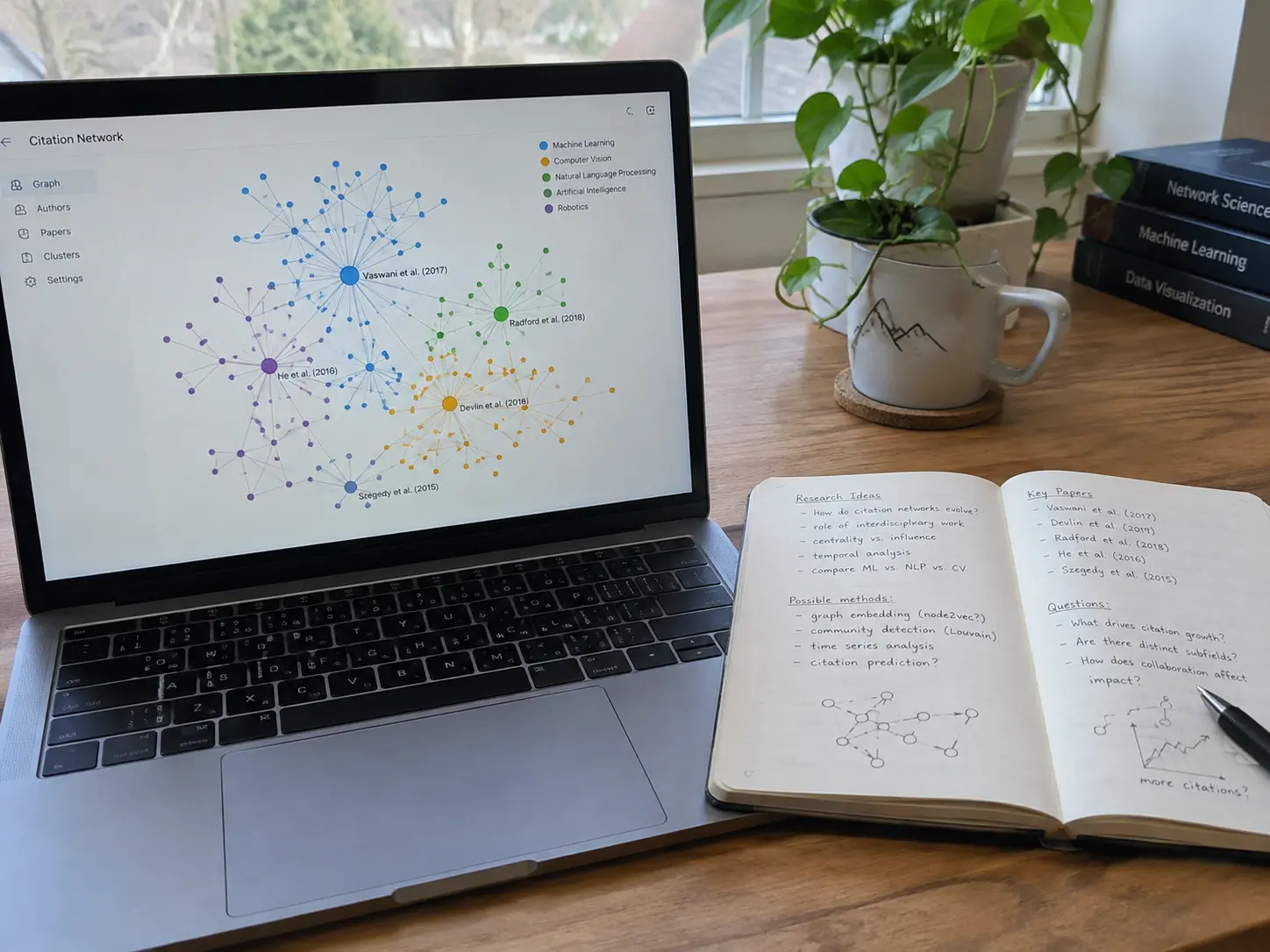
A fictional worked example, labelled illustrative. A dissertation’s related-work section states: “Vaswani et al.’s transformer architecture, introduced at NeurIPS, remains the dominant backbone for sequence modelling; a 2026 arXiv preprint proposes a sparse-attention variant claiming lower inference cost, though this has not yet appeared in a peer-reviewed venue; and DBLP confirms the original author has since published four follow-up papers at ACL and EMNLP.” Three different instruments back three different clauses: the foundational claim traces to the peer-reviewed proceedings (found via IEEE Xplore, ACM, or the venue’s own archive), the newest unverified claim is explicitly flagged as an arXiv preprint rather than implied to be peer-reviewed, and the author’s publication trajectory is confirmed via DBLP rather than asserted from memory. That explicit labelling — proceedings versus preprint versus bibliography check — is what a viva panel in a fast-moving CS sub-field is actually listening for.
Keeping Preprint and Peer-Reviewed Citations Straight as Your List Grows
A CS/DS literature review commonly runs to eighty or more citations by submission, mixing IEEE/ACM proceedings, arXiv preprints, and the occasional journal article — and hand-tracking which is which becomes unreliable well before that point. A reference manager that records the source type as metadata, not just in your memory, is the practical fix; the general shortlist of tools for Indian scholars — what is free, what needs an institutional licence, and what fits a citation-heavy technical report — is in our comparison of reference management software for Indian researchers. Whichever tool you use, tag every arXiv entry as a preprint at the moment you add it; retrofitting that label across eighty entries during submission week is exactly the kind of error-prone cleanup this article exists to help you avoid.
How Does This Differ From the Topics-and-Datasets Guide, the Proposal Guide, or the Evaluation-Metrics Guide?
Where to find datasets for your own analysis — as opposed to papers to cite — is a separate job covered in our M.Tech CS thesis topics with datasets guide. The structure and a full worked example of an M.Tech/MCA research proposal itself is in our research proposal guide, and once your experiments are run, choosing the right evaluation metric to report is covered in our guide to MCA project evaluation metrics. This article is the earlier, narrower step: knowing which index to search, and which kind of source (peer-reviewed proceedings, preprint, or bibliography record) you are actually looking at.
Keeping a preprint clearly labelled as a preprint and a peer-reviewed result clearly labelled as peer-reviewed, across dozens of citations, is exactly the discipline that slips under deadline pressure. Tesify helps you keep every citation attached to its real source and its real status as you write. Used by 9,000+ students. Write your thesis with Tesify.
Frequently asked questions
Should I use IEEE Xplore or ACM Digital Library for a CS dissertation?
Whichever your institution subscribes to, as a starting point — IEEE Xplore leans toward electrical engineering, networking and systems; ACM leans toward software engineering, HCI and theory. Many CS topics need both, so check what your library already provides before choosing.
Can I cite an arXiv preprint in my dissertation?
Yes, but label it explicitly as a preprint, not as a peer-reviewed publication — arXiv states its own content is not peer-reviewed. If a peer-reviewed version has since appeared, check it and prefer citing that version.
Is DBLP a place to read papers?
No — DBLP is a bibliographic index, not a full-text archive. Use it to verify publication details and an author’s record, then get the actual paper from IEEE Xplore, ACM, arXiv or the venue’s own site.
Do I need to pay for IEEE Xplore or ACM access myself?
Check your institution first. Many Indian institutions hold journal and database access through their own subscriptions or the INFLIBNET-coordinated One Nation One Subscription scheme; ask your library which of IEEE Xplore and the ACM Digital Library that covers before assuming a personal subscription is needed.
Is Google Scholar a substitute for IEEE Xplore or ACM?
Not fully — it is free and broad, useful for first-pass search and citation cross-checks, but it does not distinguish peer-reviewed from non-peer-reviewed content the way a curated index does.
How current is arXiv compared to a journal database?
Often months ahead, especially in machine learning and AI, since researchers post preprints before or during peer review. That currency is exactly why it needs the “not yet peer-reviewed” label attached every time you cite it.
Should I check Shodhganga before finalising my CS/DS topic?
Yes — a quick search for your specific technique and application domain shows what Indian institutions have already examined, sharpening your own gap statement even though absence from the repository does not prove no one has studied it.
What is the difference between this guide and the dataset roundup on this site?
This guide is about finding papers to cite in your literature review. The dataset guide is about finding data to analyse in your own study. They serve different chapters of the same dissertation.