| Source | Type | Cost | Best for a Pharmacy dissertation |
|---|---|---|---|
| PubMed / PubMed Central (NLM, NIH) | Literature index + full-text archive | Free | Biomedical and pharmacological literature search; PMC for free full-text |
| Scopus (Elsevier) | Abstract and citation database | Subscription (institutional) | Broad multidisciplinary coverage, citation counts, journal metrics |
| Web of Science (Clarivate) | Citation database | Subscription (institutional) | High-impact journal coverage, citation analysis across disciplines |
| Google Scholar | Free search engine | Free | Fast first-pass search, grey literature, theses, citation counts |
| DrugBank | Drug/drug-target database | Free to access; redistribution needs a licence | Pharmacology, mechanism of action, drug interactions, dosage data for a named drug |
| Indian Pharmacopoeia Commission (IPC) | Pharmacopoeial standards body | Free guidance documents; IP/NFI volumes sold | Official Indian drug quality standards and monographs |
| CDSCO | National drug regulator | Free (portal access) | Approval status, clinical trial regulation, regulatory citations |
| Shodhganga (INFLIBNET) | National thesis repository | Free | Prior Indian M.Pharm/Ph.D. theses in your sub-field |
For most M.Pharm dissertations in India, the working combination is PubMed for literature search, DrugBank for drug-specific pharmacology data, the Indian Pharmacopoeia Commission’s own published standards for any quality or monograph claim, and CDSCO for regulatory/approval facts — with Scopus or Web of Science added only if your institution already holds a subscription. None of these substitutes for reading your own department’s prescribed pharmacopoeial edition, but together they cover literature, drug data, quality standards and regulatory status — the four kinds of source a Pharmacy dissertation actually cites.
PubMed and PubMed Central — the free literature-search backbone
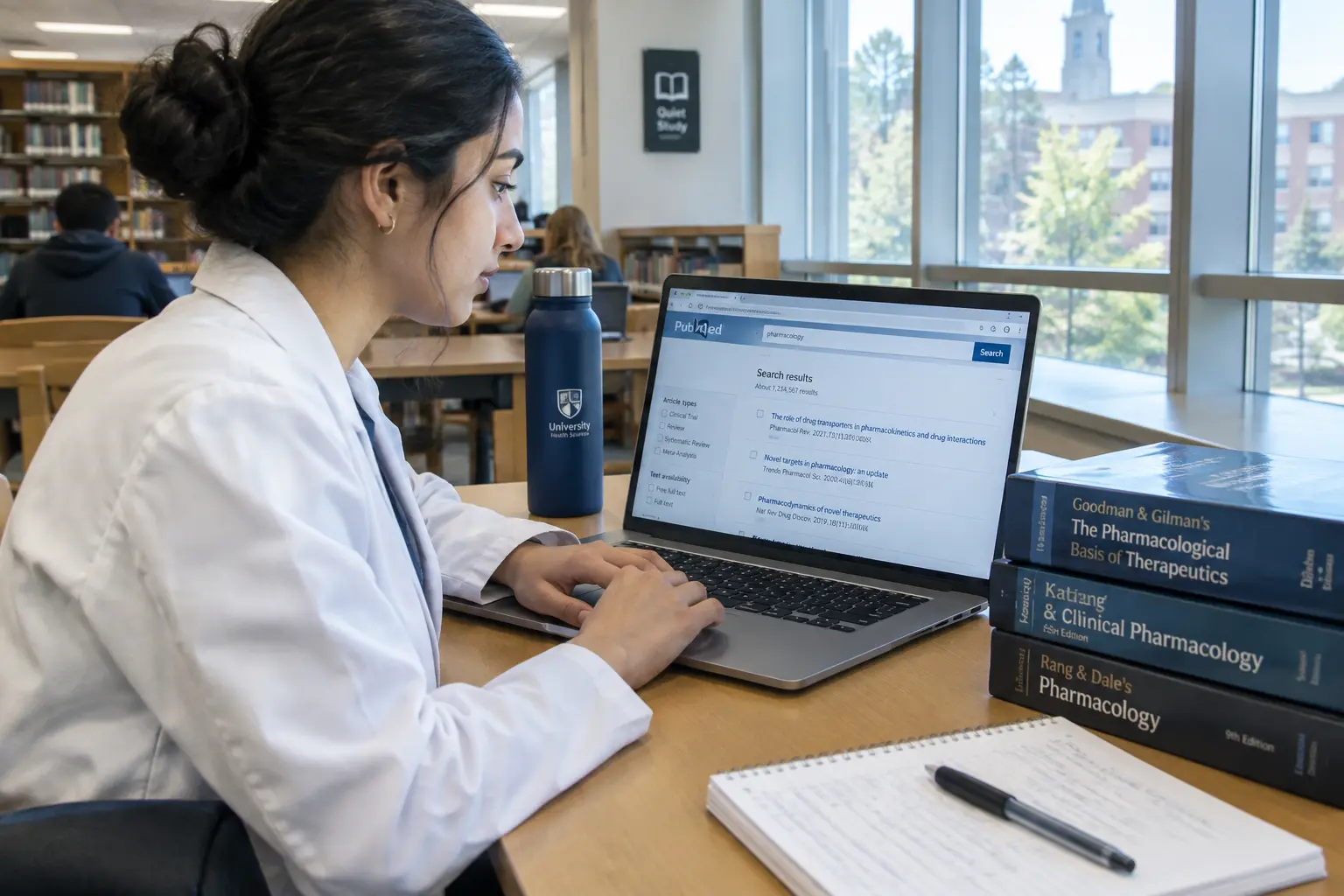
PubMed is a free resource maintained by the National Center for Biotechnology Information under the U.S. National Library of Medicine (part of the NIH), holding more than 40 million citations and abstracts of biomedical literature and available to the public online since 1996. It does not host full-text articles itself; PubMed Central (PMC), its full-text archive component, holds complete articles from journals that participate or from funder-mandated deposits. For a Pharmacy dissertation, PubMed is the default first search — free, no institutional login required, and the standard biomedical index every examiner will recognise. Its limitation: it is biomedical-focused, so a pharmaceutics or pharmaceutical-chemistry topic that leans into materials science or analytical chemistry may need a supplementary search in a chemistry-focused index your institution holds.
Scopus and Web of Science — subscription-only, use if your institution has access
Scopus (Elsevier) is a subscription abstract-and-citation database whose content, by Elsevier’s own description, extends back to 1788, with cited references from the 1970s onward. Web of Science (Clarivate) is likewise a paid-access platform, its Core Collection alone holding tens of millions of records. Both are strong where PubMed is not: citation counts, journal impact metrics, and broader multidisciplinary reach. Neither is free — but check your institution before assuming you must pay personally. Since 1 January 2025, the One Nation One Subscription (ONOS) scheme, centrally coordinated by INFLIBNET under the UGC, has given more than 6,300 government higher-education and R&D institutions access to over 13,000 scholarly journals from 30 international publishers, and N-LIST, the college component of the INFLIBNET-run e-ShodhSindhu consortium, lists access to 6,000+ journals and 1,99,500+ e-books. These schemes cover journal access; whether your campus also holds Scopus or Web of Science is a separate question, so ask your library before paying for anything. If neither Scopus nor Web of Science is available to you, PubMed plus Google Scholar covers most M.Pharm literature-review needs adequately.
Google Scholar — free, fast, and useful for triangulation
Google Scholar indexes a much broader net than PubMed — journal articles, theses, conference papers, patents, and grey literature — at no cost and with no login. Its weakness is exactly its breadth: it does not distinguish peer-reviewed from non-peer-reviewed sources, and citation counts can include preprints and non-scholarly citing works. Use it to find papers PubMed missed (especially pharmacy-adjacent engineering or formulation-science work) and to cross-check citation counts, but verify a source’s actual peer-review status before relying on it in your literature review.
DrugBank — the drug-data reference, not a literature index
DrugBank is a freely accessible database created and maintained by the University of Alberta and the Metabolomics Innovation Centre in Canada, holding drug entries — its version 6.0 lists 11,891 drug entries, including 4,030 FDA-approved small-molecule drugs and 1,601 FDA-approved biotech drugs — each with detailed pharmacology, mechanism of action, drug targets, interactions and metabolism data. It is not a journal database; it is where you look up a specific drug’s chemical and pharmacological profile once you have named it in your dissertation. Reading the online entry is free; use and redistribution of DrugBank data in whole or part requires a licence, so cite specific facts with the entry’s own reference rather than reproducing large data tables verbatim.
The Indian Pharmacopoeia Commission — the official Indian standard, not optional
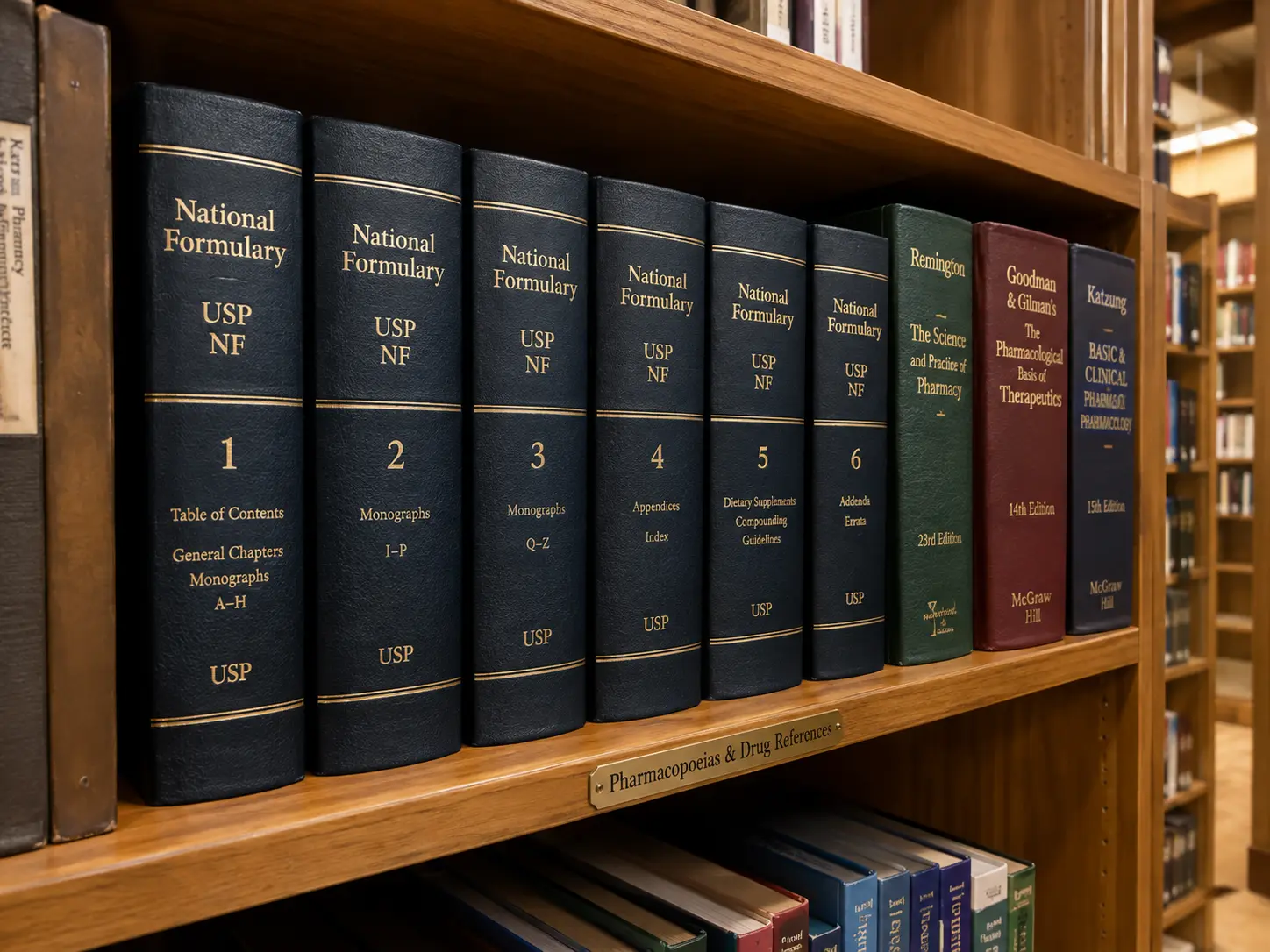
The Indian Pharmacopoeia Commission (IPC) is an autonomous institute under India’s Ministry of Health & Family Welfare responsible for pharmaceutical standards. It publishes the Indian Pharmacopoeia (IP) itself — the current edition sold through the IPC’s own shop — the National Formulary of India (NFI), and runs the Pharmacovigilance Programme of India (PvPI), the national system for monitoring adverse drug reactions. For any claim in your dissertation about an official Indian quality standard, monograph specification, or assay method, the IP is the authoritative source your examiner expects — not a generic pharmacology textbook. The IPC does offer some free guidance documents and draft monographs for stakeholder comment, but the IP and NFI volumes themselves are commercial purchases, typically already held by your department’s library.
CDSCO — for approval status and regulatory citations
The Central Drugs Standard Control Organisation, under the Ministry of Health and Family Welfare and headed by the Drugs Controller General of India, is the national authority responsible for new-drug approval, clinical trial oversight, and drug-quality control under the Drugs and Cosmetics Act. If your dissertation states a drug’s regulatory approval status in India, the clinical-trial framework it was tested under, or cites the New Drugs and Clinical Trials Rules, CDSCO’s own portal is the source to cite — not a secondary summary from a pharmaceutical-industry blog. The portal is free to access.
Shodhganga — checking what prior Indian Pharmacy theses have already done
Shodhganga, the national thesis repository maintained by INFLIBNET, is free and open access, holding several hundred thousand full-text Indian theses across all disciplines, growing continuously. Before finalising your own topic, a quick search for your sub-field and drug class is worth the ten minutes: it will not close a research gap by itself, but it tells you what has already been examined at Indian institutions and what a defensible “no prior Indian thesis addressed X” claim actually needs to say. Search your own terms and cite your own access date — repository counts grow, and a claim about what exists needs to be dated.
What a Ranked Shortlist Looks Like for a Typical M.Pharm Dissertation
- PubMed — start here for literature search, always, because it is free, comprehensive for biomedical/pharmacological literature, and the index your examiner already trusts.
- DrugBank — the moment your dissertation names a specific drug, this is where its pharmacological profile comes from.
- The Indian Pharmacopoeia (your department’s copy) — for any quality-standard or monograph claim; do not substitute a textbook summary for the IP’s own text.
- CDSCO — for regulatory and approval-status claims specifically about India.
- Scopus or Web of Science, if your institution already subscribes — added value for citation metrics and broader reach, not a replacement for PubMed.
- Google Scholar — a fast supplementary search and citation cross-check, never the sole source for a peer-review claim.
A Worked Illustrative Example: Tracing One Claim Through the Right Sources
A fictional worked example, labelled illustrative. A dissertation chapter states: “Metformin’s mechanism of action includes activation of AMP-activated protein kinase, and it remains CDSCO-approved for first-line management of type 2 diabetes in India, with the current Indian Pharmacopoeia monograph specifying its assay and dissolution limits.” Three different sources back three different clauses of that one sentence: the mechanism-of-action claim traces to a DrugBank entry (or the primary pharmacology literature PubMed would surface); the regulatory-approval clause traces to CDSCO’s own portal, not a textbook; and the assay/dissolution specification traces to the current IP monograph itself, not a paraphrase from a lecture note. Writing this way — one clause, one traceable source type — is what an M.Pharm viva panel is actually checking for when it asks “where did you get that.”
How Does This Differ From the Methodology Chapter Guide?
Once you have gathered your sources, writing the Materials and Methods chapter itself — chemical grades, instrument specifications, IAEC/IEC approval numbers, ICH-compliant validation protocols — is covered separately in our guide to the M.Pharm materials and methods chapter. Once your sources are organised, keeping every citation attached to its claim through revisions is a tooling question covered in our comparison of reference management software for Indian researchers, and the citation format itself — including how Indian departments handle government and institutional sources like CDSCO or the IPC — follows the same four-element pattern set out in our APA citation guide for an Indian thesis. This article is the earlier step: knowing where to look before you start writing.
Tracking which claim came from which source — PubMed literature, a DrugBank entry, an IP monograph, a CDSCO regulatory fact — is exactly the kind of citation discipline that gets tested at an M.Pharm viva. Tesify helps you keep every source attached to the claim it supports as you write, in your department’s citation format. Used by 9,000+ students. Write your thesis with Tesify.
Frequently asked questions
Is PubMed enough on its own for an M.Pharm literature review?
For most pharmacology and biomedical topics, yes, as a starting point — but supplement it with DrugBank for drug-specific data and the IP for quality standards, since PubMed indexes literature, not pharmacopoeial monographs or drug profiles.
Do I need to pay for Scopus or Web of Science myself?
Check your institution’s library first — many Indian institutions hold journal and database access through INFLIBNET-coordinated schemes such as One Nation One Subscription or N-LIST, or through their own licences. If neither Scopus nor Web of Science is available to you, PubMed and Google Scholar cover most M.Pharm literature-search needs adequately.
Can I cite DrugBank directly in my dissertation?
Yes, citing a specific fact from a DrugBank entry with the entry’s own reference is standard use. Reproducing large data tables verbatim requires a licence under DrugBank’s own redistribution terms.
Where do I find the current Indian Pharmacopoeia standard for a monograph?
The Indian Pharmacopoeia itself, published by the IPC — your department’s library almost certainly holds the current edition. Do not substitute a general pharmacology textbook’s summary for the IP’s own monograph text.
How do I cite a drug’s regulatory approval status in India?
Cite CDSCO’s own portal, which is free to access and is the Drugs Controller General of India’s authority for new-drug approval and clinical-trial oversight, rather than a secondary industry summary.
Is Google Scholar reliable enough for a dissertation literature review?
Use it for breadth and fast cross-checking, but verify peer-review status independently — Google Scholar indexes preprints, theses and grey literature alongside peer-reviewed journals without distinguishing them.
Should I check Shodhganga before choosing my dissertation topic?
Yes — a quick search for your sub-field and drug class tells you what Indian theses already exist, which sharpens your own gap statement even though absence from the repository is not proof that no one has studied it.
What is the difference between the IPC and CDSCO?
The IPC sets pharmaceutical quality standards (the Indian Pharmacopoeia itself); CDSCO is the regulatory authority that approves drugs and oversees clinical trials. A quality-standard claim cites the IPC; an approval-status claim cites CDSCO.