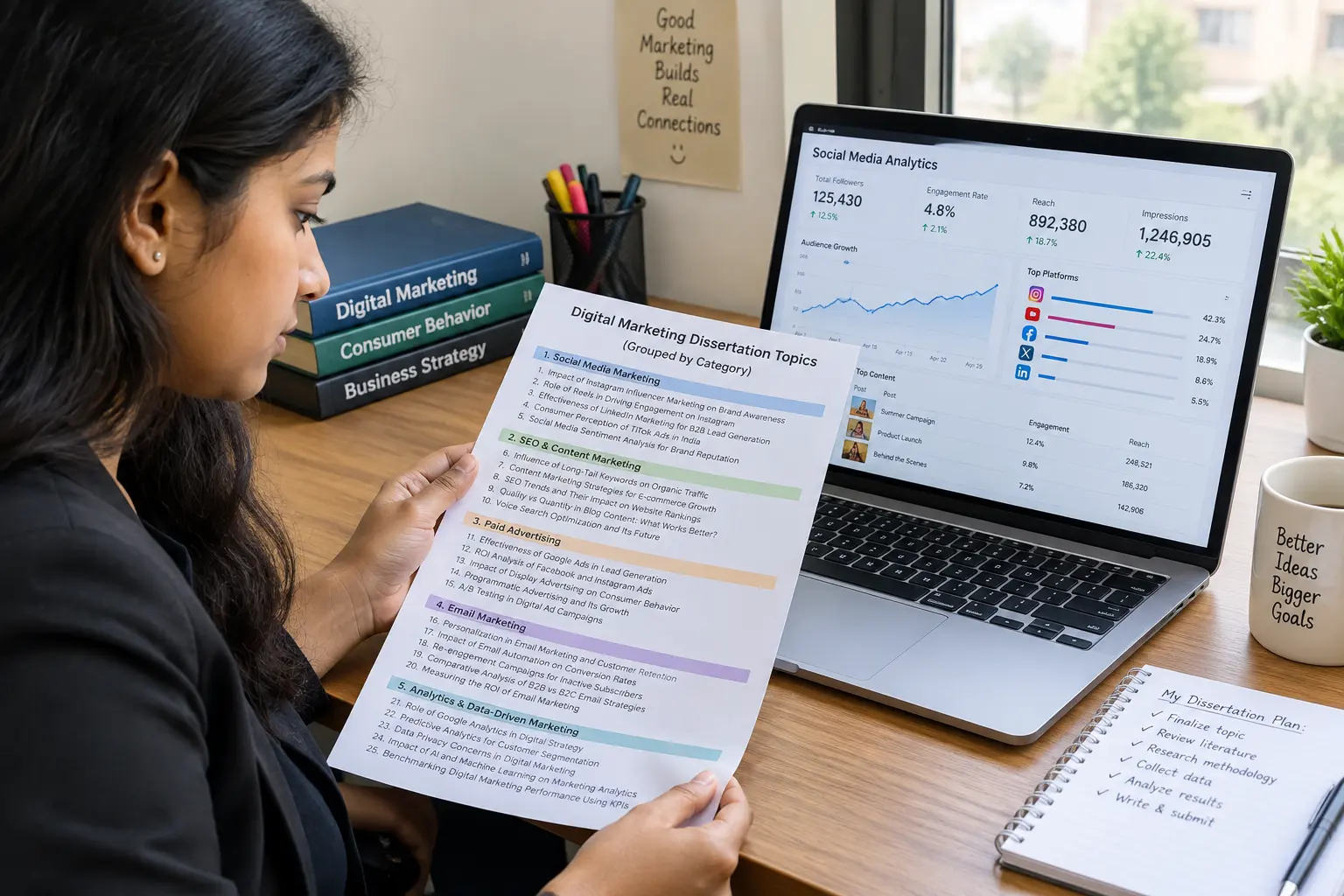
The strongest digital marketing dissertation topics for an MBA in India in 2026 name a specific platform behaviour, a specific consumer segment and a data source you can actually reach — not “the impact of digital marketing,” which is too broad to defend in a synopsis viva. Below are 30 topics grouped into six sub-areas, a three-question test for judging the data access each one needs, plus how to turn any one of them into a testable objective.
What Makes a Digital Marketing Topic Different From a General MBA Marketing Topic?
General MBA marketing topics can lean on offline constructs — brand loyalty, retail service quality, channel conflict — that have decades of Indian survey-based research behind them. Digital marketing topics are narrower and faster-moving: the platform, algorithm or ad format you are studying may behave differently in 18 months, and your data usually comes from a platform’s own analytics, a consumer survey about platform behaviour, or a scrape of publicly visible content rather than a company’s internal sales ledger. That changes what “good” data access looks like — a topic built around Instagram engagement metrics you can pull yourself is more feasible than one that assumes a brand will hand you its ad-spend dashboard.
How Should You Choose Among These 30 Ideas?
Grade every candidate on three questions before committing:
- Can you reach the data yourself? A survey of consumers, a public API, or platform-native analytics on your own or a cooperating small business’s account is realistic for a one-year MBA dissertation; a request for a large brand’s internal campaign data usually is not.
- Is there a named theory to anchor it? The Technology Acceptance Model, the Elaboration Likelihood Model, the AIDA or SOR (Stimulus-Organism-Response) frameworks, or a specific trust/e-WOM (electronic word-of-mouth) model all give your literature review a spine — an atheoretical “trends” topic is harder to defend at the synopsis stage.
- Does it say something specific about India? A topic that would read identically if “India” were swapped for any other country is weaker than one that names an India-specific behaviour — UPI-linked checkout, vernacular-language content, Tier-2/Tier-3 city adoption patterns.
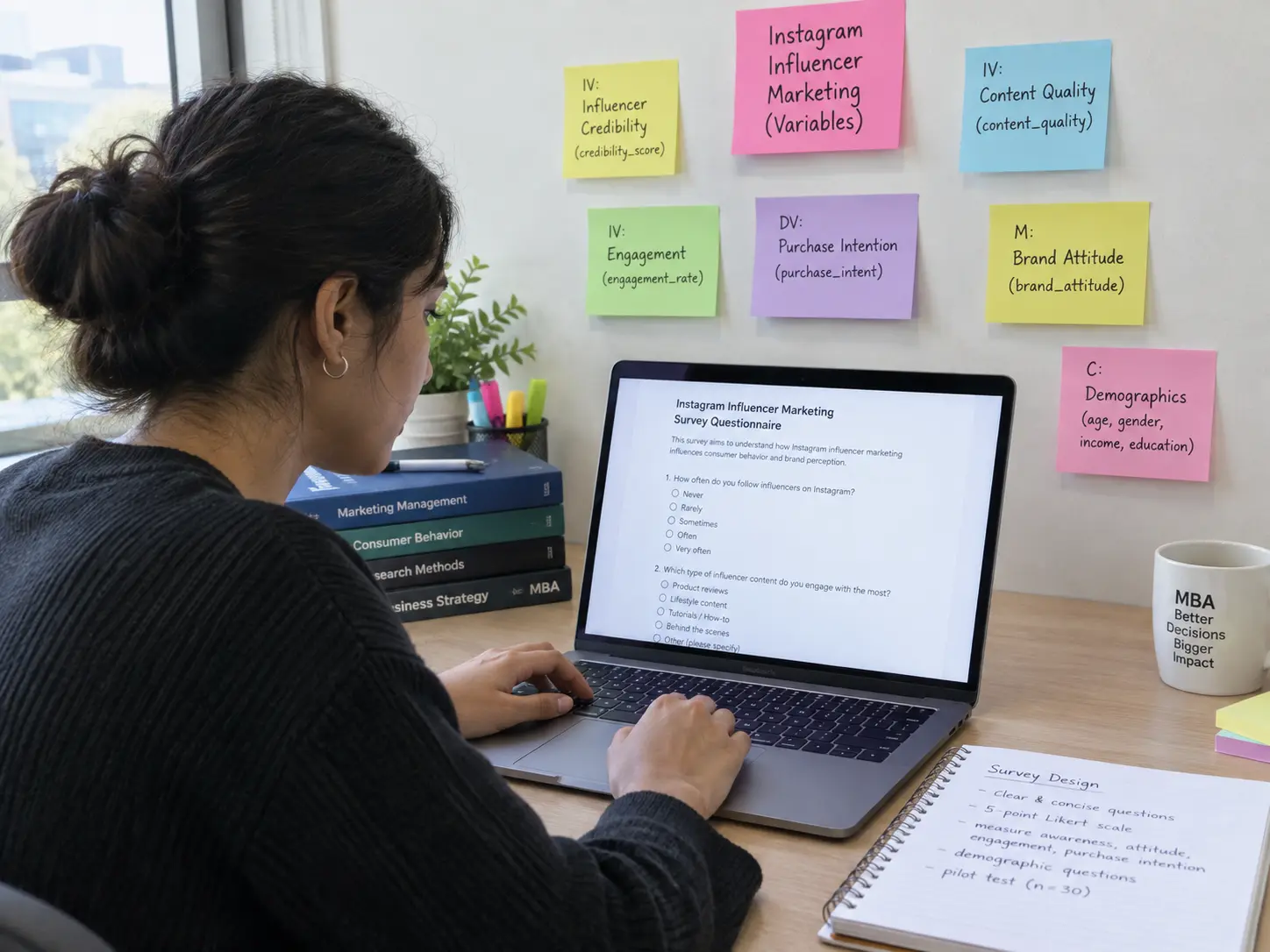
Read the sub-area groupings below as a starting point, not a fixed menu — the strongest dissertations usually combine one topic with a second, narrower qualifier drawn from your own interest (a specific product category, a specific age band, a specific region of India) once you have picked the base idea that fits your data access.
30 Digital Marketing Dissertation Topics for 2026, by Sub-Area
Social Media Marketing
- The effect of Instagram Reels engagement metrics on purchase intention among Indian Gen Z consumers.
- How influencer-brand fit (rather than follower count alone) predicts trust in sponsored content on Indian social media.
- Comparing consumer response to user-generated content versus brand-generated content for a D2C skincare brand.
- Social media customer service response time and its effect on brand recovery after a public complaint.
- The role of vernacular-language (Hindi, Tamil, Bengali) social content in engagement versus English-language content for the same brand.
Influencer and Word-of-Mouth Marketing
- Micro-influencer versus macro-influencer effectiveness for a regional Indian FMCG brand.
- Disclosure transparency (#ad labelling) and its effect on perceived authenticity among Indian consumers.
- Electronic word-of-mouth (e-WOM) valence and volume as predictors of app-store download intention.
- The effect of an influencer’s perceived expertise versus perceived similarity on purchase intention for financial products.
- Comparing review-site e-WOM (Google Reviews) with social-media e-WOM for a local services business.
Search, Content and SEO
- Voice search query patterns among Indian smartphone users and their implications for SEO content strategy.
- The effect of content pillar strategy on organic traffic for a small Indian D2C brand’s blog.
- Comparing Google Discover visibility against traditional search visibility as a traffic source.
- How schema markup adoption affects click-through rate for Indian e-commerce category pages.
- The role of long-form versus short-form blog content in lead generation for a B2B SaaS company.
E-Commerce and Direct-to-Consumer (D2C)
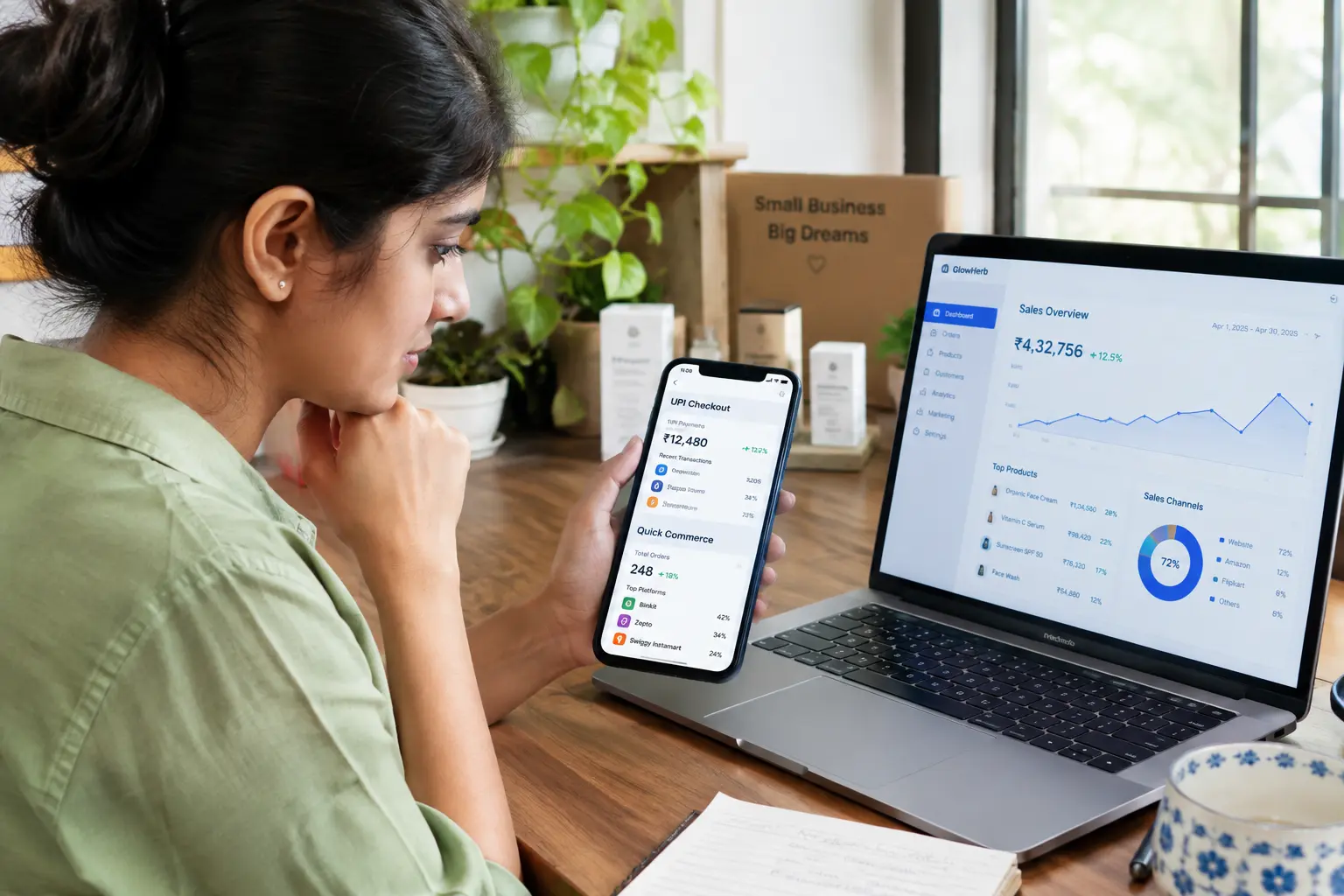
- UPI-linked one-click checkout adoption and its effect on cart abandonment for a D2C brand.
- The effect of quick-commerce (10-minute delivery) availability on impulse purchase behaviour.
- Comparing marketplace (Amazon/Flipkart) versus direct-website conversion rates for the same Indian D2C brand.
- Tier-2 and Tier-3 city adoption patterns for a D2C category compared to metro cities.
- The role of customer reviews with photos versus text-only reviews in reducing purchase hesitation online.
Programmatic and Paid Advertising
- Comparing cost-per-acquisition across Meta Ads and Google Performance Max for a small Indian business’s actual campaign data (with the business’s consent).
- The effect of ad frequency capping on ad fatigue and click-through-rate decay.
- Retargeting versus lookalike audience performance for an Indian D2C brand’s own campaign.
- Consumer perception of hyper-personalised advertising and privacy concern among urban Indian consumers.
- The effect of festival-season (Diwali, Eid) ad-spend timing on conversion rate for an e-commerce category.
Marketing Analytics and CRM
- Customer lifetime value (CLV) modelling for a subscription-based Indian D2C brand using its own transaction data.
- The effect of WhatsApp Business API adoption on repeat-purchase rate for a small retailer.
- Comparing RFM (recency, frequency, monetary) segmentation against a simple demographic segmentation for email campaign response.
- Marketing attribution modelling challenges for a brand running both online and offline campaigns simultaneously.
- The effect of chatbot-assisted customer service on conversion rate for an Indian e-commerce site.
None of the figures implied by “effect of X on Y” above are pre-determined results — each is a genuinely open empirical question you would test with your own collected data, not a finding to look up and report. As a rough rule of thumb for data access, the survey-based and public-content topics (most of the Social Media, Influencer and Search groups) are the easiest to resource on your own, while topics that need a business’s own campaign, transaction or CRM data (most of the Paid Advertising and Analytics groups) depend on securing written consent from a cooperating business first.
How Do You Turn One of These Topics Into a Testable Objective?
Pick a topic, then narrow it the same way any MBA dissertation topic narrows: name the specific independent and dependent variable, the population you can actually survey or the platform data you can actually pull, and the analysis technique that fits. “Influencer marketing and purchase intention” becomes “to examine the effect of influencer-brand fit on purchase intention among 18-24-year-old Instagram users in [your city], using a survey-based design analysed with multiple regression.” The full mechanics of building the operationalisation table that follows from an objective like this — hypothesis, variable, indicator, data source, analysis tool — are in our guide to building an MBA dissertation operationalisation table. If your interest is specifically in 2026’s AI and sustainability-driven marketing trends rather than these platform-level topics, our companion piece on trending 2026 MBA thesis topics covers that different, broader angle.
Where Do You Get Data for a Digital Marketing Dissertation?
Most of the topics above need one of three data types: a consumer survey you administer yourself, platform-native analytics from a business account (yours or a cooperating small business’s, with written consent to use the figures), or publicly visible content you code yourself (a sample of posts, reviews or ads, coded against a scheme you build and justify in Chapter 3). For market-level and industry-context figures to cite in your literature review — overall digital ad spend, internet and smartphone penetration, e-commerce market size — our guide to market and consumer data sources for an MBA marketing dissertation compares IBEF, CMIE, NSSO, data.gov.in, IAMAI, Google Trends and NielsenIQ. Do not present a platform’s own aggregate industry statistics as if they were data collected for your own study — cite them as literature-review context, and be clear in your methodology chapter about which numbers are yours and which are a cited industry source.
Frequently Asked Questions
How many of these 30 topics have already been studied in India?
Digital marketing behaviour changes fast enough that even a topic studied two or three years ago in India is usually still open to a fresh study, provided you narrow the population, platform version or time window to make clear what is new about your own study. Search Shodhganga and Google Scholar for your exact platform-and-construct combination before committing, since platform features (a specific ad format, a specific short-video feature) are added and removed often enough that an older Indian study may not cover the current version.
Do I need permission to study a specific brand’s social media account?
Studying publicly visible content (public posts, public reviews) generally does not require the brand’s permission, but using any of the brand’s own internal data (ad spend, conversion figures, customer lists) does. Get written consent before analysing anything the brand has not made public, and say in your methodology chapter exactly what was public versus provided.
Can I use a small business’s own account data if the owner agrees?
Yes — this is one of the more feasible routes to real transactional or ad-performance data for an MBA dissertation, provided the business owner gives written consent, understands what will be published (even anonymised), and you follow your institute’s ethics-clearance requirement for using organisational data.
Is a purely qualitative content-analysis topic (no survey) acceptable?
Yes, provided your guide and department’s format accept a qualitative design — coding a sample of ads, posts or reviews against a built and justified scheme is a legitimate design for several of the topics above (particularly under Social Media Marketing and Influencer Marketing), not just a fallback when a survey is not feasible.
Should I pick a trending topic like AI-generated ad content?
A trending sub-topic can work well if you can access real data about it (a survey of consumer reactions to AI-generated ad creative, for instance) rather than only a literature discussion — an under-researched trend with no accessible data route is a common cause of a topic being sent back for a feasibility check.
How specific does the platform version need to be?
State the platform and, where relevant, the specific feature (Instagram Reels rather than “Instagram” generally, WhatsApp Business API rather than “WhatsApp”) in your title and objectives, since platform features change quickly enough that vague platform references make your study harder to replicate or update.
Can two students in the same batch choose topics from the same sub-area?
Usually yes, provided the specific platform, population, brand or construct differs enough that the two studies are not answering the same question — check with your department on how much overlap is acceptable, since some universities require topics to be visibly distinct before approval.
What if my chosen brand refuses to share any data after I have committed to the topic?
Have a fallback data source in mind before you commit — most of the survey-based and content-analysis topics above do not depend on a single brand’s cooperation, which is deliberately why they are grouped here rather than tied to one company’s internal figures.
Do I need a control group for a topic that compares two platforms or formats?
A formal control group is not always required — many of the comparison topics above (Reels versus static posts, marketplace versus direct website) work as a within-subject or matched-sample comparison rather than a true experiment with random assignment, which is usually more feasible for a one-year MBA dissertation. State clearly in Chapter 3 which design you are using and why, since a comparison design that is not a true experiment still needs its limitations named honestly in your discussion chapter.
Is it acceptable to focus on one Indian city rather than a national sample?
Yes — a single-city or single-region sample is standard practice for an MBA dissertation given the time and budget available, provided you state the scope honestly as a limitation rather than generalising your findings to “Indian consumers” nationally. A well-justified single-city sample is stronger than an overreaching claim about a national population you never actually surveyed.
Turn a topic into a full proposal
Tesify takes the topic you choose from this list and helps you build out the objectives, hypotheses, a feasible data-collection plan and the literature anchor your guide will expect — so your synopsis reflects a topic you actually chose and can defend, not a generic template.
Build your digital marketing dissertation proposal in Tesify