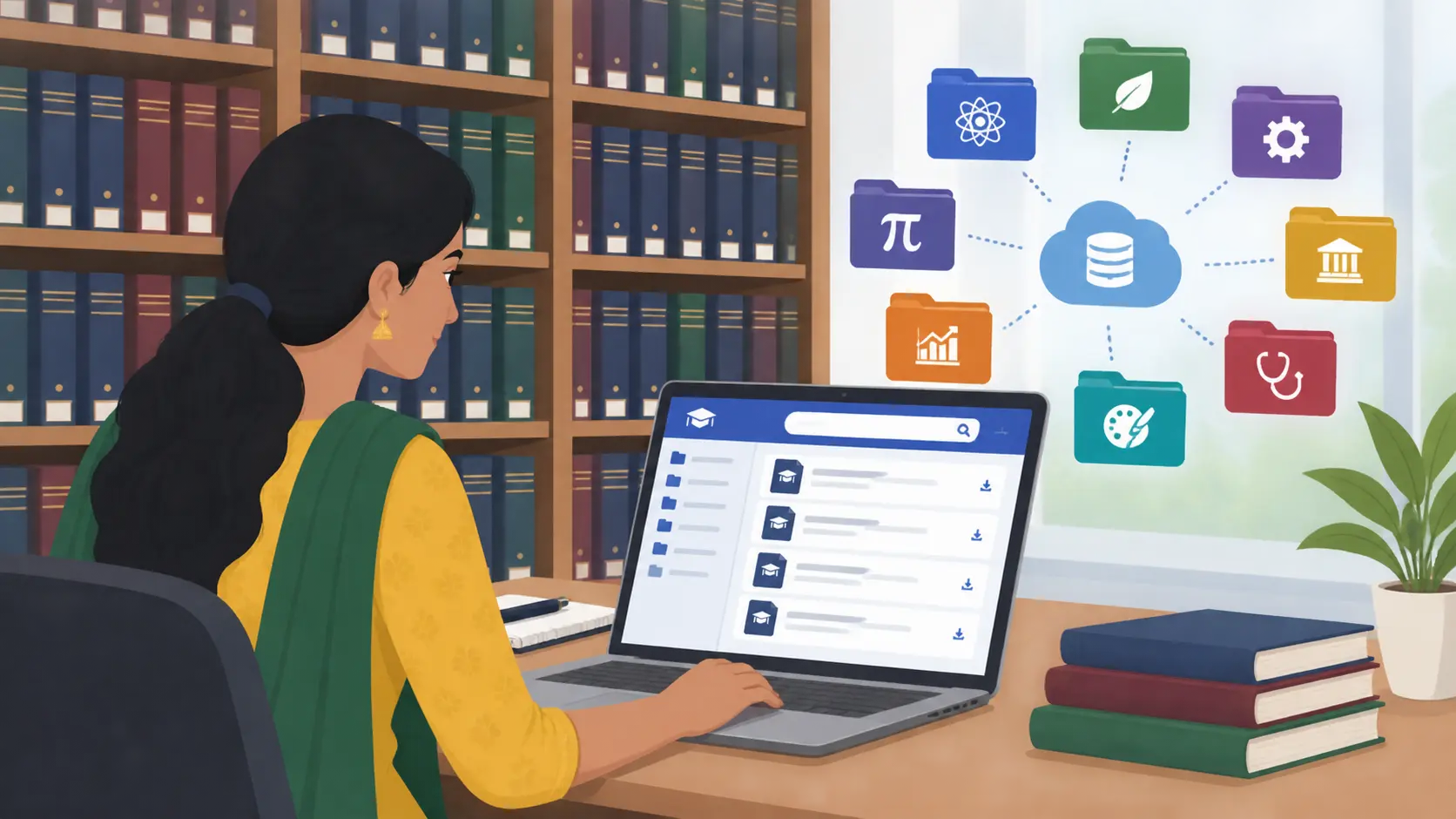
Where previous theses live: a comparison
The details below are limited to what the repositories’ own descriptions and reference sources state. Interfaces change, so use this table to decide where to look and let the repository’s own help page tell you how.
| Repository | Run by | What it holds | Access terms stated | Use it to |
|---|---|---|---|---|
| Shodhganga | INFLIBNET Centre, an inter-university centre of the UGC | Electronic copies of PhD theses and M.Phil. dissertations from participating Indian universities | Open access; submissions carry a Creative Commons Attribution-NonCommercial-ShareAlike 4.0 licence | Read finished Indian theses in your discipline, chapter by chapter |
| ShodhGangotri | INFLIBNET Centre | Synopses and research proposals of PhD programmes, described as a repository of Indian research in progress | Not stated in the description read | See what topics are already registered before you finalise yours |
| Your university or department repository | Your own library | Local theses, sometimes including M.Ed, MBA and M.Sc dissertations that never reach Shodhganga | Varies; ask the librarian | Find master’s-level examples in your own department |
| Global ETD Search | Listed by the Networked Digital Library of Theses and Dissertations (NDLTD) | Electronic theses and dissertations from institutions across multiple countries | Search portal listed on the NDLTD site | Find foreign theses for the “studies abroad” part of your review |
| CORE | Aggregator of open access research | Open access research papers; check whether the thesis you want is included | Described as a collection of open access research papers | Locate open versions of papers cited in a thesis |
The short answer: start with Shodhganga for Indian doctoral and M.Phil. work in your discipline, check ShodhGangotri for topics in progress, ask your own library for master’s dissertations from your department, and use Global ETD Search for foreign work. Then use what you find the right way: as a map to the primary literature, not as text to copy.
Why previous theses help a dissertation writer
A previous thesis in your discipline shows three things no textbook does. It shows the shape of a completed work in your field, so you know how long a methodology chapter runs and how a results chapter is organised. It shows what examiners at a given university accepted. And it hands you a reference list that took someone a year to assemble. For a student writing a dissertation in a tight semester, that is a large saving, provided you use it honestly.
The national picture of what Shodhganga holds, and what its counts can and cannot tell you, is in our guide to Shodhganga statistics, and the basics of deposit are in our guide to what Shodhganga is and whether your thesis will be uploaded. Shodhganga was established in 2010 following a UGC mandate of June 2009 requiring universities to submit electronic copies of PhD theses and M.Phil. dissertations, and it is built on the DSpace repository software.
How to search by discipline
Repositories are organised by institution, so a discipline search usually works best as two passes: first with subject words, then by narrowing to universities that are strong in your area. Four habits make the difference.
- Search by the construct, not by your title. Your exact title will not exist. Search for the variable pair, such as “teacher effectiveness” with “emotional intelligence”, then each variable alone.
- Use the field’s own words. Nursing theses say “structured teaching programme”; management theses say “consumer behaviour” or “employee engagement”; education theses say “achievement” and “attitude”.
- Search both the title and the abstract or keywords where the repository allows it, because many titles hide the variable you want.
- Record every search. Note the words, the repository and the date, as you would for the literature review procedure in our guide to the PhD literature review.
What to look for, by discipline
| Discipline | Search words to start with | What to take from the thesis |
|---|---|---|
| Education (M.Ed, B.Ed) | Variable pair plus “secondary school” or “teachers”; “achievement”, “attitude”, “effectiveness” | The tools used and how they were adapted, the sample sizes accepted, the summary tables in the review chapter |
| Nursing | Condition plus “knowledge”, “attitude”, “practice” or “structured teaching programme” | The conceptual framework chosen, the validation of the tool, the ethics steps |
| Management and commerce | Construct plus sector, such as banking or retail; “satisfaction”, “perception”, “behaviour” | The model, the scales, the sampling method and how the company access was handled |
| Psychology | The construct and the population; the scale name | Operational definitions, reliability reporting and the statistical tests used |
| Engineering and computer science | The method or system plus the application area | The experimental set-up, the datasets and the evaluation metrics |
How to read a thesis as a map, not a template
Open the thesis and go straight to three places: the review chapter’s summary tables, the methodology chapter’s tools section, and the reference list. From the summary tables you learn which studies the field treats as foundational. From the tools section you learn which instruments were used and where the author got permission. From the reference list you get a list of primary sources to read yourself. Then close the thesis and go to those sources. This is the same “citation chaining” a professional literature review uses, and it is the safest way to benefit from earlier work. For the full review procedure, see our guide to the review of related literature.
Never copy the review chapter of another thesis, even with changed words. Repository text is public, similarity-checking software used by universities may compare your text against it, and an examiner who has read the earlier thesis will recognise the structure. How the similarity limit works for your own submission is explained in our guide to the UGC plagiarism limit; your university runs the check, and the safest preparation is writing every paragraph yourself from your own notes.
How to cite a thesis you used
If you cite a thesis, cite it as a thesis, with the author, year, title, the degree type and the institution, and where you found it. In APA 7, the pattern is: author, year in brackets, the title in italics, then the bracketed description such as [Doctoral dissertation, name of university], the repository name and the web address. A labelled, invented example of the shape:
[Surname], [Initials]. ([Year]). [Title of the thesis] [Doctoral dissertation, [Name of University]]. Shodhganga. [URL of the record]
Check your department’s own format and the details in our guide to APA style for an Indian thesis. Cite a thesis only when you have read the parts you rely on; a thesis is unpublished work that has been examined by one university, so for any claim that matters, find and cite the underlying journal article.
A first session that takes an hour
Do this once, early, and keep the notes in a single file:
- Write your two or three key constructs and their synonyms on a page.
- Search each in Shodhganga and in your own library’s repository, and note every thesis whose title or abstract names two of your constructs.
- Search the same words in ShodhGangotri and note the synopses that are close to your topic.
- For the three closest theses, open the reference list and mark the ten sources you do not yet know.
- Read those sources first; add them to your literature matrix with the tool, sample and finding.
At the end you will have a list of related studies, a view of how your field frames the problem, and the names of the instruments in use, which is most of what you need to start Chapter 2 and to choose your tools. Before you adopt any instrument you found this way, check its manual, its permission terms and its reliability evidence yourself.
Doctoral and master’s theses are not the same evidence
Doctoral theses usually have larger samples, longer reviews and more elaborate designs than a master’s dissertation, and a master’s student who imitates a doctoral design will run out of time. Read doctoral theses for the review, the framework and the reference list. Read master’s dissertations from your own department for scale: how many participants, how long the methodology chapter is, and what the examiners accepted at your level.
Using ShodhGangotri before you commit to a topic
Synopses show what research is in progress, which is the first thing to check before you spend a month on a topic. If you are a PhD aspirant, a search of synopses on your variable pair tells you whether a university has already registered something close, how the problem was framed and what objectives were accepted by a doctoral committee. If you are a master’s student, the same search helps you narrow a topic that is too broad, and your guide can tell you which of the close titles your department has already seen.
Foreign theses and where they fit
Many Indian dissertations are asked to review studies abroad. Global ETD Search, which the NDLTD lists as its portal for finding theses across institutions, and CORE for open versions of the papers a thesis cites, give you that coverage without paying for databases. Foreign theses follow different conventions and degree levels, so state the country and degree level whenever you cite one, and do not compare a US doctoral dissertation directly to an Indian master’s dissertation without saying so.
Six mistakes when using previous theses
- Copying structure and wording. Use the shape, write the content.
- Trusting the thesis’s summary of a study. Read the study.
- Citing a thesis for a published finding. Cite the paper where it appeared.
- Adopting a tool without permission. A thesis using a scale does not give you the right to use it.
- Searching once. Different words find different theses.
- Ignoring master’s-level work in your own library. It often matches your design best.
Turning what you find into your own chapter
Finding earlier work is half the job; the other half is writing your own chapter around it. Tesify helps you structure the chapter and assists you as you write your own paraphrases. More than 9,000 students have used it, it has supported 15,000+ chapters, and every word of your dissertation stays 100% written by you.
Start your dissertation in Tesify
Frequently asked questions
Where can I find previous theses in my discipline in India?
Start with Shodhganga for PhD theses and M.Phil. dissertations from participating universities, check ShodhGangotri for synopses of work in progress, and ask your own library about local repositories for master’s dissertations.
What is the difference between Shodhganga and ShodhGangotri?
Shodhganga holds electronic copies of completed theses and dissertations. ShodhGangotri, maintained by the same INFLIBNET Centre, holds synopses and research proposals of PhD programmes, so it shows research in progress.
Can I read Shodhganga theses without paying and use them?
Submissions are open access under a Creative Commons Attribution-NonCommercial-ShareAlike 4.0 licence, which allows reading and sharing under its terms. You must still cite whatever you use and never present it as your own.
How do I search for theses by discipline?
Search by the construct and population in the field’s own words, search titles and abstracts where possible, and repeat the search with synonyms. Record each search.
Can I copy the literature review of an earlier thesis?
No. Use its reference list to find the primary sources, read them, and write your own review. Copied text can be detected by similarity software.
How do I cite a thesis from a repository?
Give the author, year, title, degree type and institution, the repository name and the link, following your department’s format. APA 7 uses a bracketed description such as Doctoral dissertation, then the university.
Where do I find foreign theses?
Use Global ETD Search, which the Networked Digital Library of Theses and Dissertations lists for finding theses across institutions, and check university repositories abroad directly.
Does my master’s dissertation appear on Shodhganga?
Shodhganga’s mandate covers PhD theses and M.Phil. dissertations, so master’s dissertations are more likely to be found in your own university or department repository.
Why should I check ShodhGangotri before choosing a topic?
Because synopses show topics already registered and how problems and objectives were framed, which helps you narrow or differentiate your own topic.
Should I cite a thesis or the journal article behind it?
Cite the journal article for any published finding, and cite the thesis only for what appears in the thesis itself, such as a tool adaptation or an unpublished result.