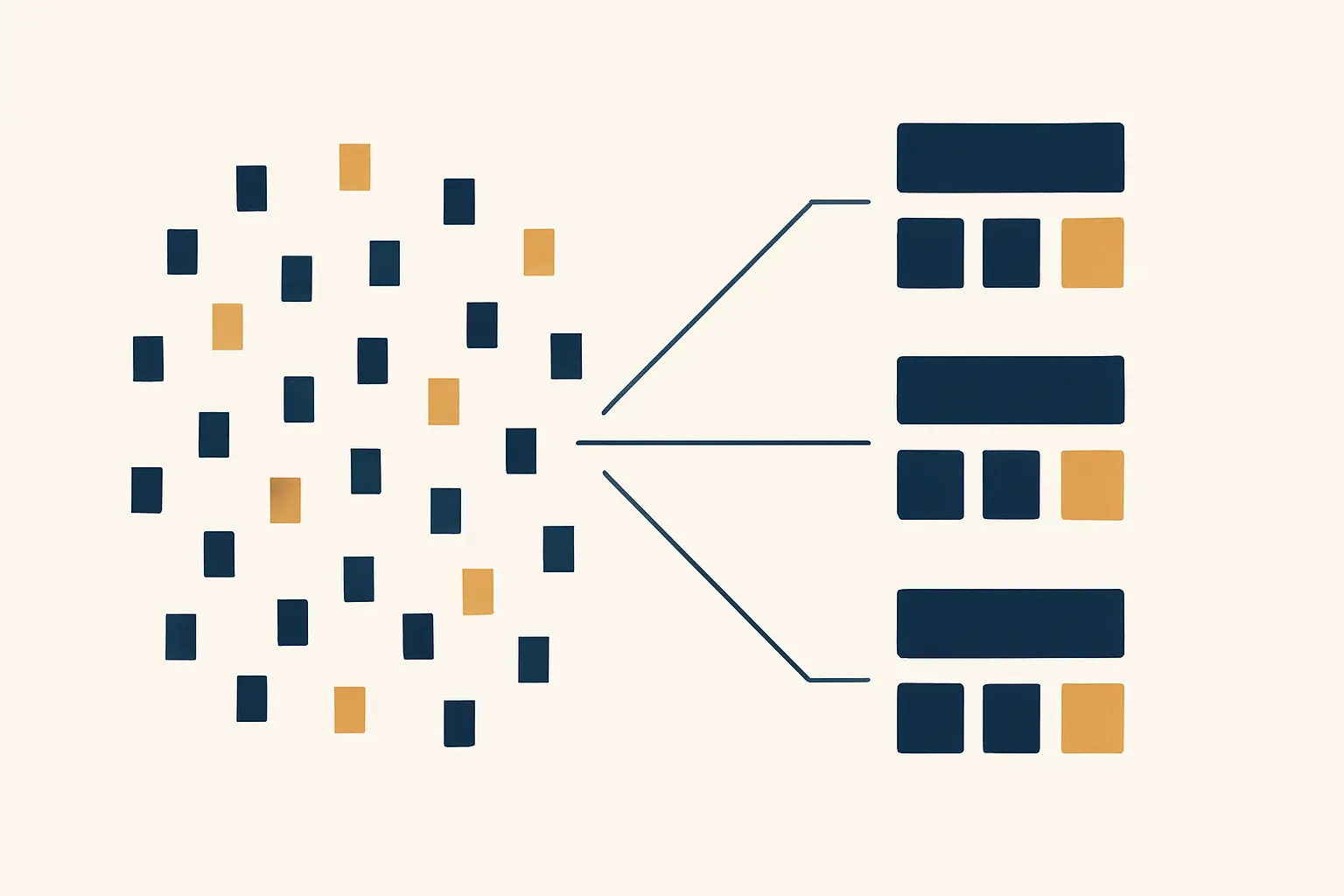
A literature review chapter is not a summary of what you read. It is an argument that ends in your research gap, built from grouped bodies of work rather than individual papers. The steps below take you from an empty search box to a finished chapter, and they front-load the part most guides skip: the search mechanics. Get the search right and the writing becomes assembly; get it wrong and no amount of good prose will hide a review that missed the three papers your examiner knows by heart. Your institute’s format manual and your research advisory committee set the final expectations for length and structure — confirm against your own ordinance.
Step 1: Write the question the review has to answer
Before you search, write one sentence: “This chapter establishes that X has been studied extensively in A and B, barely in C, and never in the Indian context of D.” You will revise it, but having a target sentence turns an open-ended reading task into a bounded one. Expected output: a single sentence, on paper, that you can show your supervisor before you spend three weeks reading.
The sentence also fixes your scope, which is what stops the review sprawling. Every paper you later consider is judged against it: does this help me establish that claim? If not, it goes in a “context” folder you may never use, not into the chapter.
Step 2: Build your search string before you touch a database
Most scholars type a phrase into Google Scholar and take what comes. That is a recipe for a review that reflects search-engine ranking rather than the literature. Build the string on paper first, in three blocks joined by AND, each block a set of synonyms joined by OR.
Worked example, for a study of digital payment adoption among small retailers:
("digital payment*" OR "mobile payment*" OR "UPI" OR "e-wallet") AND ("adoption" OR "acceptance" OR "intention to use") AND ("small retail*" OR "kirana" OR "MSME" OR "micro-enterprise*")
Four mechanics do the work here. The asterisk truncates, so retail* catches retail, retailer, retailers and retailing. Quotation marks force an exact phrase, without which the database treats your two words as two unrelated terms. Parentheses group each synonym block so AND applies between blocks, not between random words. And the local-vocabulary row — kirana, MSME, UPI — is the one that separates an Indian literature search from a generic one; the papers written about your context often do not use the international term at all. Expected output: a written string you can paste, edit and report.
Step 3: Search the databases in the right order
Run the same string across sources with different coverage, because each has a systematic blind spot.
- Scopus and Web of Science — start here if your institution subscribes. Indexed, deduplicated, with citation counts you can sort by. Access is usually through your library’s portal rather than the public site, so check with your librarian before concluding you do not have it.
- DOAJ — the Directory of Open Access Journals, free to everyone, and the practical route to open-access work you can actually read in full. At the time of writing it lists 417 journals published from India, which is a useful reminder that a substantial national open-access literature exists outside the subscription databases.
- Shodhganga — the INFLIBNET repository of Indian theses, and the single most under-used resource in Indian doctoral work. Prior theses give you full literature reviews, full instruments and full methodology chapters in your exact context. What the repository is and how deposit works is covered in our guide to Shodhganga and whether your thesis will be uploaded there.
- Google Scholar — last, not first, and used for two specific jobs: forward citation chasing (“Cited by”) and finding grey literature. Its recall is enormous and its precision is poor, which is exactly backwards from what you want early on.

Step 4: Record the search so it is reproducible
Keep a search log from the very first query. One row per search, five columns: database, exact string, date run, number of hits, number retained. It takes seconds per search and it does four things nothing else does — it stops you re-running the same query in month four, it lets you resume after a break, it gives you the raw material for a methodology paragraph, and it answers the examiner’s question “how do I know your review is comprehensive?” with evidence rather than assurance.
If your review is systematic in style, this log is also where your flow numbers come from: records identified, duplicates removed, screened on title and abstract, excluded with reasons, included. Reconstructing those numbers afterwards from memory is impossible, which is why so many otherwise good reviews quietly omit them.
Step 5: Screen in two passes, not one
Pass one is title and abstract only, against explicit inclusion criteria you wrote in Step 1. Be fast and be generous — if in doubt, keep it. Pass two is full text, and here you are strict, recording a reason for every exclusion. Splitting the work this way stops the most common failure mode, which is reading forty papers in full before realising twenty-five of them were never relevant.
Set your inclusion criteria on four axes at minimum: publication window (and a reason for it), study design, population or setting, and language. Write them down before screening starts, because criteria invented mid-screening are indistinguishable from bias.
Step 6: Build a synthesis matrix
This is the step that converts reading into structure, and it is a spreadsheet, not prose. One row per study; columns for author and year, context or country, design, sample, key construct, main finding, and — the column that earns its keep — limitation or gap noted. Fill it in as you read each paper, never afterwards.
When the matrix is populated, sort it by different columns and watch the chapter’s structure appear. Sort by construct and you see which relationships have been studied to death. Sort by context and the Indian row count tells you, in numbers, whether your gap is real. Sort by design and you may discover that everything in your area is cross-sectional survey work — which is itself a finding and a justification for your own design.

Step 7: Organise by theme, never by paper
The single clearest marker of a weak review is a chapter whose paragraphs each begin with an author’s name. Organise by approach, theme or debate — three to five groups, each becoming a section — and let each paragraph carry a claim rather than a citation.
The paragraph pattern that works: claim (a sentence stating what this body of work collectively establishes), evidence (two to four studies cited together in support, with genuine differences noted), tension or limit (what this group of studies cannot tell you), bridge (one sentence linking to the next group). Written this way, a paragraph citing six papers takes five sentences instead of six paragraphs, and the reader can see your judgement working.
Chronological organisation is the one common alternative that is sometimes correct — when the point of the section is that thinking genuinely changed over time. Use it deliberately, for that reason, and never as a default.
Step 8: End on the gap, and make it a doorway
The last section of the chapter states the gap in one sentence and then states what follows from it: the objectives, and the design your next chapter will describe. A gap that leads nowhere reads as a complaint about the literature; a gap that opens directly onto your objectives reads as a rationale.
Two cautions. First, “no one has studied X in India” is only a gap if the Indian context plausibly changes the answer — say why it does, in one clause. Second, be careful with absence claims: an empty Shodhganga search does not prove a topic is unstudied, only that this repository does not show it, and our guide to verifying a journal in India covers the related habit of checking a source’s status before you build on it.
Where this chapter sits in the wider document
The review you write in the synopsis is a compressed version of this chapter, built from the same matrix; the sequencing of that shorter document is covered in our guide to writing a PhD synopsis for your doctoral committee, and the gap sentence you draft here is the one that carries it. Two later decisions also flow directly out of the matrix: if the literature has converged on a validated instrument, you will need to report its reliability in your own sample, which is what our guide to an acceptable Cronbach’s alpha for a thesis addresses; and if your design is qualitative, the sample-size expectations set by comparable published studies are exactly the evidence base discussed in how many interviews are enough for a qualitative thesis.
Turning 120 papers into a chapter that argues
The hard part of a literature review is not reading. It is holding a hundred sources, their claims and their citations in a structure that stays coherent across the six months it takes to write, while every citation stays attached to a paper you actually opened.
Tesify builds your chapter from your own synthesis and keeps each citation bound to its real source as the document grows, so the argument you constructed in the matrix is the argument that reaches the page. The reading, the grouping and the judgement remain yours.
Start writing your literature review in Tesify
Frequently asked questions
How long should a PhD literature review chapter be in India?
Length norms are set by your institute’s format manual and vary widely by discipline. Judge completeness by whether every claim you make in later chapters has been prepared for here, not by page count.
How many references should a literature review have?
There is no fixed number, and counting is the wrong instinct. A review that groups eighty sources into four well-argued sections is stronger than one that summarises two hundred in sequence.
Should I organise chronologically or thematically?
Thematically, in almost every case. Chronological order is appropriate only when the change in thinking over time is itself the point of the section.
Can I cite theses from Shodhganga in my literature review?
Yes. Prior theses are citable sources and are often the only detailed treatment of your topic in the Indian context. Cite them with the degree and awarding university, as our APA guide sets out.
What is a synthesis matrix?
A spreadsheet with one row per study and columns for context, design, sample, construct, finding and gap. Sorting it by different columns is what reveals the structure of your chapter.
How recent do my sources need to be?
Recent enough that you have not missed a shift in the field, old enough to include the foundational work. A common pattern is comprehensive coverage of the last ten years plus the seminal older papers everyone in your area cites.
Do I need to use Boolean operators?
If you want a reproducible search, yes. AND between concept blocks, OR within them, quotation marks for phrases and an asterisk for truncation will improve both recall and precision immediately.
What if my search returns thousands of results?
Your concept blocks are too broad or you are searching full text rather than title, abstract and keywords. Restrict the field, add a third concept block, and apply your publication window.
What if it returns almost nothing?
Usually a vocabulary problem rather than an empty field. Add synonyms, including the terms used locally and in adjacent disciplines, and remove the narrowest concept block to see what the broader literature contains.
Should I include studies that contradict my expectations?
Always, and prominently. A review that only reports supportive findings is the clearest possible signal of selective reading, and it is trivially exposed at the defence.
Can I reuse my synopsis literature review in the thesis?
Yes — it is your own work, and the thesis version is the expanded form of it. Update it before submission, since the field will have moved during your candidature.
How do I avoid a high similarity score in this chapter?
The literature review is where similarity concentrates, because summarising invites near-copying. Write from your matrix rather than from the open paper, and paraphrase from your understanding of what a group of studies collectively shows.