
Start with the fact that changes everything about this task: the UGC does not prescribe your font. We read the gazette text of the UGC (Minimum Standards and Procedure for Award of Ph.D. Degree) Regulations, 2022 end to end. It contains no provision on typeface, point size, line spacing, margins, paper size, binding or page count — not one. Those rules exist, but they come from your university’s ordinance, and they differ between institutions in the same city.
What the UGC regulations do fix is a small set of things that matter more than any of the above, and that students routinely discover too late. This guide separates the two: the national requirements you cannot negotiate, then the local ones you must confirm, then the document mechanics that are true regardless.
Step 1: Confirm which rulebook applies to your document
The 2022 Regulations govern the Ph.D. thesis and nothing else. A Master’s dissertation or a taught-programme project report falls entirely under your institution’s scheme of examination, as our guide to what thesis, dissertation and project report each mean in India sets out.
Expected output: a one-line answer — “I am writing a Ph.D. thesis, so the 2022 Regulations plus my ordinance apply”, or “I am writing an M.Tech dissertation, so only my ordinance applies.” Everything below depends on which you wrote.
Step 2: Get the ordinance, not the folklore
Ask your department for the current thesis-submission ordinance or handbook as a file, in writing. Seniors’ theses are the most-used and least-reliable source of formatting rules in Indian departments, because they encode whatever was required three years ago plus whatever that scholar improvised.
Take these eleven questions to the document. They are the ones that generate re-submissions:
- Typeface and point size for body text, and for headings.
- Line spacing for body text, and for block quotations, captions and the reference list, which are often different.
- Margins, and specifically the binding-side margin, which is normally wider than the other three.
- Paper size and whether printing is single-sided or double-sided.
- Which pages carry roman numerals and where arabic numbering begins.
- The exact running order of the front matter, and whether a specimen cover page is supplied.
- Whether a word or page limit exists, and whether appendices count towards it.
- The prescribed reference style, and whether it is prescribed at all or left to the discipline.
- How many hard copies, in what binding, and to whom they go.
- The soft-copy format and file-naming convention required for submission.
- Which similarity software the institution uses and at what stage the report is generated.
Expected output: eleven written answers, saved beside your draft. If the ordinance is silent on any of them, the answer is “departmental convention” — get that in an email from your guide rather than from a senior.
Step 3: Set the page up once, before you write another chapter
Retro-fitting page setup to a finished draft breaks cross-references, re-flows tables across page boundaries and moves every figure. Do it now, in the template, and never touch it again.
Where your ordinance is silent, the conventions Indian departments most commonly apply are a serif face at 12 point for body text, 1.5 line spacing, and margins of about 1.5 inches on the binding side with 1 inch on the other three. Treat those as a default to be overwritten by your ordinance, not as a standard. They are widespread; they are not authority.
Expected output: a template file with page size, margins, default paragraph spacing and the heading styles defined, and every chapter file created from it.
Step 4: Build the front matter in a fixed running order
Orders vary by institution, but the sequence below is the one most Indian ordinances follow, and deviations from it are usually additions rather than reorderings.
- Cover page and title page
- Declaration by the scholar
- Certificate from the Research Supervisor
- Acknowledgements
- Abstract
- Table of contents
- List of tables
- List of figures
- List of abbreviations and symbols
Two practical notes. The abstract is very often word-limited by the ordinance even when nothing else is, so check that number before writing it. And the lists of tables and figures must be generated by the software from your captions, never typed — a typed list is wrong within a day of the next edit.

Expected output: every front-matter page present as its own section, with the two auto-generated lists refreshing correctly.
Step 5: Write the two documents the UGC actually requires
This is the part of the submission that is fixed nationally. Regulation 11(4) requires that a Ph.D. scholar submit the thesis for evaluation along with “(a) an undertaking from the Ph.D. scholar that there is no plagiarism and (b) a certificate from the Research Supervisor attesting to the originality of the thesis and that the thesis has not been submitted for the award of any other degree/diploma to any other Higher Educational Institution.”
Read the second one closely, because it contains two separate attestations: originality, and non-submission elsewhere. A certificate that covers only the first does not satisfy the clause.
Here is a worked declaration that contains every element the regulation names. Your department will almost certainly have its own template, which supersedes this — use it to check theirs is complete, not to replace it.
Declaration
I, [Full name], bearing registration number [number], hereby declare that the thesis entitled “[Full title of thesis]”, submitted to [University] for the award of the degree of Doctor of Philosophy in [Discipline], is the result of research work carried out by me under the supervision of [Supervisor’s name and designation]. I further declare that this thesis contains no plagiarism, that all sources used have been duly acknowledged and cited, and that this thesis has not been submitted, in whole or in part, for the award of any other degree or diploma of this or any other Higher Educational Institution.
Place: · Date: · Signature of the Research Scholar
The supervisor’s certificate mirrors it in the supervisor’s voice, attests to the originality of the work and to its not having been submitted elsewhere, and is signed and dated by the supervisor. Where the certificate must also carry the Head of Department’s counter-signature is an ordinance question, not a UGC one.
Before either document is worth signing, the similarity report has to be inside the permitted band — the thresholds are set out in our explainer on the UGC plagiarism limit for a PhD thesis, and the recovery route if yours came back high is in our guide to reducing similarity before submission.
Expected output: a signed declaration and a signed supervisor certificate, both naming the thesis by its exact final title, both dated after your final similarity check.
Step 6: Split the page numbering with section breaks
Almost every Indian ordinance numbers the front matter in lower-case roman numerals and the body in arabic numerals starting at 1. In a word processor this needs a section break, not a page break, at the end of the front matter, and the second section’s page numbering must be unlinked from the first before it is restarted.
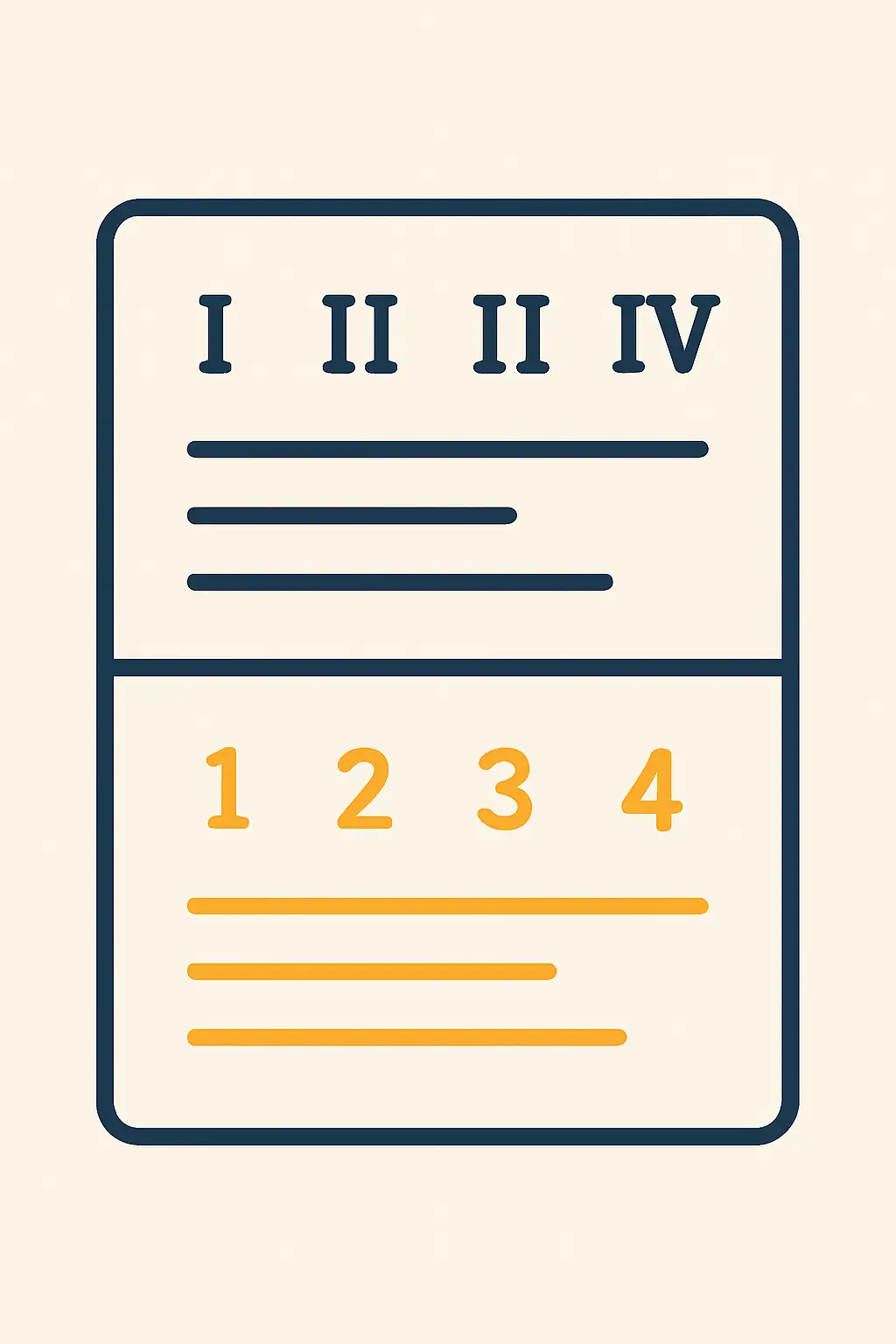
Expected output: the title page unnumbered or numbered i as your ordinance requires, front matter running in roman numerals, and Chapter 1’s first page reading 1.
Step 7: Use heading styles so the contents page builds itself
Apply a named heading style to every chapter title and every sub-heading — Heading 1 for chapters, Heading 2 and Heading 3 for the levels beneath. Do not create headings by making a line bold and larger. A hand-formatted heading is invisible to the software, so it cannot appear in a generated table of contents and cannot be cross-referenced.
Keep the hierarchy to three levels. A fourth level of numbered sub-sub-heading is where Indian theses start to read as fragmented, and examiners comment on it.
Expected output: a table of contents you can regenerate in one click, with correct page numbers, at any point in the writing.
Step 8: Number tables and figures by chapter and caption them consistently
The convention nearly all Indian departments use is chapter-based numbering: Table 4.1, Table 4.2, Figure 4.1. Table captions sit above the table; figure captions sit below the figure. Every table and figure must be referred to by number in the running text before it appears — a table that no sentence introduces will be queried.
A worked caption for a results table looks like this:
Table 4.3
Mean Perceived Service Quality Scores by Branch Category (N = 312)Note. Scores are means of a five-item summated scale. SD in parentheses.
Expected output: every table and figure numbered by chapter, captioned on the correct side, and introduced by name in the text.
Step 9: Format the reference list to one style and one style only
Ask your ordinance which style it prescribes. Many Indian ordinances name none, in which case the discipline’s convention governs and consistency is what is actually assessed. A worked APA entry for an Indian journal source looks like this:
Sharma, R., & Iyer, K. (2024). Service quality and customer retention in Indian public sector banks. Journal of Indian Business Research, 16(2), 145–162. https://doi.org/10.1000/example
The four-element structure behind that entry, the entry types you will need and the audit that catches missing references are covered in our step-by-step guide to citing in APA style for an Indian university thesis. If your department has not told you which style to use, decide before you write Chapter 2, not after.
Expected output: one style applied throughout, and a reference list where every entry has a matching in-text citation and every in-text citation has a matching entry.
Step 10: Prepare the submission package the ordinance asks for
Two things happen at the end that are national rather than local. Before submission, the scholar makes a presentation before the Research Advisory Committee, open to faculty members and other research scholars. And after evaluation, “before the announcement of the award of the Ph.D. degree(s)”, the institution submits an electronic copy of the thesis to INFLIBNET for hosting — the deposit our guide to Shodhganga explains.
The soft copy you hand over is the file that ends up in the national repository, so the version you submit should be the version you want read for the next decade. Check that the PDF’s embedded title and author metadata are correct, that all fonts are embedded, and that no tracked changes or comments survive in it.
Expected output: the number of hard copies the ordinance specifies, in the specified binding, plus a clean soft copy named as required.
A formatting checklist you can run in twenty minutes
- Margins match the ordinance, binding side included.
- Front matter present, in order, in roman numerals.
- Chapter 1 page 1 in arabic numerals after a section break.
- Table of contents, list of tables and list of figures all auto-generated and refreshed.
- Declaration and supervisor certificate signed, dated, and naming the final title exactly.
- Every table and figure numbered by chapter, captioned on the correct side, introduced in the text.
- One reference style throughout, with a two-way match between citations and entries.
- Similarity report generated on the final file, not an earlier draft.
- PDF metadata correct, fonts embedded, no comments or tracked changes.
Keeping the format from drifting
Formatting fails at the end because the document was assembled at the end — five chapter files with five sets of habits, merged the week before submission. Tesify keeps chapter structure, headings and references consistent while you draft, so the last week is a check rather than a rebuild, and every citation still points at the source you actually read.
Set up your thesis structure in Tesify
Frequently asked questions
What font does the UGC require for a thesis?
None. The UGC Ph.D. Regulations, 2022 contain no provision on typeface, point size, spacing, margins or paper size. Those rules come from your university’s ordinance. Where the ordinance is silent, a 12-point serif face at 1.5 spacing is the most common Indian convention.
What does the UGC actually require with the thesis?
Two documents: an undertaking from the scholar that there is no plagiarism, and a certificate from the Research Supervisor attesting both to the originality of the thesis and to its not having been submitted for any other degree or diploma elsewhere.
What margins should an Indian thesis have?
Whatever your ordinance states. The widespread convention is about 1.5 inches on the binding side and 1 inch on the other three, but this is departmental practice rather than a national rule, so confirm it before you typeset.
Is the front matter order fixed?
By your institution, not by the UGC. The common Indian order is cover and title page, declaration, supervisor’s certificate, acknowledgements, abstract, table of contents, list of tables, list of figures, list of abbreviations.
Should page numbers restart at the first chapter?
In most Indian ordinances yes: roman numerals through the front matter, then arabic numerals restarting at 1 on the first page of Chapter 1. Use a section break, not a page break, and unlink the sections before restarting.
How long should a PhD thesis be in India?
No UGC regulation sets a length. Indian departments commonly see theses of 150 to 300 pages, but if your handbook states a limit, that limit is the rule and you should check whether appendices count towards it.
Which citation style is required for an Indian thesis?
There is no national requirement. Many ordinances name a style; where none is named, discipline convention decides and internal consistency is what is assessed.
Do I write the declaration myself?
Most departments issue a template, and where they do, use it. If yours does not, your declaration must state that the work is your own, that there is no plagiarism, and that the thesis has not been submitted for any other degree or diploma.
Can I use a thesis template downloaded from another university?
Only as a starting shape. Margins, front matter and numbering conventions differ between Indian universities, and a template built for a different ordinance is a set of decisions you did not make.
Does formatting affect the similarity report?
Indirectly. What is excluded from the check — the reference list, quoted material, standard front matter — depends on how the report is configured, so ask which exclusions your institution applies before reading a percentage as final.
What file should I submit as the soft copy?
The exact file that will be deposited with INFLIBNET after evaluation. Confirm the format and naming convention with your department, embed all fonts, and remove comments and tracked changes before you hand it over.