The empirical studies cluster between roughly 9 and 30 interviews, and where you land inside that range is decided by how homogeneous your participants are and how narrowly your research question is drawn — not by a rule. A tightly focused study of one professional group can saturate by 12. A study spanning four stakeholder groups will not saturate at 12 no matter how well you interview.
This question arrives twice in a doctoral candidature and it hurts both times. First at the proposal stage, when a committee member asks how you arrived at your planned sample. Then again after data collection, when an examiner asks how you knew you had enough. The honest answer to both is the same, and it is not a number. It is a procedure you followed and can describe.
What does the published evidence actually say?
Three findings do most of the work here, and it is worth knowing them precisely rather than as folklore.
Guest and colleagues, in the study most often cited on this question, found that six interviews were enough to surface high-level themes, with the pattern reaching a plateau at ten to twelve interviews. Young and Casey found near code saturation at six to nine. And a 2024 secondary analysis published in the Journal of Medical Internet Research by Squire and colleagues, drawing on five studies with samples of 30 to 70 web-based interviews, reported that true saturation was reached only after 91 to 100 per cent of the planned interviews — that is, at 30 to 67 interviews — while near saturation arrived much earlier, after 33 to 60 per cent of them, at 15 to 23 interviews.
Read those numbers together and the apparent contradiction dissolves. Small numbers get you the big themes. Large numbers get you the last few codes. The question your design has to answer is which of those two you actually need.
Why is the range so wide?
Because saturation is a property of the fit between your sample, your question and your analysis — not a property of interviewing. Four factors move the number, and every one of them is under your control at the design stage.
- Homogeneity of the sample. Participants who share a role, a setting and a vocabulary repeat each other quickly. Every additional stratum — a second city, a second cadre, a second language of instruction — is effectively a second study that needs its own saturation.
- Breadth of the research question. “How do first-generation research scholars at one central university experience supervision?” saturates. “How do Indian postgraduates experience higher education?” does not.
- Structure of the interview guide. The 2024 JMIR analysis found that studies with a more structured interview guide reached both true and near saturation sooner. A guide that asks everyone the same core questions produces comparable data; a purely conversational approach produces richer but slower-converging data.
- Coding approach. The same analysis found that studies relying heavily on deductive coding saturated sooner. If your codebook is largely derived in advance from your framework, you will stop finding new codes earlier than a colleague coding inductively from scratch.

What kind of saturation are you claiming?
This is the distinction that separates a scholar who has read the literature from one who has read a blog post, and committees notice. Hennink and colleagues distinguish code saturation from meaning saturation. Code saturation is about quantity — you have heard it all, no new codes are appearing. Meaning saturation is about quality — you understand it all, each code is now richly enough developed to explain rather than merely label.
Code saturation arrives first, and often much earlier. Meaning saturation takes longer and is the more honest standard for doctoral work, because a thesis is expected to explain, not to inventory. If you write “data saturation was achieved” without saying which kind, you have invited the question.
How do I actually justify my number in the methodology chapter?
Stop treating saturation as something asserted after the fact and start treating it as a monitored, reportable quantity. Guest, Namey and Chen published a method for exactly this in PLoS One in 2020, and it is the most useful thing a qualitative thesis writer can borrow, because it turns a rhetorical claim into three declared parameters:
- Base size. The minimum number of interviews you will analyse first to establish the body of information against which “new” is judged — the denominator. You state it in advance.
- Run length. How many consecutive subsequent interviews you will examine when checking whether new information is still arriving. A single quiet interview is noise; a run of three or four is evidence.
- New information threshold. The proportion of new information, relative to the base, below which you will call saturation.
Declare all three in your methodology chapter, apply them, and report what happened. “Saturation was assessed using a base size of the first nine interviews, a run length of three, and a new information threshold of five per cent; no new codes meeting the threshold appeared after interview 17, and three further interviews were conducted to confirm.” That sentence ends the conversation. “Saturation was achieved” starts one.
What if I cannot reach that many interviews?
This is the real situation for many Indian research scholars — a hospital that grants access to eleven consultants, a firm that permits eight, a village panchayat cluster where the eligible population is fourteen people. Under-recruiting against a plan looks like failure. It usually is not, provided you handle it in the open.
Three moves protect you. Report the population, not just the sample: eight interviews out of a total eligible population of eleven is a census-like coverage that no reader can call thin, but only if you say so. Report access as a finding: if institutional gatekeeping shaped your sample, that is data about the field and belongs in your limitations and often in your discussion. Add a second data source: documents, observation notes, or a focus group triangulate a small interview set and are usually far easier to obtain than more interviews. Where to find institutional documents and datasets that can serve this purpose is covered in our guide to official data sources for an Indian thesis.
Does the same logic apply to focus groups?
The arithmetic is different because each group is a data collection event containing several voices, and the published saturation figures for focus groups are correspondingly smaller — typically a handful of groups rather than a couple of dozen sessions. The design logic, though, is identical: homogeneity within groups, comparability across them, and a declared rule for when you stop. If your study mixes individual interviews and focus groups, treat them as two strands, each needing its own adequacy argument, and say in the methodology chapter how the two were integrated in analysis.
What will the committee actually ask?
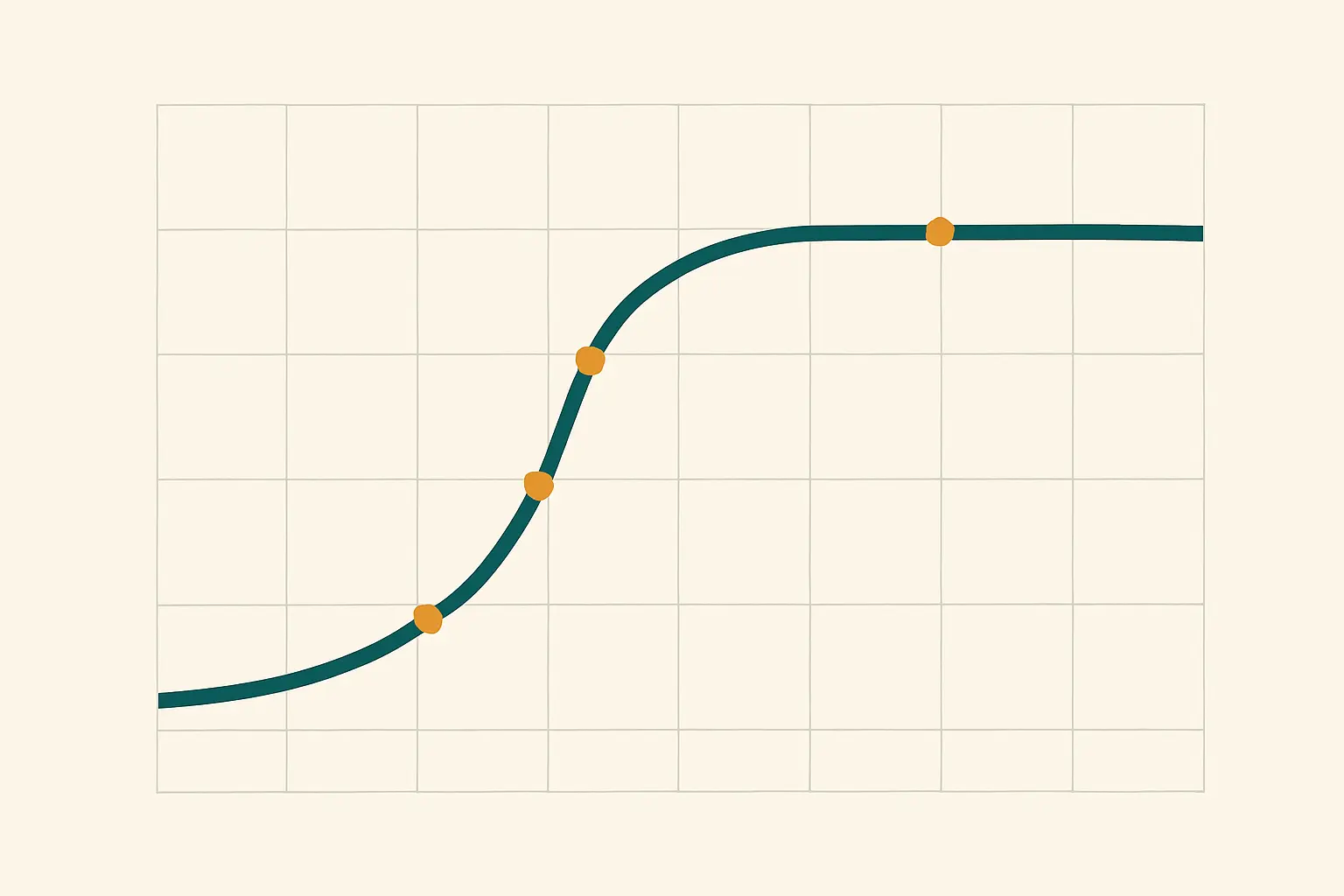
Not “why 18?” but “how did you know?” — and then, if your answer is thin, a follow-up about what you would have found in interview 19. The scholars who handle this well have a specific artefact ready: a short table showing the number of new codes generated by each successive interview, which makes the plateau visible at a glance. It takes an hour to produce from your coding software and it converts an argument into a picture.
Expect the second question too: whether your sample was purposive and on what criteria. Saturation claims collapse if the sampling was convenience-based and homogeneous by accident, because then the absence of new codes may reflect the narrowness of who you could reach rather than the completeness of your account. Name your sampling strategy and your inclusion criteria explicitly. The defence itself, where these specifics get tested by examiners who have read the whole thesis, is described in our guide to what happens in a PhD viva voce in India.
Turning transcripts into a chapter you can defend
The gap between a good interview set and a good findings chapter is organisational, not intellectual. Codes drift, quotations lose their speaker IDs, and the audit trail that would have made the saturation argument easy dissolves over eight months of part-time analysis. Keeping the chain intact from transcript to code to quotation to claim is what makes the chapter defensible.
Tesify keeps your chapters structured and every citation and source attached as you draft, so the argument you build from your interviews stays traceable back to the material it came from. The analysis and the interpretation stay entirely yours. If you are still shaping the study around the sample, the sequencing in our guide to writing a PhD synopsis for your doctoral committee shows where the sampling justification belongs.
Start writing your findings chapter in Tesify
Frequently asked questions
How many interviews are enough for a PhD thesis?
Published empirical studies find saturation between roughly 9 and 30 interviews, with narrower, more homogeneous studies at the low end. The defensible answer for your thesis is the number produced by a declared saturation procedure, reported as such.
Is 12 interviews enough?
It can be, for a tightly focused question and a homogeneous sample — Guest and colleagues found a plateau at ten to twelve. It is unlikely to be enough for a study spanning several participant groups or a broad exploratory question.
What is data saturation in simple terms?
The point at which additional interviews stop producing information that changes your analysis. It is judged against your codebook and your research question, not against a target number.
What is the difference between code saturation and meaning saturation?
Code saturation means no new codes are appearing — hearing it all. Meaning saturation means each code is developed richly enough to explain rather than just label — understanding it all. Meaning saturation takes longer and is the more appropriate doctoral standard.
Can I state my sample size in the proposal before collecting data?
Yes, and you should — as a planned range with a stopping rule, not as a fixed figure. “Approximately 18 to 25 interviews, with recruitment continuing until the declared saturation criteria are met” is both honest and reviewable.
Do I need a sample size calculation for qualitative research?
No. Statistical power calculations apply to hypothesis testing on numerical data. Qualitative adequacy is argued through sampling strategy, saturation and the fit between sample and question.
What if new themes are still appearing at my last interview?
Say so. An honest statement that saturation was not fully achieved, with the reason and the consequence for your claims, is a stronger position than an unsupported assertion that it was. It also gives you a genuine direction for future research.
How many interviews for a Master’s dissertation rather than a PhD?
Fewer, because the scope of the claim is smaller and the timeline shorter, but the reasoning is identical. Check your department’s own guidance first, since some programmes set an expected minimum in the ordinance.
Does interview length affect how many I need?
Substantially. Ninety-minute in-depth interviews yield far more codeable material per participant than twenty-minute ones, so a study of short interviews will need more of them to reach the same coverage.
Should I report the number of new codes per interview?
It is one of the most persuasive things you can include. A short table or simple chart showing new codes declining across successive interviews makes the saturation claim visible instead of asserted.
Do focus groups need the same number as interviews?
No — each group contains several participants, so published saturation figures for focus groups are considerably smaller in number of sessions. The requirement for a declared stopping rule is the same.
Where can I read these studies myself?
The 2024 secondary analysis by Squire and colleagues in the Journal of Medical Internet Research and the 2020 method paper by Guest, Namey and Chen in PLoS One are both open access. Reading the second one before you write your methodology chapter will save you an argument later.