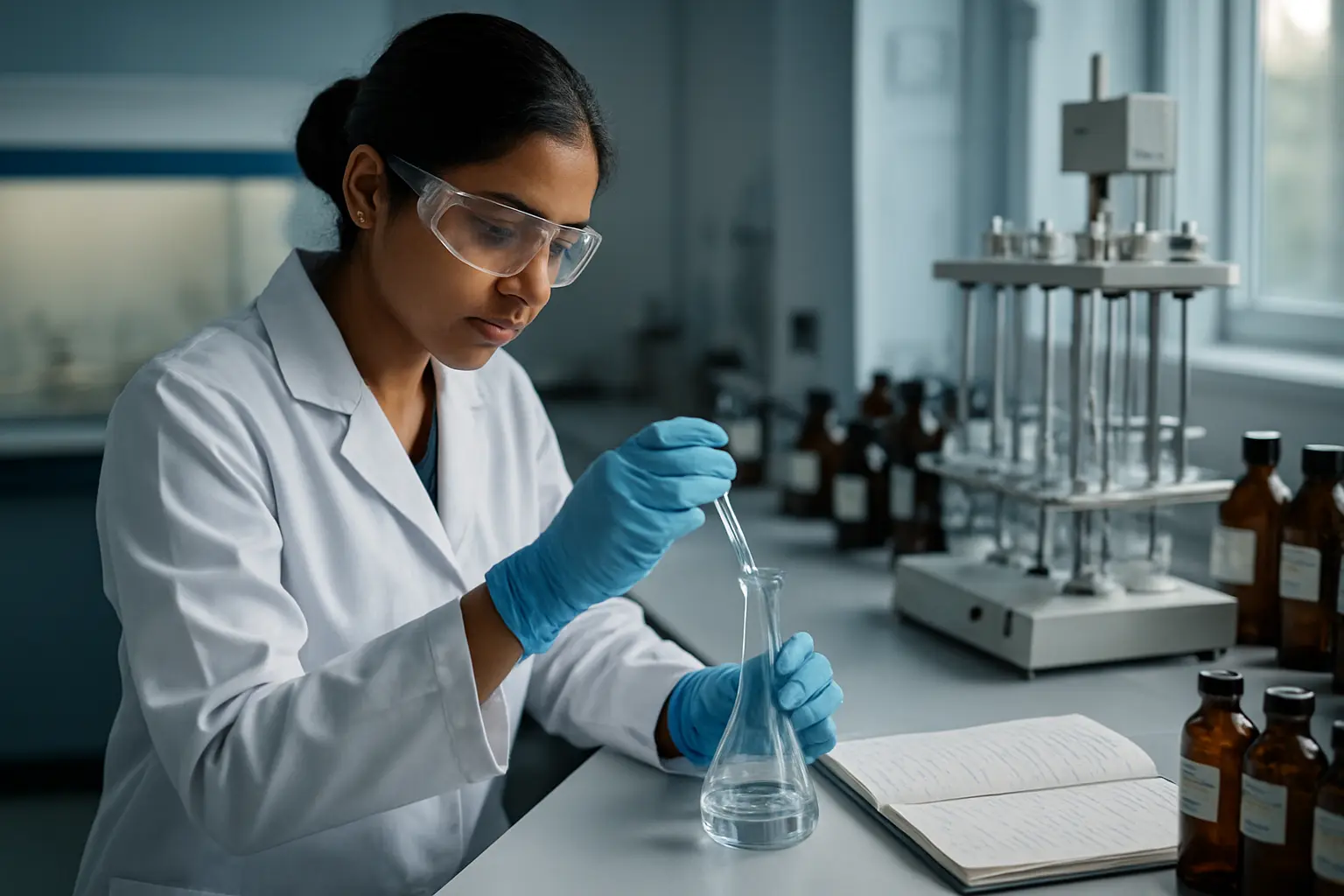
Your examiner reads the Materials and Methods chapter differently from every other chapter. They are not looking for argument or insight. They are running one test, line by line: could a competent pharmacy postgraduate repeat this work from what is written here, and get the same result? Every correction handed back on this chapter traces to a place where the answer was no.
This guide walks through the chapter in eight steps, in the order you should write them. It applies across M.Pharm specialisations — Pharmaceutics, Pharmaceutical Chemistry, Pharmacology, Pharmacognosy, Pharmacy Practice and Quality Assurance — with the specialisation-specific requirements flagged as they arise. Your institution’s own dissertation format, approved under the Pharmacy Council of India norms and your university’s ordinance, is the final authority; confirm the section numbering against it before you format.
Step 1: Write the materials list with grade, supplier and city
Start here because it is mechanical and it gets the chapter moving. Every chemical, reagent, excipient and solvent used in the work is listed with three attributes: its name, its grade, and its source.
Expected output: a table with columns for the material, its grade or specification, and the supplier with the city. For example: “Hydroxypropyl methylcellulose K4M, pharmaceutical grade, gifted by [manufacturer], Mumbai” or “Methanol, HPLC grade, Merck Life Science Pvt. Ltd., Mumbai”.
Three rules that prevent corrections:
- Grade is not optional. Analytical reagent, laboratory reagent and HPLC grade are different materials for the purposes of your result. A method run with LR-grade solvent and reported as HPLC-grade is a reproducibility failure.
- Gift samples must say so. If the API was received as a gift sample from a pharmaceutical company, state that, and acknowledge the company in your acknowledgements. This is normal practice in Indian M.Pharm work and hiding it looks worse than declaring it.
- Water is a material. “Distilled water”, “double distilled water” and “Milli-Q water” are different specifications and matter in analytical work.
Step 2: List instruments and equipment with make and model
Expected output: a second table listing each instrument with its make and model number, and for major analytical instruments, the software version used for acquisition or processing.
“UV-Visible spectrophotometer” is not sufficient. “UV-Visible double beam spectrophotometer, Shimadzu UV-1800, with UV Probe software” is. The same applies to your FTIR, DSC, HPLC system with its column dimensions and particle size, dissolution apparatus with its type designation, tablet hardness tester, friability tester and analytical balance with its readability.
For a Pharmacognosy dissertation, add the authentication details of the plant material: the botanical name with the authority, the place and month of collection, the name of the taxonomist who authenticated it, and the herbarium voucher specimen number. That voucher number is the equivalent of a batch number for a natural product and examiners look for it specifically.
Step 3: Put the approval numbers in before the protocols
If your work involves animals or human participants, the ethical approvals belong at the head of the methods, not buried in an appendix.
- Animal studies: state that the protocol was approved by the Institutional Animal Ethics Committee, give the approval reference number and date, and cite the CPCSEA registration number of the animal house facility. Give the species, strain, sex, age and weight range, the number of animals per group, the housing conditions including temperature, humidity and light cycle, and the acclimatisation period.
- Human participants: state Institutional Ethics Committee approval with number and date, the informed consent procedure, and, for an interventional clinical study, the Clinical Trials Registry – India registration number. Pharmacy Practice dissertations conducted in hospital settings also need the written permission of the institution where data was collected.
Approvals must be dated before your data collection began. A committee cannot approve retrospectively, and a reader can compare the dates. If you are still in the approval queue, our step-by-step guide to obtaining ethics committee clearance for an Indian thesis covers the documents required and realistic timelines.
Step 4: Write the preformulation and characterisation methods
For a Pharmaceutics dissertation this is the first block of actual protocol. Each study gets its own numbered sub-section, and each sub-section follows the same internal shape: purpose in one sentence, apparatus and conditions, procedure, and the parameter computed.
A worked example for drug-excipient compatibility:
“3.4.2 Drug-excipient compatibility by FTIR. Physical mixtures of the drug and each excipient were prepared in a 1:1 ratio and stored at 40 °C ± 2 °C and 75% RH ± 5% RH for four weeks in screw-capped vials. Spectra of the pure drug, the individual excipients and each stored mixture were recorded on an FTIR spectrophotometer over the range 4000-400 cm⁻¹ using the KBr disc method. Characteristic peaks of the drug were compared across spectra; the appearance of new peaks or the disappearance of characteristic peaks was taken as evidence of interaction.”
Note what the last sentence does. It states the decision rule — what observation would count as a positive finding — before any data existed. Method sections that omit the decision rule invite the viva question “how did you decide that was an interaction?”
Step 5: Write the formulation method with the design, not just the batches
Expected output: a formulation table listing every batch code against its composition in mg or percentage, preceded by a paragraph explaining how the batches were chosen.
If you used a factorial or optimisation design — a 3² full factorial, a Box-Behnken design, a central composite design — name it, name the independent variables with their coded and actual levels, name the dependent variables, and name the software used to generate and analyse the design. If you used trial and error, say that too; it is honest and it is common in a one-year dissertation. What examiners object to is a formulation table of nine batches presented as if the levels were self-evident.
Then describe the preparation procedure in enough detail to repeat: quantities, order of addition, mixing speed in rpm and duration, temperature, drying conditions, sieve number, compression force or capsule size.
Step 6: Write the analytical method and validate it to ICH
Whatever you are measuring, the method that measures it has to be shown to work. For a UV or HPLC assay, this means a validation sub-section built on the ICH Q2 framework, covering specificity, linearity and range, accuracy through recovery studies, precision as repeatability and intermediate precision, limit of detection, limit of quantitation, and robustness.
Each parameter needs its protocol and its acceptance criterion stated in advance. For example: “Precision was assessed by analysing six replicate determinations at 100% of the test concentration on the same day (repeatability) and on three consecutive days by a different analyst (intermediate precision). The acceptance criterion was a relative standard deviation of not more than 2%.”
For a chromatographic method, give the full chromatographic conditions as a table: column with dimensions and particle size, mobile phase composition and ratio, pH and buffer, flow rate, injection volume, detection wavelength, column oven temperature and run time. A reader who cannot reconstruct your chromatogram from that table will say so in the report.
Step 7: Write the evaluation and stability protocols
Evaluation parameters depend on the dosage form — hardness, friability, weight variation, disintegration and dissolution for tablets; particle size, entrapment efficiency, zeta potential and in-vitro release for nanoparticulate systems; viscosity, spreadability and pH for semisolids. Each one gets the same treatment: apparatus, conditions, number of units tested, calculation, and the pharmacopoeial limit against which you judged it, with the pharmacopoeia named.
For dissolution, the specification must be complete: apparatus type, rotation speed in rpm, dissolution medium and its volume, temperature maintained at 37 °C ± 0.5 °C, sampling time points, volume withdrawn and replaced, filtration, and the analytical method used to quantify the sample. Half-specified dissolution methods are the most common reproducibility gap in Indian M.Pharm dissertations.
For stability, state the ICH storage condition you used, the duration, the container-closure system, the time points at which samples were withdrawn, and the parameters re-tested at each point. Accelerated testing at 40 °C ± 2 °C and 75% RH ± 5% RH is the usual choice within a one-year dissertation timeline; say why you chose it and acknowledge what a short accelerated study can and cannot establish.
Step 8: Close with the statistical analysis paragraph
A short final sub-section names the software with its version, the tests applied to each comparison, the significance level, and how results are expressed — usually mean ± standard deviation with n stated. Name the post-hoc test if you ran an ANOVA. If you fitted release kinetics models, name them and name the criterion used to select the best fit.
One sentence that prevents a common objection: state whether the data were checked for normality and what you did if they were not. The conventions for presenting the resulting tables and figures are covered in our guide to writing the results chapter with properly formatted tables.
A worked citation example for a pharmacy dissertation
Most Indian pharmacy departments use Vancouver style, in which references are numbered in order of first appearance and the number appears in the text as a superscript or in square brackets. A journal reference takes this form:
1. Sharma R, Patel MK, Nair S. Formulation and in-vitro evaluation of sustained release matrix tablets of metformin hydrochloride. Indian J Pharm Sci. 2023;85(4):712-9.
Note the abbreviated journal title, no italics required, authors’ initials without full stops, and the abbreviated page range. A guideline document is cited by its issuing body: 2. International Council for Harmonisation. Validation of analytical procedures. ICH harmonised guideline Q2(R2). Geneva: ICH; 2023.
If your department has specified APA instead, the element order changes completely — our worked guide to citing in APA style for an Indian university thesis covers that pattern. Confirm which style your ordinance requires before you build the reference list, not after.
Formatting, similarity and the two mistakes that cost marks
Methods chapters attract high similarity scores, because standard procedures are described in standard words across thousands of published papers. This is expected, but it still has to be handled: describe your own parameters rather than copying a published protocol paragraph, cite the source method where you adopted one, and check the report before your department does. The recovery steps are set out in our guide to bringing a similarity report under the permitted limit.
The two mistakes that most often come back from evaluation are writing methods in the future tense — carried over from the synopsis, where “will be prepared” was correct and now must become “were prepared” — and reporting a result inside the methods chapter. Keep every number that came out of an experiment in Chapter 4. Chapter 3 says what was done, never what was found.
Page layout, margins, font and the front-matter order follow your university’s rules, summarised for the Indian context in our guide to formatting a thesis to UGC norms. Scholars in engineering departments writing an equivalent chapter may also find the structure comparison in our M.Tech dissertation report guide useful.
Write the chapter while the last batch is still on stability
Materials and Methods is the one chapter you can finish before your results are in — it describes decisions already taken and experiments already run. Tesify turns your lab notebook entries, batch tables and protocol notes into a structured chapter in your department’s format, with the references numbered as you write, so the chapter is done before the stability study reports out.
Draft your Materials and Methods chapter with Tesify and take one chapter off the deadline.
Frequently asked questions
Should the Materials and Methods chapter be written in the past tense?
Yes. The work has been done, so it is reported in the past tense and conventionally in the passive voice: “the tablets were compressed”, not “we compress the tablets”. The most common cause of tense errors is copying the protocol across from the approved synopsis, which was written in the future tense. Run a search for “will be” through the chapter before submission.
How long should the Materials and Methods chapter of an M.Pharm dissertation be?
Length is set by the number of experiments, not by a page target — commonly 20 to 40 pages in a laboratory-based dissertation once the materials tables, formulation tables and validation protocols are included. No university ordinance we know of prescribes a length for this chapter. Completeness is the criterion.
Do I need IAEC approval if I only used a cell line?
Established cell lines are generally outside the remit of the animal ethics committee, but your institution may still require an institutional biosafety clearance, and you must document the source and passage number of the cell line. Work involving primary cells taken from animals does require animal ethics approval. Ask your institution’s committee rather than assuming.
Can I cite a published paper instead of writing out a standard method?
You can cite the source of a method, and you should. But you must still state the parameters you actually used, because you will almost certainly have changed something — a concentration, a wavelength, a time point. The correct form is “the method described by [author] was followed with modifications”, immediately followed by the modified parameters in full.
Where do calibration curves belong, in methods or results?
The procedure for constructing the calibration curve — the concentration range, the number of levels, the replicates, the solvent, the wavelength — belongs in methods. The resulting curve, the regression equation and the correlation coefficient are results and belong in Chapter 4.
Is a six-month stability study compulsory for an M.Pharm dissertation?
No. Full accelerated stability testing runs for six months under the ICH framework, but that is a regulatory expectation for a product dossier, not a dissertation requirement. Many dissertations report one to three months of accelerated data because of the academic timeline. State the actual duration honestly and note the limitation in your discussion rather than implying a complete study.
How do I present a formulation table for an optimisation design?
Give two tables. The first maps the coded levels of each independent variable to their actual values. The second lists every batch by code against its coded combination and its actual composition in milligrams. That pair lets a reader reconstruct the design and the batches without ambiguity, which one combined table rarely achieves.
Should the plagiarism-prone standard procedures be paraphrased heavily?
Do not distort a method to lower a percentage. Technical procedures have precise vocabulary and mangling it makes the method wrong. Write the procedure with your own parameters, cite the source you adapted, and let the similarity report show what it shows — a methods chapter with legitimate technical overlap, correctly cited, is defensible to a departmental screening committee.