
The UGC guidelines for PhD are the UGC (Minimum Standards and Procedures for Award of Ph.D. Degree) Regulations, 2022, notified on 7 November 2022 in the Gazette of India. Superseding the 2016 regulations, these rules set the minimum national standards for admission, coursework, supervision, thesis evaluation, viva voce, and repository deposit across Indian higher education institutions.
As you move from coursework and synopsis approval to writing your chapters, Tesify helps you structure your thesis chapter by chapter, and every word stays 100% written by you.
What do the 2022 UGC guidelines for PhD say at each stage of your degree?
Every research scholar registered or preparing to register at an Indian university is governed by two layers of rules: the national baseline published in the UGC (Minimum Standards and Procedures for Award of Ph.D. Degree) Regulations, 2022, and the university-specific PhD ordinance approved by the institution’s academic council or research board. The table below summarises the mandatory baseline rules from the 2022 Gazette notification across every stage of your doctoral programme.
| Rule | What the 2022 regulations say | Regulation number |
|---|---|---|
| Programme duration and extensions | Minimum 3 years (including coursework) and maximum 6 years from admission; up to 2 additional years via re-registration (maximum 8 years); further 2-year relaxation for women scholars and persons with more than 40% disability (maximum 10 years); up to 240 days of maternity or child care leave for women scholars. | Regulation 4 |
| Admission procedure | Admission via national fellowship tests (NET, CSIR-NET, GATE, CEED and similar national tests) based on an interview, and/or a university entrance test (50% research methodology, 50% subject-specific; 50% qualifying marks with 5% relaxation for reserved categories; 70% test and 30% interview weightage). | Regulation 5 |
| Supervisor eligibility | Permanent Professor or Associate Professor with a Ph.D. and at least 5 publications in peer-reviewed or refereed journals; permanent Assistant Professor with a Ph.D. and at least 3; recognised supervisors guide only in their own university or its affiliated PG colleges. | Regulation 6 |
| Coursework requirements | Minimum 12 credits including courses on Research and Publication Ethics and research methodology; minimum 55% marks (or equivalent grade on the UGC 10-point scale) required to continue and submit the thesis; training in teaching, pedagogy, and writing with 4–6 hours per week of assistantship. | Regulation 9 |
| Research Advisory Committee (RAC) | Committee convened by the supervisor for each scholar to review the proposal, finalise the topic, guide methodology, and review semester progress reports; unsatisfactory progress can lead to cancellation of registration. | Regulation 10 |
| Pre-submission and submission | Open pre-submission presentation before the RAC, faculty, and research scholars; plagiarism check via institutional software; submission with scholar’s undertaking of no plagiarism and supervisor’s certificate of originality. | Regulation 11 |
| Thesis evaluation and viva voce | Evaluation by the supervisor and at least two external examiners outside the institution (one from outside India wherever possible); open viva voce (in-person or online) only if both external examiners (or an approved alternate if one rejects) recommend acceptance; entire evaluation completed within 6 months of submission. | Regulation 11 |
| Part-time and distance mode rules | Part-time PhD permitted if eligibility conditions are met and a No Objection Certificate (NOC) is provided by the employer; PhD through distance and/or online mode is prohibited. | Regulation 13 |
| M.Phil. programme status | Higher educational institutions shall not offer the M.Phil. programme. | Regulation 14 |
| Provisional certificate | Issued by the degree-granting institution prior to the actual award of the degree, certifying compliance with the 2022 regulations. | Regulation 15 |
| Repository deposit | Electronic copy of the thesis submitted by the institution to INFLIBNET (hosted on Shodhganga) after evaluation and before announcing the award. | Regulation 17 |
How does PhD admission work under Regulation 5?
Under Regulation 5 of the 2022 UGC regulations, Indian universities admit doctoral candidates through two recognised channels. First, candidates who qualify for fellowship or scholarship in UGC-NET, UGC-CSIR NET, GATE, CEED, or similar national-level tests may be admitted directly on the basis of an interview. Second, universities may conduct their own entrance test for PhD admission.
When a university conducts an entrance test, the syllabus must consist of 50% research methodology and 50% subject-specific questions. Candidates must score at least 50% marks in the entrance test to be called for the interview. The regulations grant a 5% relaxation in qualifying marks (bringing the threshold from 50% to 45%) for candidates belonging to SC, ST, OBC, differently-abled, Economically Weaker Section (EWS), and other categories of candidates as notified by the Commission from time to time. For candidates admitted through the university entrance test, the final merit list must give 70% weightage to the entrance test score and 30% weightage to performance in the interview or viva voce.
Consider a postgraduate in chemistry applying to a state university through its entrance test (illustrative). After scoring above the qualifying threshold on a paper split evenly between chemical sciences and research methodology, the candidate presents a preliminary research interest before the departmental admission committee, where the interview accounts for 30% of the final selection score. While the UGC fixes the 50:50 syllabus split and the 70:30 selection weightage, your university decides the application calendar, seat matrix, and whether a written research synopsis is required at the interview stage.
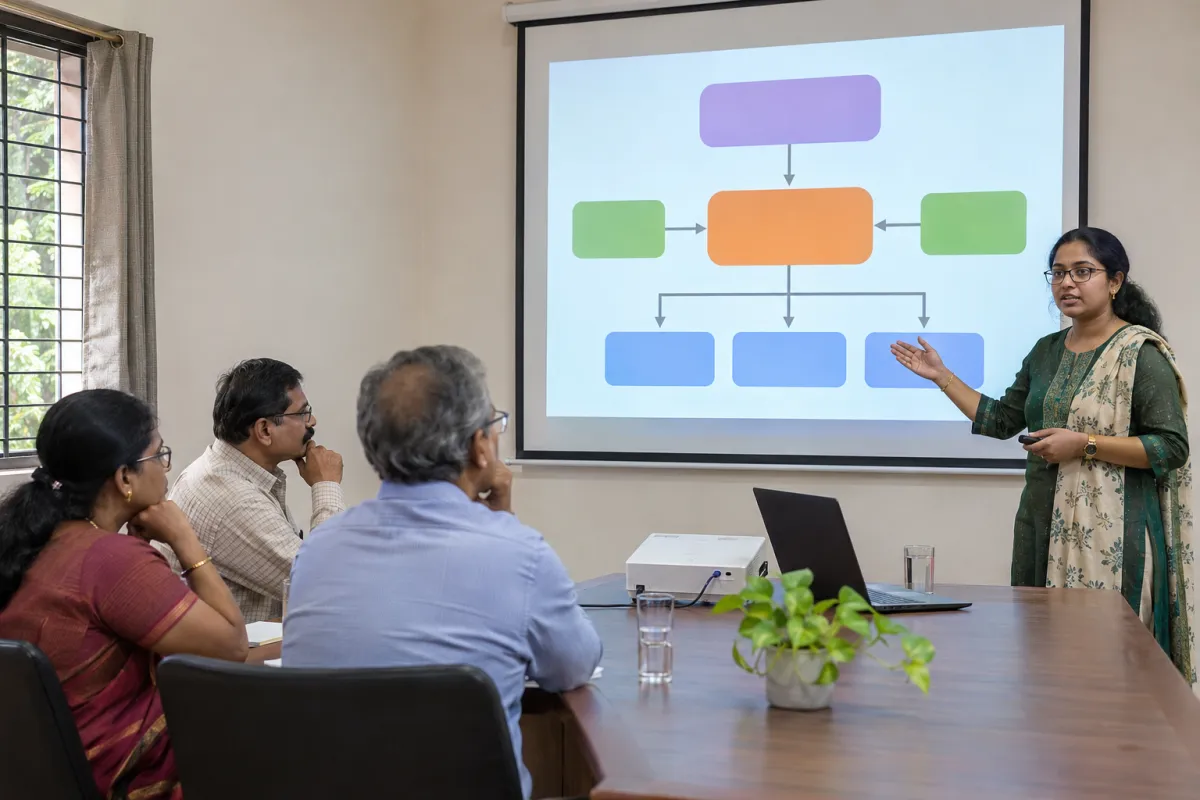
How long does a PhD take under Regulation 4, and what are the part-time rules under Regulation 13?
Regulation 4 sets the duration of the Ph.D. programme from the date of admission, which includes the time spent on coursework, to a minimum of three years and a maximum of six years. If a research scholar needs additional time beyond six years to complete the thesis, the institution may grant up to two more years through a process of re-registration according to the university’s statute or ordinance, provided that the total period to complete the Ph.D. programme does not exceed eight years from the date of admission.
The regulations provide further time relaxations for two specific groups. Women research scholars and persons with disabilities (having more than 40% disability) may be allowed an additional relaxation of two years, subject to a maximum total duration of ten years for completing the degree. In addition, women research scholars may be granted maternity leave or child care leave for up to 240 days in the entire duration of the Ph.D. programme. You can read a full breakdown of how extensions and leave periods are calculated in our guide on PhD duration in India under the UGC regulations.
Under Regulation 13, part-time Ph.D. programmes are permitted, provided that all the admission, coursework, supervision, and evaluation conditions stipulated in the regulations are met. A candidate registering for a part-time Ph.D. must submit a No Objection Certificate (NOC) from the appropriate authority in the organisation where the candidate is employed, confirming that the employee is permitted to pursue studies on a part-time basis, that official duties permit sufficient time for research, and that, if required, the candidate will be relieved from duty to complete the coursework. Regulation 13 also explicitly prohibits universities from offering Ph.D. programmes through distance and/or online mode.
What does an illustrative 3-to-6-year timeline look like for a full-time research scholar?
While individual progress varies by discipline and university ordinance, a full-time research scholar’s journey from admission to degree award typically follows a structured sequence across three to six years (illustrative):
- Semester 1 (Months 1–6): Admission completion, supervisor allocation, constitution of the Research Advisory Committee (RAC), and completion of the mandatory 12-credit coursework (including Research and Publication Ethics and research methodology) with at least 55% marks.
- Semester 2 (Months 7–12): Literature survey, formulation of the research proposal or synopsis, presentation before the RAC to finalise the research topic and methodology, and first semester progress report.
- Semesters 3–4 (Year 2): Primary data collection, laboratory experimentation, archival fieldwork, or model building, accompanied by six-monthly progress reports and presentations before the RAC, alongside 4–6 hours per week of teaching or research assistantship if assigned.
- Semesters 5–6 (Year 3, minimum submission window): Data analysis, chapter-by-chapter drafting of the thesis, open pre-submission presentation before the RAC, faculty, and research scholars, incorporation of feedback, institutional plagiarism verification, and formal thesis submission (or continuation into Years 4–6 for complex empirical or longitudinal studies).
- Post-submission (Within 6 months of submission): Evaluation by the supervisor and at least two external examiners, open viva voce examination, electronic thesis deposit with INFLIBNET (Shodhganga), and issuance of the provisional certificate.
What are the PhD coursework requirements under Regulation 9?
Every scholar admitted to a Ph.D. programme is required under Regulation 9 to complete a minimum of 12 credits of coursework. Two components are mandatory across all disciplines: a course on “Research and Publication Ethics” as notified by the UGC, and a course on research methodology. On the recommendation of the Research Advisory Committee, part of the coursework requirement may be completed through UGC-recognised online courses offered as credits.
To be eligible to continue in the programme and eventually submit the thesis, a Ph.D. scholar must obtain a minimum of 55% marks in the coursework, or its equivalent grade on the UGC 10-point scale. Beyond classroom examinations, Regulation 9 states that all Ph.D. scholars, irrespective of discipline, shall be trained in teaching, education, pedagogy, and writing related to their chosen Ph.D. subject during their doctoral period. Scholars may also be assigned 4–6 hours per week of teaching or research assistantship for conducting tutorials, laboratory work, and evaluations.
For a commerce scholar designing a survey-based dissertation (illustrative), the coursework phase is not merely an administrative hurdle: the research methodology paper provides the statistical framework for the methodology chapter, while the literature review assignment often forms the structural backbone of the thesis synopsis presented to the RAC.

Who can supervise a PhD, and what does the Research Advisory Committee do under Regulation 10?
The 2022 regulations define strict eligibility criteria for faculty members who act as research supervisors (guides). Under Regulation 6, permanent faculty working as Professor or Associate Professor with a Ph.D. and at least five research publications in peer-reviewed or refereed journals, and permanent Assistant Professors with a Ph.D. and at least three such publications, may be recognised as research supervisors in the university where they are employed or its affiliated postgraduate colleges. A recognised supervisor cannot supervise scholars in other institutions except as a co-supervisor, and adjunct faculty can act only as co-supervisors. Where a discipline has few peer-reviewed journals, the institution may relax the publication condition with reasons recorded in writing. If circumstances such as a supervisor’s retirement, transfer, or prolonged absence require a reassignment of guidance during your programme, see our guide on how to change your PhD supervisor in India.
Under Regulation 10, every Ph.D. scholar must have a Research Advisory Committee (or an equivalent body as defined by the institution), with the research supervisor serving as the convener. This committee has three core statutory responsibilities:
- To review the research proposal and finalise the topic of research;
- To guide the research scholar in developing the study design and methodology of research, and to identify the course(s) that the scholar may have to take;
- To periodically review and assist in the progress of the research work of the research scholar.
Each semester, the research scholar must appear before the Research Advisory Committee to make a presentation and submit a brief report on the progress of the work for evaluation and further guidance. If the progress of the research scholar is unsatisfactory, the committee records the reasons and suggests corrective measures. If the research scholar fails to implement these corrective measures, the Research Advisory Committee may recommend to the institution, with specific reasons, the cancellation of the scholar’s registration.
What happens at the pre-submission presentation and thesis submission under Regulation 11?
Before you are allowed to submit your bound or digital thesis for external examination, Regulation 11 requires you to make a pre-submission presentation. This presentation is conducted before the Research Advisory Committee and must be open to all faculty members and other research scholars of the department or institution. For practical steps on organising your slides, chapter summary, and defence responses for this milestone, read our article on the PhD pre-submission presentation in India.
Alongside academic readiness, Regulation 11 mandates strict checks on academic integrity. Higher educational institutions must implement a mechanism using well-developed software tools to detect plagiarism in research work, and research integrity is to be an integral part of all research activities leading to the degree. When submitting the final thesis for evaluation, the Ph.D. scholar must submit an undertaking that there is no plagiarism, together with a certificate from the research supervisor attesting to the originality of the thesis and that it has not been submitted for the award of any other degree or diploma to any other institution.
For a mechanical engineering scholar preparing to submit a dissertation on thermal storage systems (illustrative), this stage means completing all experimental chapters, defending the full draft at the open RAC seminar, revising the discussion chapter based on faculty questions, running the university’s mandatory plagiarism scan, and collecting the supervisor’s signed certificate of originality before filing the thesis with the examination branch.
How are PhD thesis evaluation and the viva voce conducted under Regulation 11?
Once your thesis is formally submitted, Regulation 11 requires that it be evaluated by your research supervisor and at least two external examiners who are experts in the field and are not in the employment of your higher educational institution. The regulations stipulate that such examiners should be academics with a good record of scholarly publications in the field and that, wherever possible, one of the external examiners should be chosen from outside India.
The public viva voce examination is held only if both external examiners recommend acceptance of the thesis. If one of the two external examiners recommends rejection, the institution must send the thesis to an alternate external examiner from the approved panel of examiners, and the public viva voce examination is held only if the alternate examiner recommends acceptance. If the alternate examiner also does not recommend acceptance of the thesis, the thesis is rejected and the research scholar is declared ineligible for the award of the Ph.D. degree.
When acceptance is recommended, the public viva voce of the research scholar to defend the thesis is conducted by a board consisting of the research supervisor and at least one of the two external examiners. The viva voce may be conducted online, and it must be open to be attended by members of the Research Advisory Committee, faculty members, research scholars and students. You can prepare for how examiners question your methodology and findings by reading our guide on what happens in the PhD viva voce in India. Under Regulation 11, the institution must complete the entire process of evaluating the Ph.D. thesis, including the declaration of the viva voce result, within a period of six months from the date of submission of the thesis.
What happens after the viva voce under Regulations 15 and 17?
Passing your public viva voce is followed by two final statutory steps before your degree is formally conferred. First, under Regulation 17, following the successful completion of the evaluation process and before the announcement of the award of the Ph.D. degree, the institution concerned must submit an electronic copy of the Ph.D. thesis to INFLIBNET so that it becomes accessible to all institutions and universities. INFLIBNET hosts these Indian doctoral theses on Shodhganga, the national digital repository. To understand how electronic thesis files are prepared and uploaded to the repository, read our guide on what Shodhganga is and how PhD thesis deposit works.
Second, under Regulation 15, prior to the actual award of the Ph.D. degree, the degree-granting institution issues a provisional certificate to the successful scholar. This provisional certificate explicitly states that the Ph.D. is being awarded in accordance with the provisions of the UGC Regulations, 2022.
What changed from 2016 in the 2022 UGC PhD regulations?
Scholars who began their postgraduate studies under the earlier regulatory regime or who hear conflicting advice from senior scholars often ask how the 7 November 2022 Gazette notification differs from the 2016 M.Phil./Ph.D. regulations. Two specific points stand out directly in the 2022 regulatory text:
- Discontinuation of the M.Phil. degree: While the 2016 regulations governed both M.Phil. and Ph.D. programmes, Regulation 14 of the 2022 regulations explicitly states that higher educational institutions shall not offer the M.Phil. programme.
- Research paper publication before thesis submission: Regarding a UGC-mandated requirement for scholars to publish research papers in journals or present at conferences before submitting their thesis, the 2022 text contains no such requirement; check your university. Because individual universities can still set their own ordinance rules, you should read our detailed analysis of how many papers are required for a PhD under the UGC guidelines and verify your institution’s current handbook.
What does your university still decide?
The 2022 UGC regulations establish the minimum national standards, which means no Indian university may dilute the three-year minimum duration, the 12-credit coursework baseline, the 55% coursework passing mark, or the requirement for at least two external examiners. However, every university’s Academic Council, Executive Council, or Research Board enacts its own PhD ordinance to govern day-to-day academic administration. In practice, your university still decides: (Source: UGC PhD Regulations 2022)
- Thesis format and layout: The required sequence of preliminary pages, chapter headings, font size, line spacing, margin dimensions, citation style (such as APA, MLA, IEEE, or Vancouver), and word or page limits.
- Number of copies at submission: How many spiral-bound or hard-bound copies of the synopsis and thesis must be submitted to the examination section alongside the electronic PDF.
- Programme and examination fees: Application fees, semester tuition, laboratory fees, re-registration charges beyond six years, and thesis evaluation fees.
- Exact RAC composition: How external departmental nominees or subject experts are appointed to your Research Advisory Committee alongside your supervisor.
- University-specific publication expectations: Whether the university’s own ordinance or departmental research board expects peer-reviewed journal publications or conference presentations prior to the pre-submission seminar.
Whenever you plan your synopsis or final submission checklist, always cross-check the 2022 UGC Gazette notification with the latest PhD ordinance issued by your university’s research cell or controller of examinations.
How can you structure your PhD thesis chapter by chapter?
Meeting every UGC milestone—from your first semester RAC progress report to your open pre-submission seminar and external examiner evaluation—depends on building a coherent, well-organised manuscript. Tesify helps you structure your thesis chapter by chapter; 50,000+ students have used it across 230,000+ chapters, and every word stays 100% written by you.
Frequently asked questions (FAQ)
When were the 2022 UGC guidelines for PhD notified?
The UGC (Minimum Standards and Procedures for Award of Ph.D. Degree) Regulations, 2022 were notified in the Gazette of India on 7 November 2022, superseding the earlier 2016 M.Phil./Ph.D. regulations.
What are the minimum and maximum durations for a PhD under the 2022 UGC regulations?
Under Regulation 4, the minimum duration is 3 years including coursework and the maximum duration is 6 years from the date of admission. Up to 2 additional years may be granted through re-registration (for a total not exceeding 8 years), and women scholars and persons with more than 40% disability may receive a further 2-year relaxation (for a total not exceeding 10 years).
How is admission conducted under Regulation 5 of the 2022 PhD guidelines?
Universities admit candidates who qualify for fellowships or scholarships in NET, CSIR-NET, GATE, CEED, or similar national tests based on an interview, and/or through a university entrance test with 50% research methodology and 50% subject-specific syllabus, where final selection gives 70% weightage to the test and 30% to the interview. (Source: UGC PhD Regulations 2022.)
How many credits and what passing marks are required in PhD coursework?
Regulation 9 requires a minimum of 12 credits of coursework, including courses on Research and Publication Ethics and research methodology. Scholars must score at least 55% marks (or an equivalent grade on the UGC 10-point scale) in coursework to continue in the programme and submit their thesis.
Is it mandatory under the 2022 UGC regulations to publish research papers before submitting a PhD thesis?
Regarding a mandatory requirement to publish papers before thesis submission, the 2022 text contains no such requirement; check your university, as individual university ordinances or departmental boards may still specify publication expectations.
Is a part-time PhD valid under the 2022 UGC guidelines?
Yes. Regulation 13 permits part-time PhD programmes if all regulatory conditions are satisfied and the scholar submits a No Objection Certificate (NOC) from their employer. However, PhD programmes through distance and/or online mode are strictly prohibited.
Can Indian universities still offer the M.Phil. degree?
No. Under Regulation 14 of the 2022 UGC regulations, higher educational institutions shall not offer the M.Phil. programme.
How many external examiners evaluate a PhD thesis under Regulation 11?
The thesis is evaluated by the research supervisor and at least two external examiners who are experts not employed by the institution, with one examiner from outside India wherever possible. If one external examiner recommends rejection, the thesis is sent to an alternate external examiner from the approved panel.
How long should the PhD thesis evaluation and viva voce take after submission?
Under Regulation 11, the higher educational institution must complete the entire process of thesis evaluation, including the declaration of the viva voce result, within six months from the date of thesis submission.
Does Tesify write my PhD thesis for me?
No. Tesify does not write your thesis; it helps structure your thesis chapter by chapter, and every word stays 100% written by you.