The similarity report is due with your submission, your department gives you one official check, and the free checker you found last night says 4% — so why does your stomach still drop? Because you already suspect the truth: the free tool and the department tool are not looking at the same universe, and a clean free score can precede an ugly official one. Skip the anxiety. This guide tells you exactly what free checkers genuinely deliver, where their blind spot begins, and the writing workflow that makes any similarity check — free or official — a formality instead of a lottery. Tesify’s editor with its built-in plagiarism checker is how thousands of scholars get there; the reasoning below is useful even if you never sign up.
What Free Checkers Genuinely Get You
Credit where due: a free web-based checker catches the two problems that dominate early drafts. It finds forgotten copied text — the paragraph you pasted “temporarily” from a review article in month three and absorbed into your chapter by month six. And it finds missing citations — passages that track a source closely enough to need attribution you have not yet given. Both are real, fixable, and best found early, which free tools’ unlimited availability suits perfectly. For a scholar on a stipend, that is genuine value at the right price.
Used this way — as a drafting instrument, run on chapters as you finish them — a free checker earns its place in your workflow. Used as a predictor of your official result, it sets you up for exactly the submission-week shock this article opened with.
Where the Blind Spot Begins
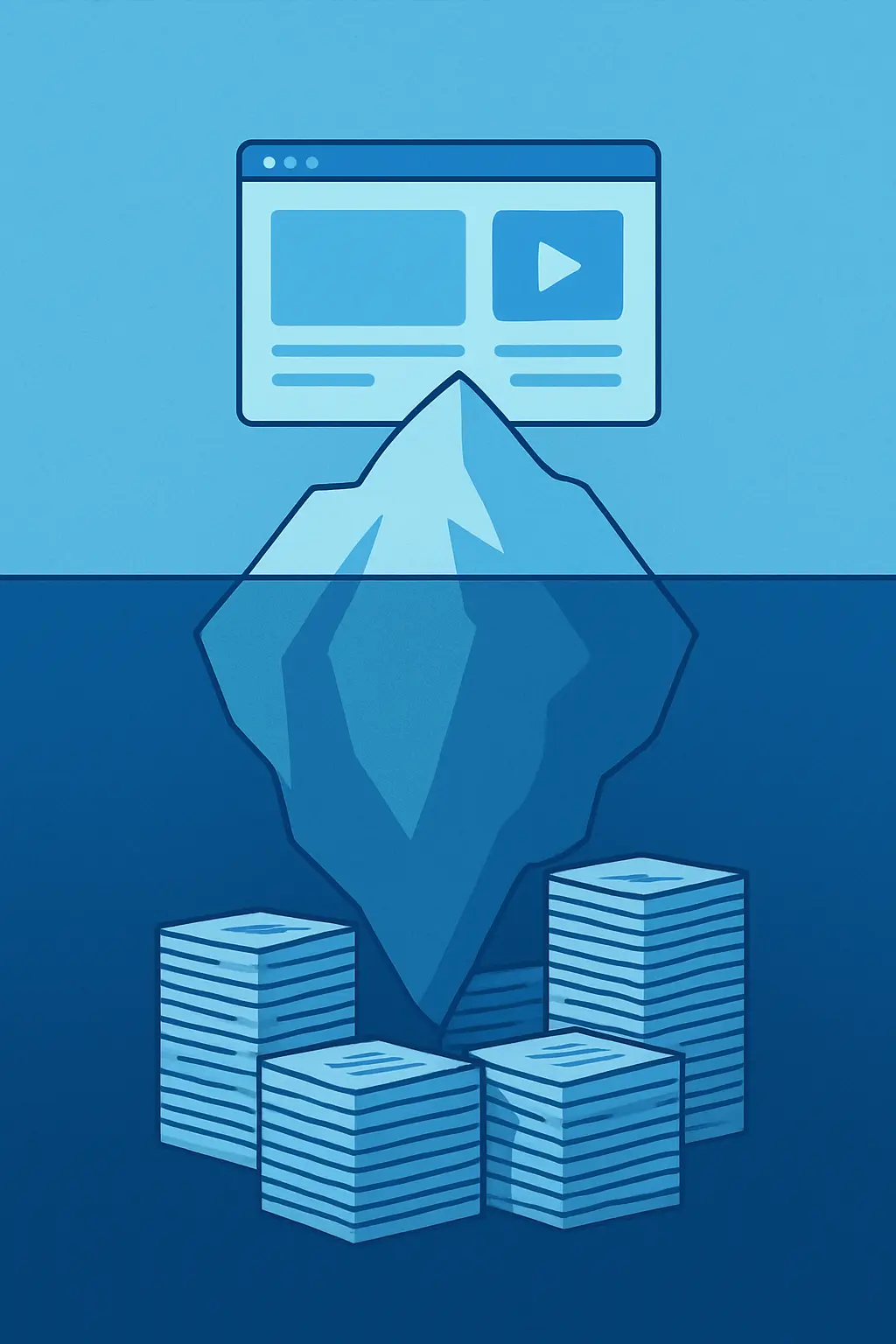
Institutional screening tools compare your thesis against a repository that — in Turnitin’s own description of its product — includes student papers, current and archived web pages, and premium publisher articles spanning 170 languages and twenty-plus years of content. Free checkers compare against the public web they can reach. The difference is not marginal, because thesis similarity concentrates precisely in the invisible layer: the chapter structures inherited from your lab’s previous scholars, the instrument descriptions adapted from a senior’s appendix, the standard passages that circulate between batches — and every prior thesis your university itself has screened. Two consequences: your official score will typically exceed any free score, unpredictably; and “which checker did you use?” matters less than departmental folklore suggests, since the binding number comes from your institution’s tool under your institution’s settings. (Even the folklore about tools rots — the Urkund system many departments swore by ended in June 2026.)
Remember also what the number means legally: the national framework of similarity levels and penalties — including the 10%-no-penalty band — is set by regulation, not by any tool; the details are in the UGC plagiarism limit explainer.
The Upload Question Nobody Asks Until Too Late
Before pasting a chapter into any free service, read its retention policy. A draft stored and indexed by a checker can surface later as a match against your own submitted thesis — the self-plagiarism trap of the free-checker economy, and the most expensive “free” in academia. The rule with no exceptions: no readable retention policy, no upload. Services that state clearly that submissions are not stored or resold are usable; services with no policy page are advertising their business model by omission. Your thesis is years of your life — treat its drafts like the asset they are.
A Tale of Two Submission Weeks
Picture the same scholar in two timelines. In the first, she writes three chapters over a year with pasted “placeholder” passages and a references file she means to reconcile later. In submission week she runs a free check (6%), submits to the department screening — and gets 19%, driven by matches to two previous theses from her own lab and a methods section that tracks a textbook too closely. The next ten days disappear into triage under the worst possible pressure, one official recheck remaining. In the second timeline, the same scholar wrote the same chapters in an editor where every citation attached at the moment of use, ran in-flow checks as each chapter closed, and fixed small problems while they were small. Her free check reads 5%, her official check reads 8% — different numbers, same calm, because every match in the report is one she can name. The difference between the timelines was never the checker. It was where the checking happened: at the end, or inside the writing.
The Workflow That Makes Every Check a Formality
Here is the reframe that dissolves the whole anxiety: scholars with clean official reports are not the ones with the best checkers — they are the ones whose writing leaves no orphan text. Three habits produce that state. Cite at the moment of use: every quote marked as a quote, every paraphrase carrying its source, from the first draft. Paraphrase from understanding: close the paper, write the idea in your own argument’s terms, reopen to verify — never shuffle a source’s words. Keep text and reference list synchronised continuously, so the audit examiners run is one you have already passed.
This is precisely the workflow Tesify builds in rather than bolts on. You write in an editor where every citation stays attached to its source through months of revisions; the reference list regenerates itself; and the Tesify Plagiarism Checker runs inside the same flow, on drafts whose source hygiene is already structural. The check stops being a verdict you await and becomes a confirmation you expect. And because the writing history documents your process, you also hold the strongest possible answer to any integrity question a committee could raise — about similarity or about AI assistance, whose disclosure rules are covered in AI and thesis writing in India.
If you are reading this with a bad report already in hand and weeks to the deadline, the recovery sequence exists and works — the similarity recovery plan walks it step by step. But if you are earlier in the journey, the cheaper path by far is to write in a system where the problem cannot accumulate.
The Decision, Plainly
Keep a free checker for what it does: early-draft sweeps for forgotten text and missing citations, on services whose retention policies you have read. Do not buy a consumer checker subscription expecting it to predict your official score — the student-paper layer stays invisible at every consumer price point. Move the real investment upstream into the writing system: source-attached citations, synchronised references, in-flow checking. That is what Tesify’s free tier lets you start today — structure a chapter, attach your first citations, run a check — and what its paid plan (priced for Indian students, in rupees) scales to a full thesis. The honest limit, stated as always: Tesify will not lower a similarity score for text you did not write honestly; it makes honest writing fast enough that you never need such a thing.
Stop checking for problems. Start writing without creating them. Tesify keeps every citation attached to its source, your reference list synchronised, and a plagiarism check inside your writing flow — your thesis, 100% written by you, with the process to prove it. Used by 9,000+ students. Start free with Tesify.
FAQ: Free Checkers, Price and Privacy
Is there a good free plagiarism checker for a thesis in India?
Free web checkers genuinely catch missing citations and forgotten copied text in early drafts. None see the student-paper and publisher layers your university’s screening uses — treat free scores as problem maps, never as predictions.
Will a clean free check guarantee I pass the official screening?
No. The official tool sees more, so its number is typically higher and unpredictable from any free score. Source discipline while writing is the only reliable strategy.
Is it safe to upload my thesis to free checkers?
Only with a readable retention policy stating your draft is not stored or indexed. An indexed draft can match against your own official submission later — the costliest free lunch in academia.
How much does Tesify cost in rupees?
There is a free tier to start — structure chapters, attach citations, run checks — with paid plans priced for Indian students in rupees shown at sign-up. No charge is hidden behind the check itself.
Does using Tesify comply with UGC academic integrity norms?
Tesify is built for the compliant path: you write, sources stay attached, and the process is documented — supporting the undertaking of originality the regulations require. It assists honest writing; it does not generate a thesis for you, which no integrity framework permits.
What happens to my thesis data in Tesify?
Your document remains yours; the platform exists to help you write it, not to harvest it. Review the privacy policy at sign-up as you should for any service — the same standard this article applies to free checkers.
My official check is days away and my free score is high — what now?
Work the recovery sequence: confirm which exclusions your department applies, classify every match (cited quote, uncited paraphrase, forgotten copy), fix substantively starting with the largest matches, and recheck once. The full plan is in our similarity recovery guide.
Do free checkers detect AI-written text?
Similarity and AI detection are different functions; free similarity tools do not meaningfully screen for AI writing, while institutional platforms increasingly can. The durable position is disclosed, permitted use — not detection roulette.
Can I use my university’s official check more than once?
Policies vary — many departments allow a limited number of pre-checks through the library or research section. Ask exactly how many runs you get and through whom; it is the cheapest information in this entire process.