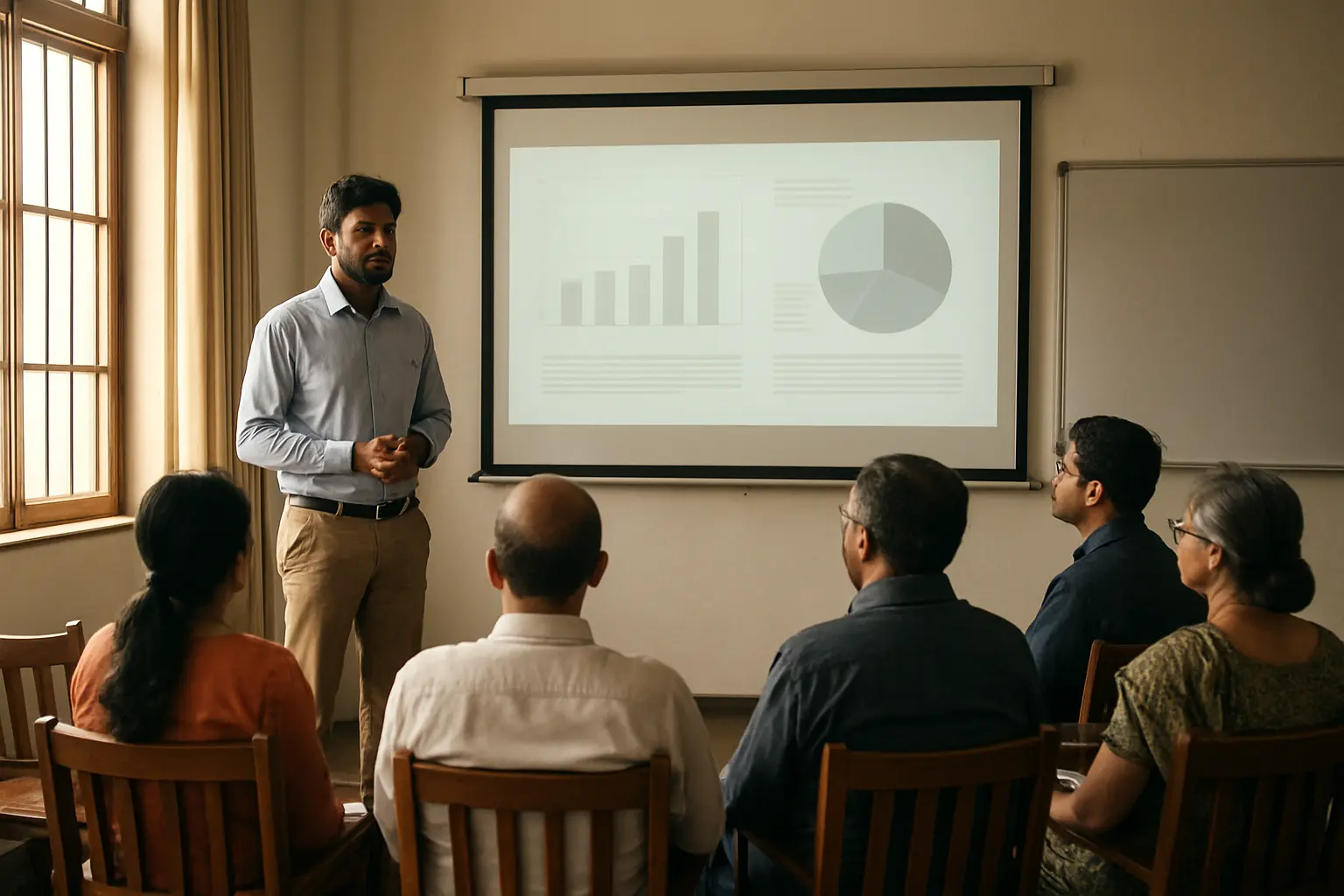
The pre-submission presentation is the open seminar you must give before you are allowed to submit your thesis at all. Regulation 11(2) of the UGC Ph.D. Regulations, 2022 requires every scholar to present before the Research Advisory Committee, and that presentation must be open to all faculty members and other research scholars. It is not the viva voce, and it happens months earlier.
Almost every Indian research scholar knows the viva voce is coming. Far fewer realise that the 2022 Regulations place a second, earlier, public examination in the pipeline — and that it is the one gate you reach first. Departments call it different things: the pre-submission seminar, the pre-synopsis seminar, the open seminar, the final DRC presentation. The regulation calls it a presentation before the Research Advisory Committee, and the wording matters, because it is the only public event the Regulations require before submission.
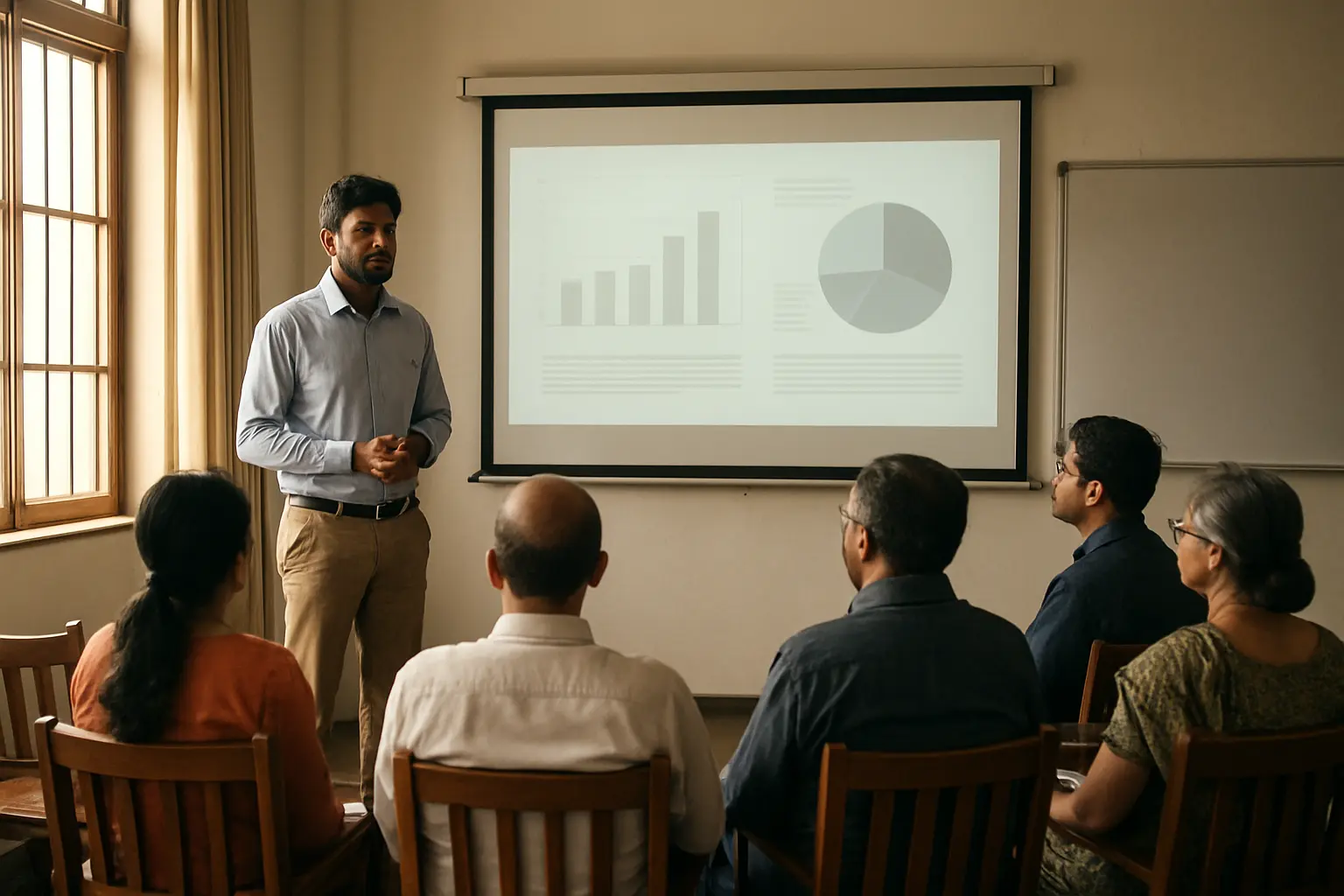
What exactly does the UGC require?
Regulation 11(2) of the University Grants Commission (Minimum Standards and Procedure for Award of Ph.D. Degree) Regulations, 2022 reads:
“Before submitting the dissertation/thesis, the Ph.D. scholar shall make a presentation before the Research Advisory Committee of the Higher Educational Institution concerned, which shall also be open to all faculty members and other research scholars/students.”
Three obligations sit inside that one sentence. The presentation must happen before submission, not after. The audience of record is your Research Advisory Committee. And the room must be open — your department cannot conduct it as a private meeting between you and your guide.
What the regulation does not do is prescribe the format. There is no national rule on how many slides, how long you speak, what the pass mark is, or whether the committee votes. That is left entirely to your institution’s ordinance, exactly as the UGC leaves thesis page setup to the university rather than prescribing it nationally. Ask your department for the written procedure before you prepare anything.
How is this different from the viva voce?
They are separate events, separated by months, with different rooms and different stakes. Confusing them is the single most common mistake scholars make when planning the last year.
| Pre-submission presentation | Viva voce | |
|---|---|---|
| Regulation | 11(2) | 11(5) and 11(6) |
| When | Before you submit the thesis | After both external examiners recommend acceptance |
| Who examines | Your Research Advisory Committee | Your supervisor plus at least one external examiner |
| Who may attend | All faculty members and other research scholars/students | RAC, faculty, research scholars and students |
| External examiner present | No | Yes |
| What is being judged | Whether the work is ready to be submitted | Whether you can defend a thesis the examiners have already accepted |
| Possible outcome | Proceed to submission, or revise first | Award, corrections, or rejection |
The practical consequence is that the pre-submission presentation is the last point at which the work can still be changed cheaply. Once the thesis is submitted, the evaluation clock in Regulation 11(7) starts — the institution must complete the whole process, including declaring the viva result, within six months — and any weakness the committee could have flagged now becomes a correction demanded by an external examiner instead. The viva voce process is a separate article; this one is about the gate before it.
Is this the same as my semester progress presentation?
No, and the Regulations treat them separately. Regulation 10(2) requires something quite different:
“Each semester, a Ph.D. scholar shall appear before the Research Advisory Committee to make a presentation and submit a brief report on the progress of his/her work for evaluation and further guidance.”
That is a recurring internal review, held every semester, with a written progress report attached. The RAC submits its recommendations plus a copy of your progress report to the institution, and you receive a copy of the recommendations. It is routine, and it is not open to the whole department by rule.
The stakes on the recurring review are nonetheless real. Regulation 10(3) provides that where progress is unsatisfactory, the committee records reasons and suggests corrective measures — and if the scholar fails to implement them, the RAC may recommend cancellation of the registration. Scholars who treat the semester presentation as a formality are the ones most surprised by the pre-submission seminar, because the two are cumulative: the committee that hears your final seminar has watched every earlier one.

Who is actually in the room?
Your Research Advisory Committee is the body of record. Regulation 10(1) makes your Research Supervisor its Convener and gives the committee three named responsibilities: to review the research proposal and finalise the topic, to guide you in developing the study design and methodology and identify the courses you may need, and to periodically review and assist the progress of your work.
Read that list again before you prepare. The committee sitting in judgement on your readiness to submit is the same committee that approved the topic and the methodology. Their questions are therefore rarely “why this topic?” and almost always “you promised X in your synopsis — where is it?” The synopsis you had approved is the contract they are auditing.
Beyond the committee, the regulation opens the room to all faculty members and other research scholars and students. In practice this means colleagues from adjacent specialisations who have not read your chapters and will ask broad, first-principles questions, and junior scholars who are attending to learn what the event looks like. The broad questions are the ones that catch people out, because a scholar deep in chapter four often cannot summarise the whole argument in two sentences any more.
What do they ask?
The questions cluster, and they cluster around the gap between what you promised and what you produced.
- Objective drift. An objective in the approved synopsis that quietly disappeared, or one that has been reworded so that it now matches the data you happened to collect. Bring a one-page mapping of approved objectives to delivered chapters.
- Methodology substitution. The sampling frame, instrument or analysis you actually used, where it differs from the one the committee approved. A documented, reasoned change is fine. An undisclosed one is not.
- Sample and its defence. Why this N, why these respondents, and what the limitation is. Have the justification ready in the form you will write it in the methodology chapter.
- Contribution. Stated in one sentence, without hedging. If you need a paragraph, the committee will conclude the contribution is not yet clear to you either.
- Publication position. Where the work stands, and whether your ordinance requires anything. The 2022 Regulations set no national publication requirement before submission, but many ordinances do, and the committee will know yours.
- Similarity status. Whether the draft has been through the institution’s plagiarism screening and where it stands against the permitted limit. Regulation 11(3) requires the institution to run such software; the committee will not want to hear that you have not checked.
How should you prepare?
Work backwards from the two documents the committee is holding: your approved synopsis and your latest progress report.
- Build the promise-to-delivery table first, not the slides. One row per approved objective, one column for the chapter and section that delivers it, one column for any change and its reason. This single page answers most of the questions before they are asked, and it becomes the spine of the deck.
- Write the contribution sentence and test it on someone outside your area. If a scholar from another department cannot repeat it back, rewrite it. The open audience is exactly that test, conducted publicly.
- Budget the deck by argument, not by chapter. Problem, gap, objectives, method, key findings, contribution, limitations. Findings deserve the most time; the literature review deserves the least, because the committee already accepted it at proposal stage.
- Prepare the limitations slide honestly and put it in yourself. A limitation you raise is a sign of judgement. The same limitation raised by a professor in the third row is a finding against you.
- Rehearse the interruption, not the speech. Ask your lab mates to stop you mid-sentence and ask why. Fluency under interruption is what the room actually tests.
- Confirm the local procedure in writing. Duration, whether a synopsis copy must circulate in advance, how many days’ notice the department gives, whether a formal minute is recorded, and what the committee’s recommendation is called on paper. Departments differ, and the regulation does not settle any of it.

What happens if the committee is not satisfied?
Nothing in the Regulations describes a “fail” at this stage, because the presentation is not framed as an examination with a result. What the committee can do is decline to clear you for submission and specify what must change first. That is an internal decision, governed by your ordinance.
Treat that outcome as the cheapest possible version of bad news. A committee asking for an extra analysis costs you weeks. The same objection arriving from an external examiner after submission costs you a corrections cycle inside the six-month evaluation window of Regulation 11(7), with your degree waiting on it. Scholars who have already been through a synopsis rejection tend to understand this instinctively; the committee is doing the same job it did then, later and with more evidence.
What comes immediately after?
Once you are cleared, submission is a documents exercise. Regulation 11(4) requires the thesis to be accompanied by two specific attestations: an undertaking from you that there is no plagiarism, and a certificate from your Research Supervisor attesting both to the originality of the thesis and that it has not been submitted for any other degree or diploma at any other institution. A supervisor’s certificate that covers only originality does not satisfy the clause — check the wording on your department’s template.
After that, Regulation 11(5) sends the thesis to your supervisor and at least two external examiners not employed by your institution, with one preferably from outside India, and Regulation 11(7) starts the six-month clock. Your thesis will eventually be deposited with INFLIBNET and appear on Shodhganga.
Frequently asked questions
Is the pre-submission presentation compulsory in India?
Yes for Ph.D. scholars. Regulation 11(2) of the UGC Ph.D. Regulations, 2022 states that before submitting the thesis the scholar shall make a presentation before the Research Advisory Committee. It is a national requirement, not a departmental preference.
Is the pre-submission seminar the same as the viva voce?
No. The pre-submission presentation happens before you submit and is heard by your Research Advisory Committee. The viva voce happens only after both external examiners recommend acceptance, and its board is your supervisor plus at least one external examiner.
Who can attend my pre-submission presentation?
Regulation 11(2) requires it to be open to all faculty members and other research scholars and students, in addition to your Research Advisory Committee. Your department cannot hold it privately.
How long should the presentation be?
The Regulations do not say. Duration is set by your institution’s ordinance or departmental practice, and commonly runs between thirty and sixty minutes including questions. Ask your department for the written norm rather than copying a senior’s timing.
Do I need to submit my synopsis before the pre-submission presentation?
That depends on your ordinance. Many departments circulate the synopsis or a draft abstract in advance so attendees can prepare questions; others treat the seminar itself as the trigger for synopsis submission. This is a local rule and must be confirmed locally.
Can the pre-submission presentation be conducted online?
The Regulations expressly permit the viva voce to be conducted online but say nothing about the mode of the pre-submission presentation. Where a regulation is silent, the institution decides. Ask, and get the answer in writing if you are travelling.
What is the difference between the semester progress presentation and this one?
The semester presentation under Regulation 10(2) is a recurring internal review with a written progress report attached, held every semester for evaluation and guidance. The pre-submission presentation under Regulation 11(2) happens once, immediately before submission, and must be open to the department.
Can my registration be cancelled because of a bad presentation?
Not directly by the pre-submission seminar. But Regulation 10(3) provides that where the Research Advisory Committee finds progress unsatisfactory it records reasons and suggests corrective measures, and may recommend cancellation of registration if the scholar fails to implement them. The mechanism runs through the semester reviews, not through a single seminar.
What if my department calls it something else?
Names vary — pre-synopsis seminar, open seminar, final DRC presentation, pre-submission colloquium. Match the event to the regulation by its two markers: it happens before submission, and it is open to faculty and other scholars. If both are true, it is the Regulation 11(2) presentation whatever the notice board calls it.
Does this apply to M.Tech or master’s dissertations?
No. The 2022 Regulations govern the Ph.D. Master’s-level presentations, where they exist, are set entirely by the university. See which document you are actually writing for how the rules differ by degree level.
Where can I read Regulation 11(2) myself?
In the Gazette of India notification of the University Grants Commission (Minimum Standards and Procedure for Award of Ph.D. Degree) Regulations, 2022, Part III Section 4. Regulation 9 covers coursework, Regulation 10 the Research Advisory Committee, and Regulation 11 evaluation and assessment.
Turning the seminar into a submitted thesis
The committee has just told you, in public, exactly what stands between your draft and your submission. That list is the most valuable planning document you will get in the whole degree — and it usually arrives with a deadline attached, because the department wants the thesis in before the semester closes.
Tesify helps you work through that list without losing the argument you just defended: it keeps your chapters, objectives and references in one place, so a change demanded in the seminar propagates through the document instead of being patched in three files. The research stays yours; the rewriting gets faster. Start with the free tier and bring the committee’s list with you.