| Scale | Measures | Items / range | Best suited to |
|---|---|---|---|
| Visual Analogue Scale (VAS) | Pain intensity | 1 item, 0–10 cm line | Any condition where pain is a primary or secondary outcome |
| Oswestry Disability Index (ODI) | Low back pain-related disability | 10 domains, 0–100 | Low back pain and lumbar spine dissertations |
| Berg Balance Scale (BBS) | Static and dynamic balance | 14 tasks, 0–56 | Geriatric, neurological and fall-risk studies |
| Modified Ashworth Scale (MAS) | Spasticity / muscle tone | 6-point ordinal grade per muscle group | Stroke, cerebral palsy, spinal cord injury studies |
| Fugl-Meyer Assessment (FMA) | Post-stroke motor recovery | Multi-domain, up to 226 points | Stroke rehabilitation dissertations |
| WOMAC Index | Osteoarthritis pain, stiffness, function | 24 items across 3 subscales | Knee and hip osteoarthritis studies |
| Six-Minute Walk Test (6MWT) | Functional exercise capacity | Distance walked in 6 minutes | Cardiopulmonary and general mobility studies |
An Indian physiotherapy dissertation (BPT, MPT or M.Phil) lives or dies on whether the outcome measure actually matches the condition being studied — a validated scale chosen for the wrong population is a common examiner objection at the viva even when the statistics behind it are sound. Seven scales physiotherapy scholars reach for most, compared on what they measure, how they are scored, and which population they suit, followed by a ranked shortlist by condition and one clear recommendation route.
Pain: the Visual Analogue Scale is still the default
The Visual Analogue Scale (VAS) — a 10 cm line anchored “no pain” to “worst pain imaginable,” with the patient marking their pain level — remains the most widely used single-item pain measure in physiotherapy research because it is fast, requires no licence, and is understood across almost every Indian department without further justification needed in a viva. Its main limitation is that it captures pain intensity alone; a dissertation studying pain’s functional impact (not just how much it hurts, but what it stops the patient doing) typically pairs VAS with a condition-specific functional scale rather than relying on VAS alone.
Low back pain and lumbar spine: the Oswestry Disability Index
The Oswestry Disability Index (ODI), first published in 1980, is the most cited condition-specific outcome measure in low back pain research worldwide and the standard choice for an Indian physiotherapy dissertation on lumbar spine conditions. It covers ten domains — pain intensity, personal care, lifting, walking, sitting, standing, sleeping, sex life, social life and travelling — each scored 0 to 5, summed and doubled to a 0–100 disability percentage. Because it is old and widely translated, Hindi and several regional-language validated versions exist in the published literature; cite the specific validated translation you used rather than the original English version if your sample was administered a translated form.
Balance and fall risk: the Berg Balance Scale
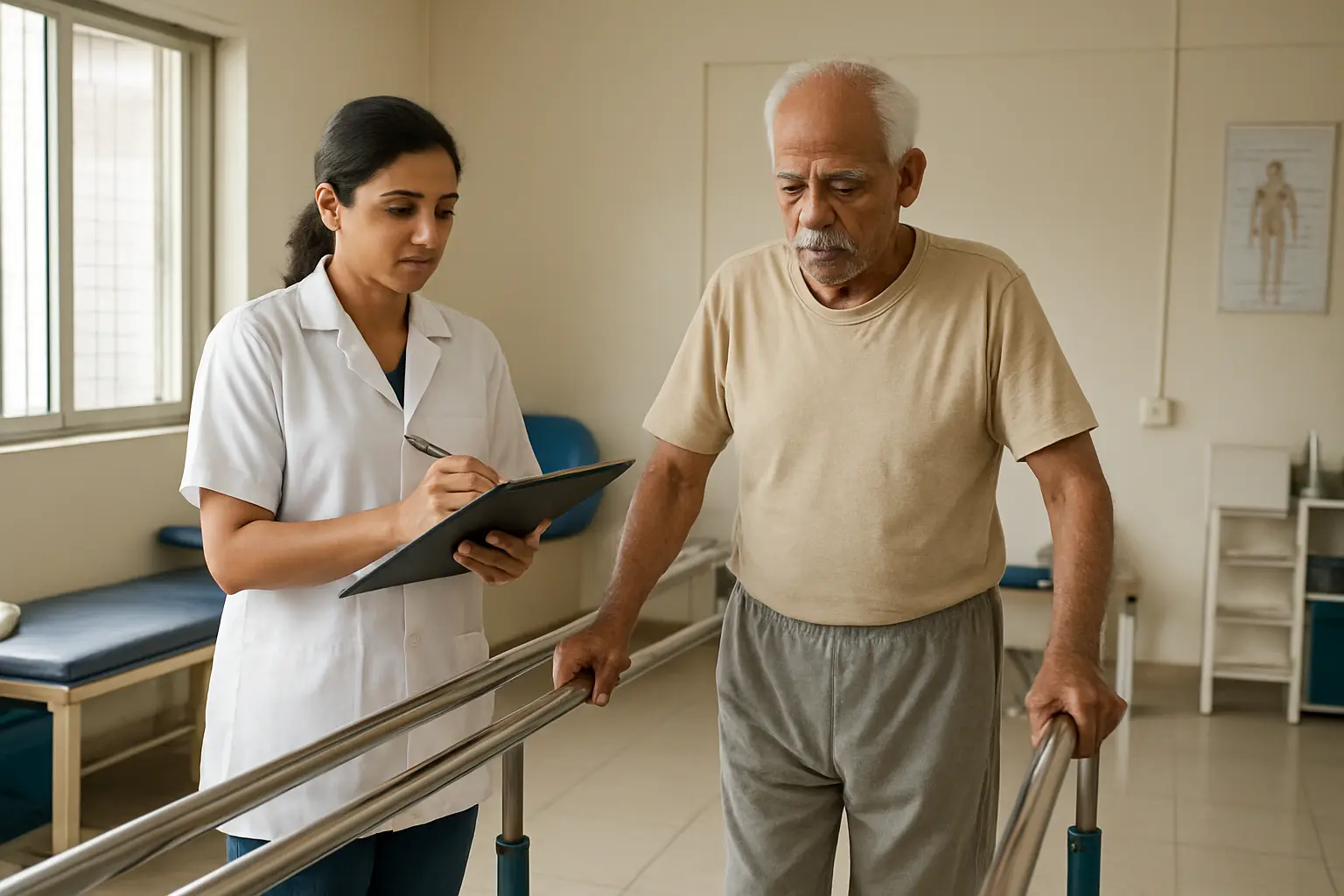
The Berg Balance Scale (BBS) is the standard clinical measure of static and dynamic balance for geriatric, neurological and fall-risk-focused Indian physiotherapy dissertations. It comprises 14 functional tasks — from sitting unsupported to standing on one leg — each scored 0 (unable) to 4 (independent), for a total range of 0 to 56. A commonly cited threshold places scores below 45 at increased fall risk and below 20 at wheelchair-dependent function, though your discussion chapter should state where your own sample fell relative to these published bands rather than assume the cutoff applies unchanged to every population. The BBS takes roughly 15 to 20 minutes to administer, which matters when planning your data-collection timeline against your sample size.
Spasticity and stroke recovery: Modified Ashworth Scale and Fugl-Meyer Assessment
For stroke, cerebral palsy or spinal cord injury dissertations, two scales cover different constructs and are often used together rather than as alternatives:
- The Modified Ashworth Scale (MAS) grades resistance to passive movement on a six-point ordinal scale (0, 1, 1+, 2, 3, 4) per muscle group, and is the standard, fast clinical measure of spasticity — its main limitation for a dissertation is inter-rater reliability, so report who performed the assessment and whether a second rater checked a subsample
- The Fugl-Meyer Assessment (FMA) measures post-stroke motor recovery across multiple domains (upper extremity, lower extremity, balance, sensation, joint function) with a maximum score of 226, and is considerably more time-consuming to administer than MAS but captures a broader functional picture — most stroke-recovery dissertations that only need a spasticity marker use MAS alone, while those tracking overall motor recovery over time use FMA
Osteoarthritis: the WOMAC Index
The WOMAC (Western Ontario and McMaster Universities Osteoarthritis) Index is the standard condition-specific outcome measure for knee and hip osteoarthritis dissertations, covering pain (5 items), stiffness (2 items) and physical function (17 items) across 24 total items, each scored on a 5-point Likert or a 100 mm VAS format depending on which version your department licenses. It is copyrighted, unlike VAS, ODI or BBS, so confirm your institution’s access or licensing route before committing your methodology chapter to it.

Cardiopulmonary and general mobility: the Six-Minute Walk Test
The Six-Minute Walk Test (6MWT) is a performance-based measure — the distance a patient walks in six minutes on a flat, measured course — rather than a questionnaire, and suits cardiopulmonary rehabilitation, general mobility and functional-capacity dissertations where a directly observed outcome is preferable to self-report. Standardise the course length, instructions given and any rest allowances exactly the same way across every participant and state this protocol explicitly in your methodology chapter, since 6MWT results are sensitive to administration differences an examiner may probe.
What examiners check in the tools section of Chapter 3
Beyond naming the scale, Indian physiotherapy examiners look for four specific things in a tools-and-techniques section:
- Published reliability and validity evidence for the instrument in a population comparable to your own sample — a scale validated only in a Western elderly population, cited without comment, invites a question about its applicability to your Indian sample
- Scoring and interpretation stated precisely — not just that a scale was used, but how the raw score was calculated and what range or cutoff was applied to classify participants, if your analysis groups them by severity
- Who administered the assessment and their training or calibration, especially for scales like MAS or BBS that involve rater judgement rather than pure self-report
- Permission or licensing status stated explicitly where the instrument requires it, even briefly — a single sentence noting the scale is used with permission (or is in the public domain) closes an otherwise easy examiner objection
Verdict: match the condition first, the psychometrics second
Choose your outcome measure by condition, not by which scale is easiest to score: VAS alone is rarely sufficient as a sole outcome for a dissertation beyond a purely pain-focused study, ODI is the default for lumbar spine work, BBS for balance and fall-risk work, MAS and FMA (together or separately depending on scope) for stroke and neurological work, WOMAC for osteoarthritis, and 6MWT wherever a directly observed functional outcome is preferable to self-report. Once the condition-appropriate scale is chosen, report its published reliability and validity evidence in your tools section and, where you administered a translated version, cite the specific validation study for that translation rather than the original.
Choosing the right instrument is only the first methodological decision your examiner will probe; how many interviews are enough for a qualitative thesis and how to calculate sample size for a thesis cover the population and sample-size reasoning that typically follows the tools section in a physiotherapy dissertation’s methodology chapter. What is an acceptable Cronbach’s alpha for a thesis covers the reliability-reporting convention if you are also validating an instrument in your own sample rather than relying solely on published psychometrics. Tesify’s AI thesis assistant can help structure the tools section of your methodology chapter around the scale you choose — the scoring convention, the reliability evidence to cite, and the administration protocol an examiner expects stated explicitly — see which validated scale for a psychology dissertation for how the same instrument-selection discipline applies in a closely related field.
Frequently asked questions
Can I use more than one outcome measure in a single physiotherapy dissertation?
Yes, and it is common — a study on post-stroke rehabilitation might combine MAS for spasticity with FMA for motor recovery and BBS for balance, provided each instrument is justified against a specific objective rather than added without a stated purpose.
Do I need permission to use these scales in my dissertation?
It depends on the instrument. VAS, ODI and BBS are widely used without a licensing fee in academic research, though some translated or condition-specific versions do require permission from the original developer or a distributor. WOMAC is copyrighted and typically requires licensing through its rights holder. Check the current permission requirements for your specific instrument and version before finalising your methodology chapter.
Which scale is best for a dissertation on a paediatric population?
None of the seven scales above are paediatric-specific; a dissertation on children needs an age-appropriate validated instrument (such as a paediatric-specific balance or pain scale) rather than an adult scale applied to a child sample, since validity does not automatically transfer across age groups.
How do I report inter-rater reliability if two physiotherapists administered the same scale?
Report the inter-rater reliability statistic appropriate to your data type — a weighted kappa for ordinal scales like MAS, or an intraclass correlation coefficient for continuous or near-continuous scores like BBS or ODI — calculated from a subsample both raters assessed independently, and state this in your methodology chapter rather than assume the published literature’s reliability figures apply automatically to your own raters.
Is a translated Hindi or regional-language version of these scales acceptable?
Yes, provided it is a published, validated translation rather than an ad hoc translation you produced yourself — cite the specific validation study for the translated version you used, and note in your limitations section if no validated translation existed for your study’s language and you had to translate and back-translate the instrument yourself.
What if my chosen scale has a ceiling or floor effect in my sample?
Report it honestly — if most of your sample scored near the maximum or minimum possible score, the scale may not have been sensitive enough to detect meaningful differences in your specific population, and this is a legitimate limitation to discuss rather than a result to disguise.
Should I choose an outcome measure before or after finalising my sample size?
Choose the measure first — the scale’s scoring properties (continuous versus ordinal, its typical variance in the literature) feed directly into the statistical power calculation that determines your sample size, so reversing the order risks a sample-size justification that does not actually match the data your chosen instrument will produce.
Can I substitute a shorter or informal version of a standard scale to save time in data collection?
Only if a validated short-form exists in the published literature and you cite it as such — an informally shortened version you create yourself is no longer the validated instrument, and an examiner who checks the original scale’s item count against your description will flag the discrepancy.