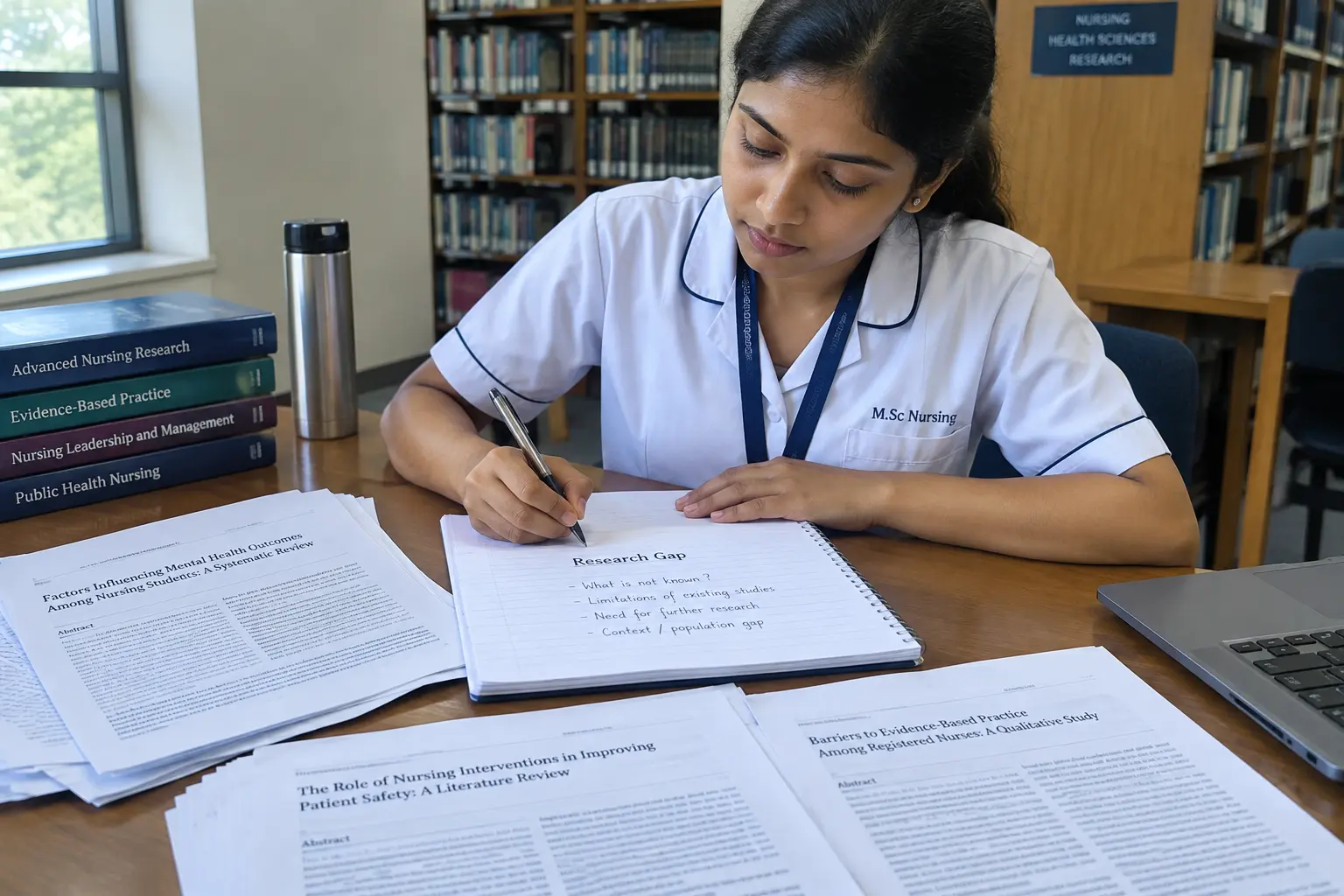
A research gap in a psychiatric or mental health nursing thesis is a specific, evidenced absence in the existing literature — not a general statement that “more research is needed.” A strong gap names the population, the setting and the outcome that has not yet been studied together in the Indian context, and points to the one or two sources that come closest without actually closing it. The five worked examples below are illustrative and fictional — built to show the shape of a defensible gap, not to be copied as your own topic.
What Counts as a Research Gap in Psychiatric Nursing Research?
A gap is not the same as a problem. “Patients with schizophrenia struggle with medication adherence” is a problem — it is well documented and true across many settings. A gap is narrower: it says what, specifically, about that problem has not yet been studied, in what population, and why that absence matters to nursing practice. Four shapes of gap recur across Indian M.Sc and Ph.D. Nursing psychiatric specialisation proposals:
- Population gap — the outcome is studied, but not in this specific group (adolescents, geriatric psychiatric patients, first-time caregivers, a particular diagnostic group).
- Setting gap — the outcome is studied in tertiary psychiatric hospitals but not in community mental health centres, or in urban but not rural primary health settings.
- Intervention gap — an intervention is well studied elsewhere (a Western nurse-led psychoeducation programme) but not adapted and tested in an Indian setting.
- Measurement gap — the construct is studied, but with a scale or method that leaves a specific dimension unmeasured (stigma studied broadly, but not self-stigma specifically among nursing students who will go on to work in psychiatric wards).
Reviewers on a doctoral research committee are trained to spot a gap statement that is actually just a restated problem statement. If your sentence would still be true with “more research” swapped in for your specific variable, it is not yet a gap.
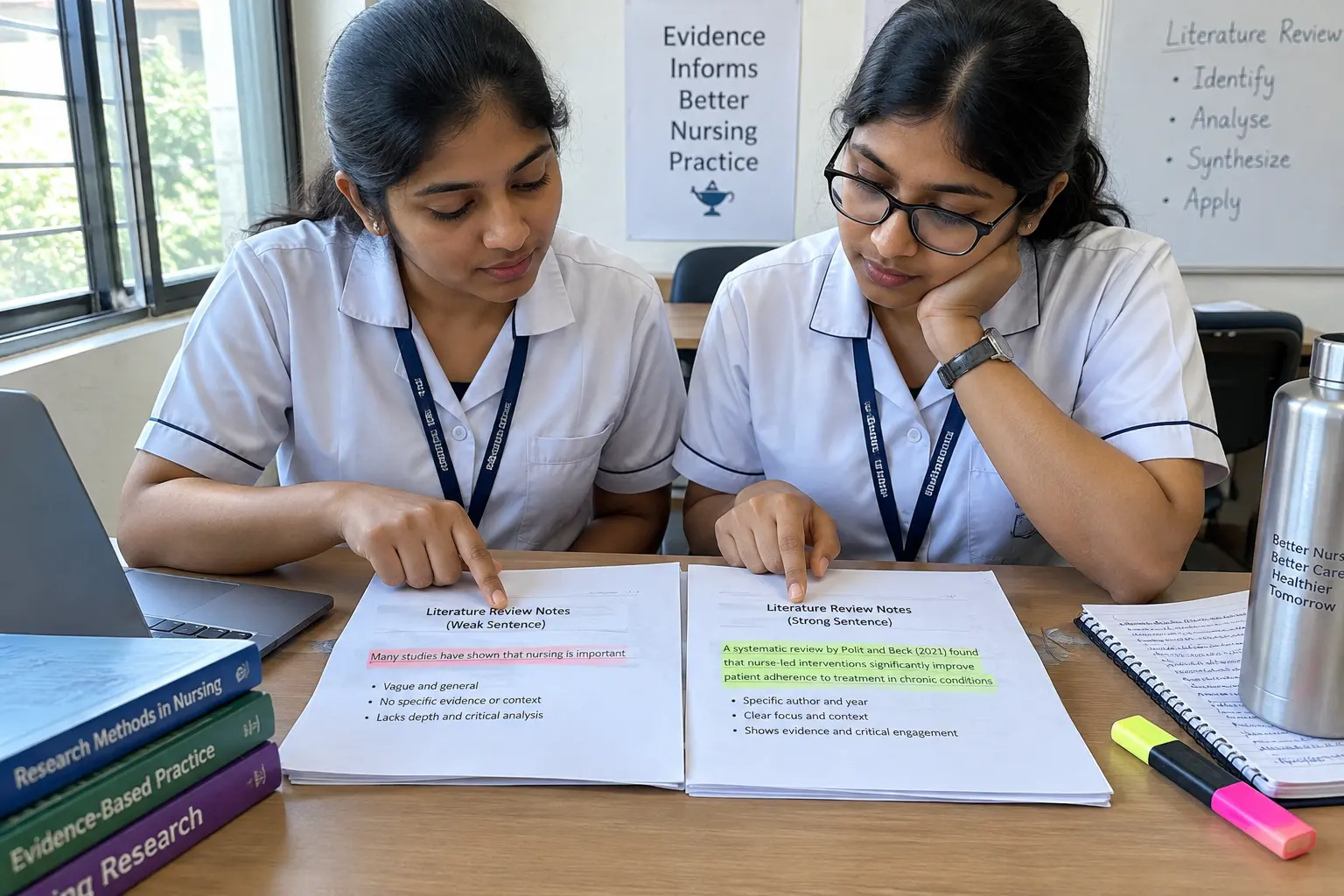
What Do Weak and Strong Research Gap Statements Look Like Side by Side?
| Weak (restates the problem) | Strong (names the specific absence) |
|---|---|
| “There is a need for more research on caregiver burden in mental illness.” | “Caregiver burden has been studied extensively among caregivers of persons with schizophrenia, but few Indian studies have examined burden specifically among first-time caregivers of a family member’s first psychotic episode, within the first six months, when burden is plausibly highest and support-seeking behaviour least established.” |
| “Stigma towards mental illness remains a problem in India.” | “Studies of stigma among psychiatric nursing students in India have measured general attitudes toward mental illness, but few have separately measured self-stigma — the internalised belief that choosing psychiatric nursing as a specialisation will be professionally devalued — which may independently predict whether students pursue the specialisation after graduation.” |
Notice what the strong versions add: a named population, a named time window or measurement distinction, and a stated reason the absence matters. None of the specific figures or claims above are drawn from a real published study — they are illustrative sentence patterns for you to test your own topic against, not citable facts.
Five Worked, Illustrative Research Gap Examples for a Psychiatric Nursing Thesis
Each of the following is fictional and illustrative, built to demonstrate structure. Do not cite these as evidence of an actual gap in the literature — the literature review for your own topic has to be built from studies you have actually read.
1. Medication adherence in outpatients with schizophrenia
Illustrative gap: Adherence interventions for schizophrenia are well studied globally, but few Indian outpatient-department studies separate adherence behaviour by whether the patient lives with family versus alone, even though family supervision of dosing is a commonly reported informal adherence mechanism in Indian settings that most adherence scales do not capture as a variable.
2. Caregiver burden in families of persons with bipolar disorder
Illustrative gap: Caregiver burden during a manic episode is documented, but the burden trajectory during the depressive phase of bipolar disorder — when the caregiving task shifts from managing acute agitation to managing withdrawal and risk of self-harm — is comparatively under-examined in the same Indian caregiver population.
3. Nurse-led psychoeducation for depression in a primary health centre
Illustrative gap: Nurse-led psychoeducation for depression has an evidence base in tertiary psychiatric settings, but its feasibility when delivered by general-duty nurses (rather than psychiatric-trained nurses) in a rural primary health centre, where psychiatric nursing staff are frequently unavailable, is not yet established.
4. Self-stigma among psychiatric nursing students
Illustrative gap: See the worked comparison table above — self-stigma specifically, as distinct from general attitudes toward mental illness, among nursing students choosing (or avoiding) a psychiatric specialisation.
5. Telepsychiatry follow-up compliance after hospital discharge
Illustrative gap: Telepsychiatry follow-up after discharge is increasingly offered, but compliance specifically among patients discharged to areas with inconsistent mobile network connectivity — a real constraint in parts of India — is rarely reported as a separate variable from general telepsychiatry compliance.
How Do You Turn a Research Gap Into an Objective and a Hypothesis?
Once you have a defensible gap sentence, the move to an objective is mechanical: the gap names an absence, the objective names what you will do about it. “Few studies examine X in Y population” becomes “to assess X among Y population in [your setting].” From there, if your objective is relational rather than purely descriptive, a hypothesis follows — stated as a non-directional alternative unless your own literature review genuinely supports a direction. The worked mechanics for this whole chain, including how each hypothesis pairs with a variable and a design, are covered in our guide to hypotheses and variables in an M.Sc Nursing thesis. If you are still choosing which specialty and topic to commit to before writing a gap statement at all, our graded list of M.Sc Nursing dissertation topics for 2026 sorts forty ideas by how difficult ethics and clinical-site access will be — a genuinely under-studied topic is not worth choosing if you cannot realistically get the access to study it.
Where Do You Find the Literature to Support a Genuine Gap?
A gap statement is only as strong as the search that produced it. Before writing your final gap sentence, search at minimum PubMed/MEDLINE for the international evidence base on your construct, and Shodhganga for Indian theses that may already have covered your exact angle — a gap that turns out to already be closed by an unpublished Indian M.Sc thesis is a wasted year. Search using both the clinical term and its common Indian-context synonyms (for example, both “caregiver burden” and “family burden,” both “telepsychiatry” and “tele-mental health”), since indexing is inconsistent across databases and a single-term search will miss relevant work. Read the discussion and limitations sections of the two or three closest studies you find — that is usually where the authors state, in their own words, what they did not get to, and it is the fastest route to confirming your gap is real rather than assumed.
Keep a simple search log as you go: the database, the exact search string, the date you ran it, and the number of results. Nursing committees increasingly ask for this log as an appendix, and it also protects you — if a committee member later asks why you did not cite a particular study, a dated search log shows the search was systematic rather than selective. Where a database returns results in the hundreds, screen by title and abstract first, then read only the shortlist in full; trying to read every abstract in full at the first pass is the most common reason literature searching stalls for weeks without producing a usable gap statement.

What Do Guides and Examiners Look for When They Say “No Gap”?
Three comments recur on Indian nursing synopsis committees when a gap statement is sent back:
- “This has already been studied” — usually means the student searched too narrowly (one database, one search term) and missed existing Indian work on the exact topic.
- “This is a problem statement, not a gap” — the sentence describes a known clinical issue without naming what specifically about it is unstudied.
- “Why does this gap matter?” — a gap can be real and still trivial; the strongest proposals state, in one sentence, what nursing practice would do differently once the gap is closed.
Frequently Asked Questions
Is a research gap the same as a problem statement?
No. A problem statement describes a known clinical or practice issue; a research gap names the specific, narrower absence in the literature about that issue — a population, setting, intervention or measurement dimension nobody has yet studied together.
How many studies do I need to read before I can be confident a gap is real?
There is no fixed number stated by any UGC or nursing-council document; the working standard most Indian nursing guides apply is that you can name the two or three closest existing studies and explain precisely what each one did not cover, not that you have exhaustively reviewed every paper ever published on the topic.
Can I use a gap from a study published outside India?
Yes, provided you can show the gap plausibly transfers — or does not transfer — to the Indian context you are proposing to study. A gap that is purely about replicating a Western finding in an Indian setting is a legitimate gap type, but say so explicitly rather than implying the topic itself is unstudied everywhere.
What if my committee says my gap is “too narrow”?
A narrow gap is usually a feasibility strength, not a weakness, provided it is genuinely researchable within your timeline and ethics-approval window. If a committee calls it too narrow, the more common issue is that the narrow gap has not been connected back to why it matters for practice — add that one sentence rather than broadening the gap itself.
Should my research gap statement cite the exact studies it is contrasting with?
Yes. A gap statement without named citations reads as an assertion; the same sentence with two or three specific citations reads as a literature-grounded claim, which is what a synopsis committee is checking for.
Is “no Indian data exists on this topic” a strong gap on its own?
On its own, no — an absence of Indian data is a starting point, not a complete gap statement. Pair it with why the international evidence might not transfer directly (a cultural, systemic or resource difference), which is usually the more defensible half of the argument.
Where does the research gap statement go in my proposal or synopsis?
It typically closes the literature review section, immediately before the statement of the problem and objectives — see the structure this fits into in our guide to a complete, annotated M.Sc Nursing thesis specimen.
Can I have more than one research gap in my introduction?
Most Indian nursing proposals present one primary gap that the whole study addresses, sometimes with one or two secondary gaps folded into secondary objectives. Presenting several unrelated gaps usually signals the topic itself has not been narrowed down yet.
Does a research gap need a specific number or statistic to be credible?
No — a gap can be entirely credible as a stated absence in coverage without a supporting statistic. Where you do cite a number (a prevalence figure, a caseload count), it must come from a source you have actually read and can cite by name and year, never a plausible-sounding round figure.
My topic overlaps with a study I found after I had already started. What now?
Do not discard the topic automatically. Read the study in full and identify precisely what it covered — often a newly found study addresses a different population, setting or outcome than yours, and the overlap is only superficial. Where the overlap turns out to be genuine, narrow your gap to the dimension that study still leaves open (a different age group, a different care setting, a longer follow-up period) rather than abandoning months of preparatory reading.
Write a gap statement you can actually defend
Tesify helps you search your construct across the literature you name, checks that your gap sentence is a genuine absence rather than a restated problem, and carries the gap through into a matching objective and hypothesis — so the sentence you defend in your synopsis viva is one you built, not one you copied.