
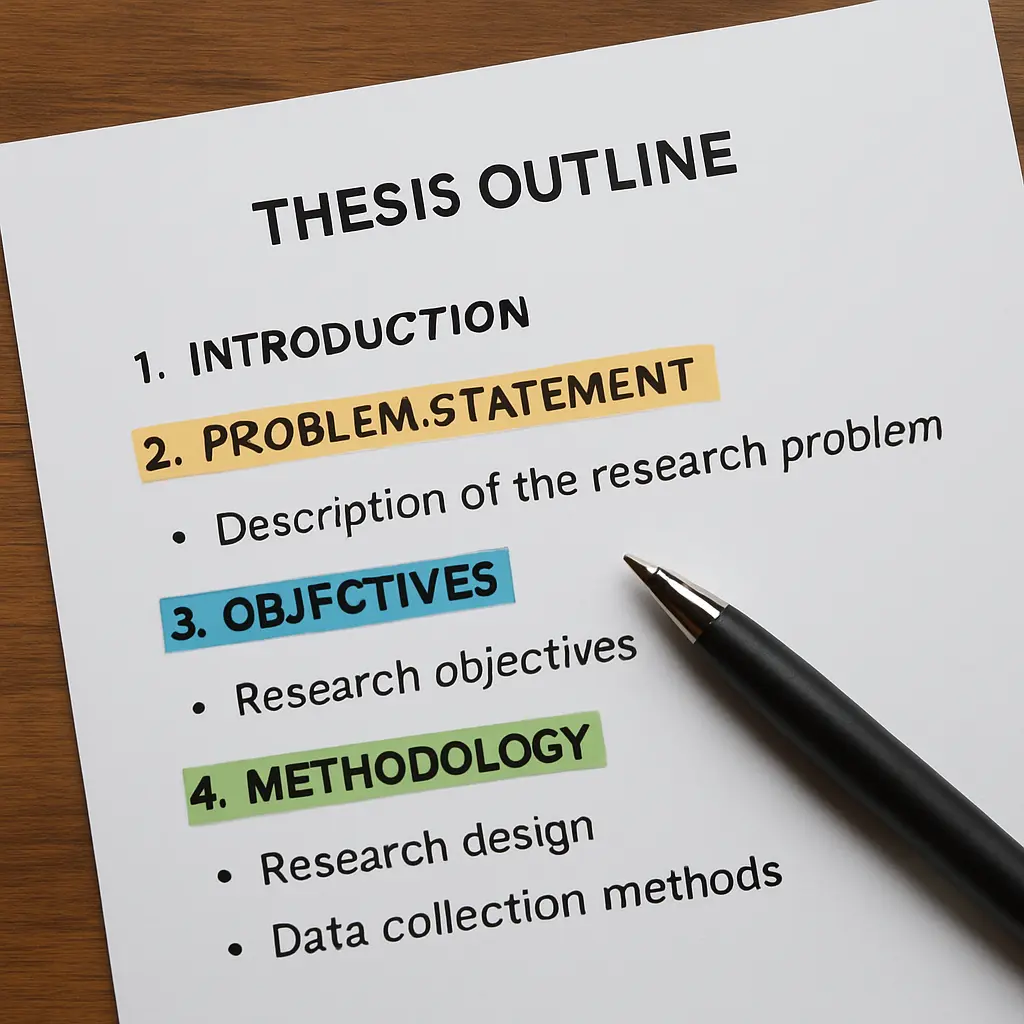
A complete M.Sc Nursing thesis model runs through nine parts in a fixed order: title, statement of the problem, objectives, hypotheses, conceptual framework, methodology, a results excerpt, a discussion excerpt and the conclusion with recommendations. What follows is a full, annotated specimen of every part, written as a shape rather than a real study — no real patients, scores or findings are attributed to anyone — with a note after each section on exactly what makes it pass at the viva.
This is not the place to learn how hypotheses and variables are built from scratch; that groundwork is covered step by step in our guide to hypotheses and variables in an M.Sc Nursing thesis. This page assumes that groundwork is done and shows what the finished sections look like once assembled into one document.
What does the title of a strong M.Sc Nursing thesis look like?
“Effectiveness of a Structured Teaching Programme on Knowledge and Practice Regarding [Condition/Procedure] Among [Population] in Selected [Setting], [City]”
What makes it pass: five things are named in one sentence — the intervention (structured teaching programme), what it changes (knowledge and practice), the condition, the population, and the setting. A title missing any one of these five is the first thing a research committee sends back, because the title is read as a compressed statement of the whole study.
What should the statement of the problem say?
[Condition] remains a significant concern among [population] in [setting], where [named gap in current practice] persists despite [existing effort]. Nurses caring for this population report [observed difficulty], yet a structured, evidence-based approach to [addressing the gap] is not consistently used at [setting]. This creates a need to determine whether a structured teaching programme can improve [population]’s knowledge and practice regarding [condition/procedure], so that nursing care at [setting] can be strengthened with an intervention whose effect has actually been measured.
What makes it pass: the paragraph moves from the condition, to the specific gap in current practice, to the nurse’s own difficulty, and lands on exactly what the study will measure — knowledge and practice, in this population, in this setting. It names no statistic it has not verified and no study it has not read; six fully worked statement-of-the-problem paragraphs across other disciplines, with the same funnel, are in our guide to the statement of the problem for an Indian dissertation.
How do the objectives of the study read?
1. To assess the pre-test level of knowledge and practice regarding [condition/procedure] among [population] in [setting].
2. To develop and administer a structured teaching programme on [condition/procedure] to [population].
3. To assess the post-test level of knowledge and practice among [population] after the structured teaching programme.
4. To compare the pre-test and post-test knowledge and practice scores among [population].
5. To determine the association between post-test knowledge scores and selected demographic variables.
What makes it pass: each objective is answerable by exactly one table in the results chapter, in the same order, and the fifth objective is the one examiners check first, because an association claim with no demographic variables actually collected in the tool is the single most common gap between Chapter 1 and Chapter 4.
What do the hypotheses look like?
H1: There is a significant difference between the pre-test and post-test knowledge scores of [population] regarding [condition/procedure].
H2: There is a significant difference between the pre-test and post-test practice scores of [population] regarding [condition/procedure].
H3: There is a significant association between post-test knowledge scores and selected demographic variables (age, educational status, source of information) of [population].
What makes it pass: each hypothesis is stated as a research (alternative) hypothesis — a difference or an association is expected, and the matching null is what the statistical test evaluates; H1 and H2 as written are non-directional, and a directional version would also state which way the change runs (post-test higher than pre-test). Each names the exact scores the objectives promised, and H3 lists the demographic variables by name rather than “selected demographic variables” left vague until Chapter 4. The full reasoning behind writing hypotheses this way, variable by variable, is in our dedicated guide linked above.
What does the conceptual framework section say?
This study is guided by [named nursing model, e.g. Pender’s Health Promotion Model / the Modified Health Belief Model], which proposes that [one-sentence statement of the model’s core mechanism relevant to this study]. Within this study, the structured teaching programme functions as the [modifying factor / cue to action], knowledge and practice scores represent the [perceived benefit / behaviour outcome], and the pre-test to post-test change is interpreted as evidence of the mechanism the model proposes.
What makes it pass: the model is named, its mechanism is stated in the study’s own terms, and every element of the study (the intervention, the outcome, the comparison) is mapped onto a named part of the model. A framework section that names a model and never maps the study onto it is decoration, not a framework.
What does the methodology section look like, condensed?
Design: One-group pre-test post-test pre-experimental design.
Population and sample: [Population] at [setting], accessible population of [n]; [n] participants selected by [technique] sampling meeting the inclusion criteria of [criteria] and excluding [exclusion criteria].
Tool: A structured knowledge questionnaire of [n] multiple-choice items and a practice checklist of [n] observed items, developed by the investigator and validated by [n] experts, with a reliability of [value] established on a pilot of [n] participants not included in the main study.
Intervention: A structured teaching programme of [duration], delivered using [method: lecture-cum-demonstration / audio-visual aids / booklet], covering [n] content areas as set out in the lesson plan.
Data collection: Pre-test administered on day one; intervention delivered; post-test administered on day [n], after institutional ethics committee approval (reference [number], dated [date]) and written informed consent from every participant.
What makes it pass: every noun in this paragraph is followed by a number, a name, or both — the sample size, the reliability value, the number of content areas, the interval between pre-test and post-test. A methodology section with adjectives instead of numbers (“a good sample size”, “a suitable interval”) is the second most common reason a synopsis is returned.

What does a results excerpt look like?
Table 2: Comparison of pre-test and post-test knowledge scores (n = 60)
Pre-test mean knowledge score: 12.4 (SD 3.1) out of a maximum of 25. Post-test mean knowledge score: 21.6 (SD 2.4). Paired t-test: t = 18.72, df = 59, p < 0.001.
Interpretation: The post-test mean knowledge score is markedly higher than the pre-test mean, an increase of 9.2 points on a 25-point scale. Inference: The paired t-test result (p < 0.001) leads to rejection of the null hypothesis; the structured teaching programme was associated with a statistically significant improvement in knowledge scores among the sample.
What makes it pass: the table states the sample size in its own caption, the interpretation reads the numbers without repeating them verbatim, and the inference states the statistical decision (reject or fail to reject the null) before drawing the substantive conclusion. All figures here are illustrative placeholders for the shape of a results block, not a claim about any real intervention’s effect.
What does a discussion excerpt look like?
The improvement in knowledge scores observed in this study is consistent with the pattern reported in structured-teaching-programme research in other nursing sub-specialities [cite two comparable published studies here], where a lecture-cum-demonstration format produced measurable short-term knowledge gains. The comparatively larger effect seen here may be attributable to [a plausible, stated reason tied to this study’s setting or sample], though the absence of a control group and the short post-test interval limit how far this can be generalised; the same finding examined over a longer follow-up period is the natural next step for this line of enquiry.
What makes it pass: the finding is placed against comparable prior work rather than left to stand alone, a plausible reason for the study’s own result is offered without overclaiming, and the design’s own limitation (no control group, short interval) is named honestly rather than buried in a closing paragraph. The four-move pattern behind a paragraph like this is set out in full in our guide to turning results into a discussion.
What does the conclusion and recommendations section say?
The study concludes that a structured teaching programme is associated with a significant improvement in [population]’s knowledge and practice regarding [condition/procedure] in this setting. It is recommended that [setting] incorporate a similar structured teaching component into routine care for this population, that nursing staff be oriented to the content areas covered, and that a follow-up study with a control group and a longer post-test interval be undertaken to confirm whether the improvement is sustained.
What makes it pass: the conclusion restates only what the results actually support (an association observed in this sample, in this setting), and every recommendation is something the study’s own findings point to directly, rather than a general call for “further research” detached from what was found.
Frequently asked questions
Is this a real M.Sc Nursing thesis?
No. Every figure, score and finding above is a placeholder shape, not a real result. The purpose of this model is to show the structure and the register each section is written in, not to be copied with numbers filled in.
Can I use this structure for a non-experimental nursing thesis?
The nine-part shape (title through conclusion) applies broadly, but a descriptive or correlational study replaces the pre-test/post-test hypotheses and the paired t-test with hypotheses and tests suited to its own design; which test fits which design is covered in our decision table for choosing a statistical test.
How long should each section be?
Length is set by your university’s ordinance, not by this model. The proportions that matter more than absolute length are that the methodology and results sections carry the most detail, and the conceptual framework and conclusion stay comparatively short.
Does every M.Sc Nursing thesis need a conceptual framework based on a named model?
Most Indian nursing departments expect one, commonly Pender’s Health Promotion Model, the Health Belief Model, Roy’s Adaptation Model or Orem’s Self-Care Deficit Theory, chosen for fit with the study’s own variables rather than familiarity alone.
What is the difference between the objectives and the hypotheses?
Objectives state what the study will do (assess, compare, determine); hypotheses state what the study expects to find, as a testable claim about a difference or an association. Every hypothesis should trace back to one objective.
Can I skip the hypotheses if my study is purely descriptive?
Yes. A purely descriptive study (for example, only assessing existing knowledge with no intervention or comparison) states objectives without hypotheses, since there is no difference or association being tested.
What sample size is typical for this kind of pre-experimental study?
There is no single number; it depends on the effect size expected and the statistical test planned. The reasoning and the three common calculation methods are in our guide to calculating sample size for a thesis.
Do I need ethics committee approval for this kind of study?
Yes, before data collection begins. The documents required and a realistic timeline are set out in our guide to ethics committee clearance for an Indian thesis.
What is the most common reason this kind of thesis is sent back at the synopsis stage?
A methodology section written with adjectives instead of numbers, and objectives that are not each answerable by exactly one table later in the document. Both are corrected by working backward from the results table you plan to produce.
Should the discussion compare my findings with other studies?
Yes, wherever comparable published work exists. A discussion that only restates its own numbers without placing them against prior findings reads as incomplete to most examiners.
Turn this model into your own chapters
The shape above is the easy part; filling every bracket with your own setting, tool and numbers, and keeping the objectives, hypotheses and results consistent as the document grows, is where a synopsis usually goes wrong. Tesify structures each section from your own study design and keeps the numbers in Chapter 1 matching the tables in Chapter 4 as you write.