
In 2026, the Supreme Court of India held twice, in separate rulings, that relying on AI-fabricated case law is not a harmless error — it is professional misconduct with disciplinary consequences. If you are writing an LL.M. dissertation and reaching for ChatGPT or any other AI tool to help with your legal research, this is the year that question stopped being hypothetical. Here is exactly what the Court said, why it matters more for a law dissertation than for any other discipline, and a safe workflow for using AI in legal research and drafting without putting your degree or your future practice at risk.
What the Supreme Court actually said in 2026
Two rulings this year moved AI-hallucinated case law from a professional embarrassment to a disciplinary matter, and both are worth reading in your own dissertation’s introduction if your topic touches AI and the legal profession at all.
In Gummadi Usha Rani & Anr v. Sure Mallikarjuna Rao & Anr (Justices P.S. Narasimha and Alok Aradhe, order dated 27 February 2026), the Bench held: “A decision based on such non-existent and fake alleged judgments is not an error in the decision-making process. It would be a misconduct and legal consequence shall follow.” The Court sought responses from the Attorney General, the Solicitor General and the Bar Council of India, with a further hearing fixed for 10 March 2026.
In Pooja Ramesh Singh v. Jammu and Kashmir Bank Ltd. and Anr. (judgment dated 2 July 2026), arising out of insolvency proceedings where lower tribunals had relied on fabricated citations, the Court went further: “A decision of a Court or an adjudicating authority based on material which is fake and hallucinated is no decision at all, and it amounts to subversion of the rule of law.” The Court declared a policy of zero tolerance for the production, citation, or use of AI-generated precedents without human verification, and directed the Bar Council of India to constitute a committee to prescribe disciplinary consequences for violations.
As of this writing, that Bar Council committee has been directed but a completed, published AI-use policy from the Bar Council of India itself could not be located on the Council’s own site — the Supreme Court’s direction is the current, verifiable state of the law, not a settled Bar Council regulation yet. State it this way in your own dissertation rather than asserting a completed policy that does not yet exist: the Court has acted, the profession’s own regulator is in the process of following.
This was already happening before the Court ruled
The Supreme Court’s 2026 rulings did not come out of nowhere. On 30 December 2024, the Bengaluru bench of the Income Tax Appellate Tribunal delivered an order in the Buckeye Trust matter, a trust-taxation dispute worth approximately ₹669 crore, that cited three Supreme Court judgments and one Madras High Court ruling — none of which existed. The tribunal was forced to recall its own order under Section 254(2) of the Income-tax Act, 1961, the provision that allows rectification of a mistake apparent from the record. An order of that magnitude was unwound because the authorities cited in it were never real. That incident, and others like it working through the tribunal and High Court system, is the pattern the Supreme Court’s 2026 rulings responded to.
Why this lands differently on a law dissertation than any other
Every discipline on this site has to worry about AI accuracy. Law is different for one specific reason: the case law you cite in your LL.M. dissertation is the same skill you will be judged on as a practising advocate, and the Supreme Court has now said in terms that getting it wrong through unverified AI use is misconduct, not just a bad grade. A fabricated citation in a dissertation is an academic integrity problem; the exact same failure mode in a court filing, a few years later, is now explicitly a professional-conduct problem the apex court has flagged by name. Building the verification habit now, at the dissertation stage, is not just about passing your viva.
A safe workflow for AI in an LL.M. dissertation
1. Never let AI be the last word on whether a case exists
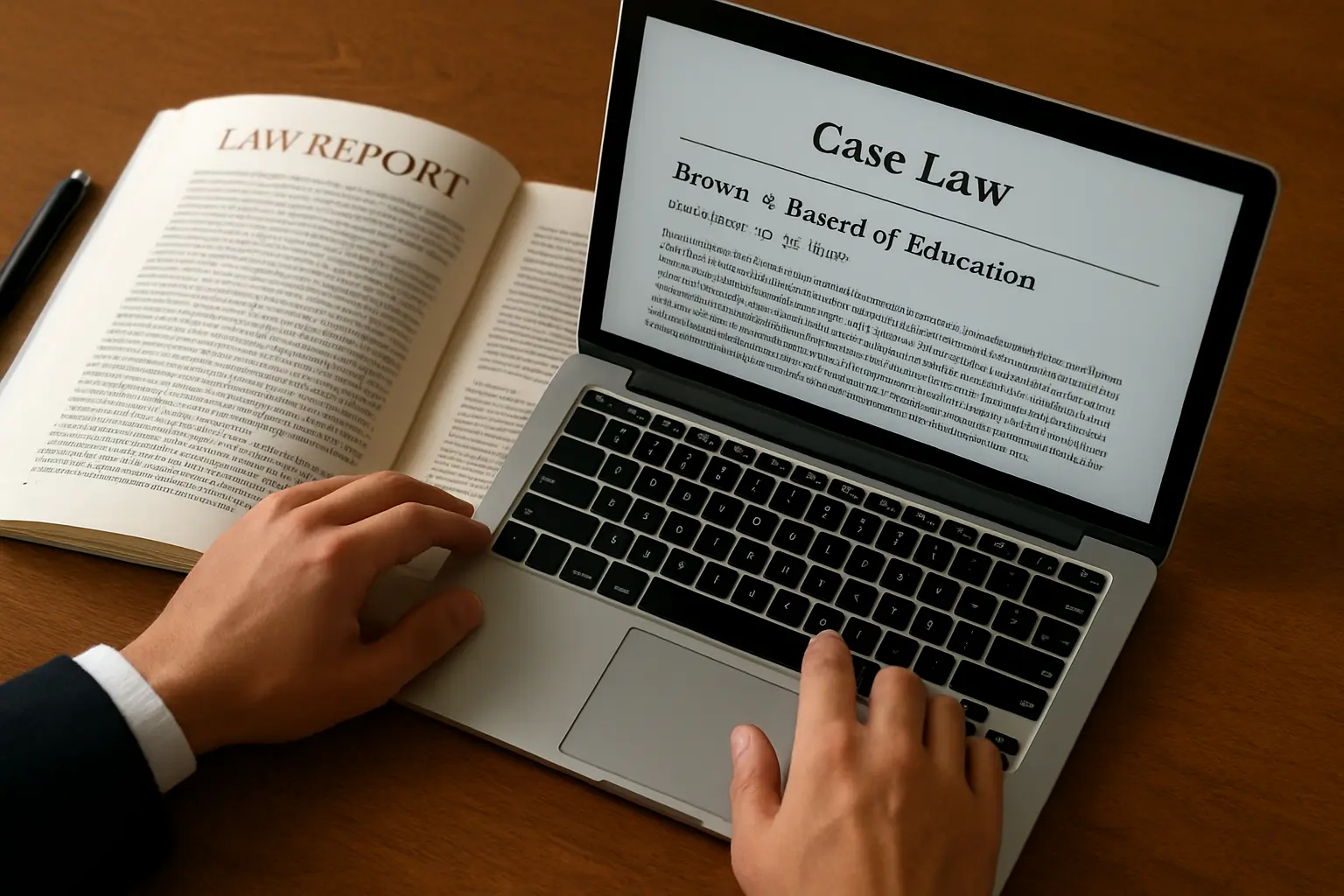
The pattern in every documented incident — from the U.S. case of Mata v. Avianca (Southern District of New York, decided 22 June 2023, where the presiding judge fined the plaintiff’s lawyers US$5,000 for submitting a motion built on fabricated case citations that ChatGPT had itself falsely assured them were real) to the Indian tribunal and court incidents cited above — is the same: an AI tool generates a citation that sounds exactly right, and no one checks it against the actual report before it is submitted. The rule for your dissertation is absolute: every case citation is verified against a primary source — the Supreme Court’s own Digital SCR, the eSCR service, India Code, or a licensed database — before it appears in your text, with no exception for a citation that “looks standard”. The databases and what each actually holds are compared in our guide to legal research databases for an LL.M. dissertation.
2. Use AI for structure and expression, not for the law itself
Asking an AI tool to help outline a chapter, tighten a paragraph you have already drafted, or explain a concept in plain language so you can then go and read the primary source properly is a defensible use. Asking it to write your case-law analysis, generate your literature review of secondary sources, or draft an argument you have not yourself verified against the primary material is not — not because a rule forbids the tool, but because you cannot defend in a viva, or later in practice, an argument built on sources you never checked.
3. Comparative and foreign-law sections need extra scrutiny
If your LL.M. dissertation compares Indian law with a foreign jurisdiction, AI tools are especially prone to conflating similarly named doctrines, misattributing a foreign court’s holding to an Indian one, or inventing a plausible-sounding foreign case to fill a gap. Treat every foreign citation with the same verification discipline as an Indian one, checked against that jurisdiction’s own official law reports or a recognised database, not against the AI’s own restatement of it.
4. Disclose the use exactly as your certificate already requires
Nothing in the 2026 rulings changes the underlying declaration mechanics your university already requires; the UGC integrity framework, the reference format for citing a generative AI tool, and a worked disclosure statement you can adapt are set out in full in our guide to citing ChatGPT and declaring AI use in an Indian thesis. What the 2026 rulings add is not a new disclosure form — it is a much higher cost to being caught having skipped the verification step.
5. Keep your verification trail, not just your final citations
For every case your dissertation cites, keep a note of where you actually read it — the database, the report citation, the date you accessed it — separate from the citation itself. If a supervisor or examiner asks how you confirmed a citation is genuine, “I checked it on the Supreme Court’s Digital SCR on [date]” is a complete answer; “an AI tool gave it to me” is now, after these rulings, a materially weaker one even where the citation happens to be genuine.
What the general integrity rules already cover, and what is new here
The UGC’s 2018 academic-integrity regulations say nothing about artificial intelligence by name, and the general permission-and-disclosure framework that follows from them applies to every discipline equally; that ground is covered in full in our guide to AI and thesis writing in India: what the integrity rules actually require. What is new, specifically for law students, is not a change to that framework but a 2026 Supreme Court position that gives the same underlying failure — submitting unverified AI output as fact — a name and a consequence particular to the legal profession: misconduct, not just an academic penalty.
Frequently asked questions
Does the Supreme Court’s ruling ban using AI to write an LL.M. dissertation?
No. Both 2026 rulings target unverified AI-generated case law specifically — citing or relying on precedents that turn out to be fake or hallucinated without checking them. They do not address or prohibit using AI for structuring, language editing or explaining a concept to yourself before you read the primary source.
Has the Bar Council of India issued its own AI policy yet?
Not as a completed, published policy as of this writing. The Supreme Court’s July 2026 ruling directed the Bar Council to constitute a committee to prescribe disciplinary consequences; that committee’s work was directed, not yet completed, at the time this guide was written. Check the Bar Council’s own site for the current position before you rely on this changing.
What is the actual risk if I accidentally cite a fake case an AI tool gave me?
At the academic level, a fabricated citation is a serious integrity and credibility problem that an examiner or supervisor is very likely to catch, since checking a citation against a primary source takes moments. The Supreme Court’s 2026 position additionally establishes that, in a professional legal setting, the same failure is treated as misconduct rather than a mere error.
Can I cite the 2026 Supreme Court rulings themselves in my dissertation?
Yes, if your topic touches AI, legal ethics, the legal profession or civil procedure, these rulings are directly relevant primary sources; cite them from the Court’s own record or a verified law report, in your department’s required citation style, exactly as you would any other judgment.
Is foreign case law from AI tools riskier than Indian case law?
It carries the same fabrication risk plus an added risk of jurisdiction confusion — an AI tool conflating a similarly named doctrine or case across jurisdictions. Verify foreign citations against that jurisdiction’s own official reports, not against the AI’s restatement.
Should I mention in my declaration that I used AI to check citations, as opposed to generate them?
Using AI to locate a possible citation, which you then independently verified against the primary source yourself, is different from using AI-generated case law unverified. Describe accurately what happened in your declaration; the worked template in our citation-declaration guide covers exactly this distinction.
What about using AI to summarise a long judgment for me?
A summary can help you navigate a long judgment faster, but you still have to read the operative holding and the material facts yourself before relying on it or citing it, since an AI summary can misstate exactly the part of a judgment that matters for your argument.
Does this apply only to case citations, or to statutes too?
The same discipline applies to statutory citations, section numbers and amendment dates — verify against India Code or the relevant official gazette rather than an AI tool’s restatement, since section numbering changes with amendments and an AI tool trained on older data can cite a superseded version.
Write your LL.M. dissertation with every citation verified
The workflow above adds one habit to your research process: check before you cite, every time, with no exception for a citation that looks routine. Tesify helps you structure your LL.M. dissertation’s chapters and keep your argument consistent as it grows, while leaving the verification of every case and statute exactly where it belongs — with you, checked against the primary source.