
A dentistry dissertation’s sample size is decided by the sub-specialty’s typical effect size and available patient flow through your college’s OPD, not by a single rule of thumb — an orthodontic cephalometric study, a periodontal clinical trial and an in-vitro material-testing study each justify a different sample logic. Population and sample considerations across the major BDS/MDS sub-specialties, with the recruitment and ethics steps examiners actually check.
| Sub-specialty | Typical population | Sampling approach |
|---|---|---|
| Orthodontics | Patients seeking malocclusion correction, OPD or archived records | Consecutive sampling from OPD; cephalometric archives for retrospective studies |
| Periodontics | Patients with a defined periodontal disease stage | Purposive sampling by clinical staging criteria; control group matched by age/sex |
| Conservative dentistry & endodontics | Often in-vitro (extracted teeth) rather than patients | Convenience sampling of extracted teeth meeting inclusion criteria; sample size from prior in-vitro studies |
| Prosthodontics | Edentulous or partially edentulous patients | Consecutive OPD sampling; smaller samples common given lower patient flow per criterion |
| Oral pathology / oral medicine | Biopsy or lesion cases meeting a diagnostic criterion | Often retrospective record review; prospective case series where lesion type is rare |
| Public health dentistry | Community or school-based population samples | Cluster or stratified sampling across schools/communities |
Where does your patient sample actually come from?
Most Indian BDS and MDS dissertations recruit from the dental college’s own outpatient department, which shapes both the strengths and the limitations an examiner expects you to name. OPD-based consecutive sampling — enrolling every eligible patient who presents within your data-collection window until your target N is reached — is the standard, defensible method for a clinical dissertation, and it is faster to justify than a claimed random sample your OPD flow cannot actually support. State your inclusion and exclusion criteria precisely (an age range, a specific diagnosis, absence of a confounding systemic condition) and report how many eligible patients were approached versus enrolled, since the gap between the two is itself a piece of methodological transparency examiners look for.
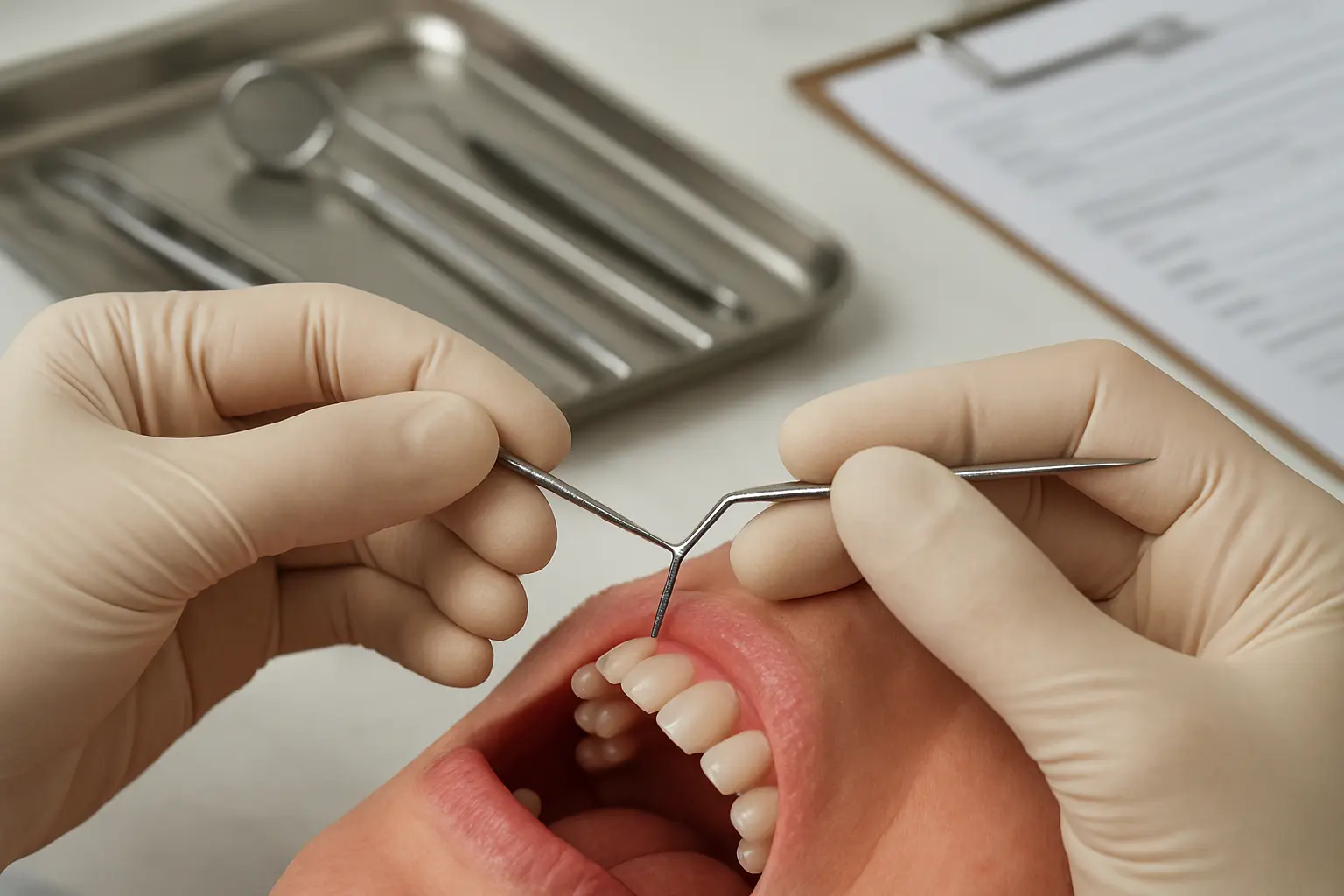
How is sample size actually calculated for a clinical dental study?
The same formula families used across health-science dissertations apply in dentistry, but the input values differ by sub-specialty because expected effect sizes and outcome variability differ:
- For a study comparing two treatment groups on a continuous outcome (a periodontal pocket-depth reduction, for instance), a sample-size calculation typically needs the expected mean difference and standard deviation from a prior published study in that same outcome — cite the specific study your effect-size assumption comes from rather than assert a round number without a source
- For a diagnostic-accuracy or prevalence-focused study (an oral lesion’s prevalence in a population, for instance), the calculation instead needs an expected prevalence and a desired confidence interval width
- For an in-vitro material or technique comparison (a common design in conservative dentistry and prosthodontics), sample size is often set by convention from prior similar in-vitro studies in the literature rather than a formal power calculation, since the “population” is standardised specimens rather than variable human subjects — state this explicitly rather than force an inapplicable clinical-trial formula onto an in-vitro design
Whichever approach applies to your design, report the software or method used (G*Power is common), the input values with their source, and the resulting minimum sample size in your methodology chapter — a sample size stated without its calculation basis is a frequent examiner objection.
What ethics and consent steps does a dental dissertation need?
A dental college’s Institutional Ethics Committee (IEC) clearance is standard practice before patient recruitment begins for a BDS or MDS dissertation involving human subjects, following the same general framework the ICMR National Ethical Guidelines set out for health research more broadly. Beyond general informed consent, dental research carries a few sub-specialty-specific consent points worth naming explicitly in your methodology chapter: consent for any additional radiograph or imaging taken purely for research purposes (beyond what routine clinical care would require), consent for extracted-tooth specimens used in in-vitro research rather than discarded as clinical waste, and parental or guardian consent alongside child assent for any paediatric dentistry study.
What changed with the shift from DCI to the National Dental Commission?
Dental education and practice in India were regulated by the Dental Council of India, incorporated under the Dentists Act, 1948, until the National Dental Commission Act, 2023 restructured national oversight, including introducing a National Exit Test after BDS. For a dissertation methodology chapter, the practical point is which regulatory body currently governs your specific requirement — check the current regulator’s own published guidance for the specific dissertation, thesis-submission or research-ethics rule you are citing, rather than assume older DCI-era references still apply unchanged, since the transition changed some administrative and oversight structures. This matters directly for a dissertation’s front matter and ethics-clearance paperwork too: a declaration or certificate template referencing the old regulatory body by name should be checked against your current university’s format, since some institutions update these templates promptly after a regulatory transition and others lag behind — confirm the current expected wording with your department rather than reuse an older student’s submitted thesis as a template without checking.
How does sample-size logic differ across dental sub-specialties in practice?
Beyond the general formula families above, each sub-specialty’s typical study design shapes how the sample-size conversation actually plays out in an Indian dental college:
- Orthodontics: cephalometric and model-analysis studies often use archived patient records, so sample size is frequently constrained by how many complete, well-documented records the archive actually holds meeting your criteria — state this constraint honestly if your final N came from an exhaustive archive search rather than a target set in advance
- Periodontics: clinical trials comparing a treatment against a control (a new regenerative material against standard therapy, for instance) need the fullest formal power calculation of the group, since a genuine two-arm comparison with a continuous outcome is the classic case the standard formulas were built for
- Prosthodontics: patient-based studies (denture satisfaction, implant outcomes) often run smaller than periodontics trials simply because eligible patients present less frequently per specific criterion — a smaller, honestly justified sample with a clearly stated limitation is more defensible than an inflated target the OPD cannot realistically supply
- Public health dentistry: community and school-based studies need a cluster-sampling design rather than simple random sampling, and the sample-size calculation must account for the design effect of clustering, which is a distinct step many first-time student researchers omit
Common sample-size and population mistakes examiners flag
- A stated sample size with no calculation shown, or a calculation shown with no cited source for the effect-size assumption
- A convenience OPD sample described in the text as “randomly selected,” which examiners recognise as a methodological inconsistency the moment recruitment is described in more detail
- An in-vitro specimen count justified by a clinical-trial power calculation formula that does not actually apply to standardised laboratory specimens
- No stated inclusion/exclusion criteria, or criteria stated only in general terms (“healthy patients”) without an operational definition an examiner could apply themselves
Once your population and sample are defined, the next methodology decisions follow the same logic as any Indian health-science dissertation; how to calculate sample size for a thesis covers the G*Power, Krejcie-Morgan and Cochran methods in worked detail, and which statistical test should you use covers the decision table for analysing whatever data your sample produces. How to get ethics committee clearance for a thesis covers the general IEC process this guide assumes as background. Tesify’s AI thesis assistant can help you structure the population-and-sample section of your methodology chapter around your specific sub-specialty’s conventions, with the sample-size calculation and its cited basis stated the way an examiner expects to see it — see which standardised tool for an M.Ed dissertation for how the same instrument-and-sample discipline applies in a related applied field.
Frequently asked questions
How many patients are typically needed for a BDS or MDS clinical dissertation?
There is no single number — it depends entirely on your specific outcome measure, expected effect size and chosen confidence level, calculated through a formal power calculation for a clinical comparison, or set by convention from similar prior studies for an in-vitro or descriptive design. State your own calculation rather than rely on what “sounds like enough.”
Can I use patient records retrospectively without individual consent?
Retrospective record-based studies are common in oral pathology and orthodontics, and Institutional Ethics Committees frequently permit a waiver of individual consent for de-identified retrospective data, but this waiver must be explicitly requested and granted by your IEC — do not assume it is automatic simply because the data already exists.
What if my OPD does not have enough eligible patients within my thesis timeline?
Discuss the shortfall with your guide early rather than at the deadline — options include extending the recruitment window, broadening inclusion criteria within a defensible clinical rationale, or, for some designs, collaborating across multiple college OPDs with appropriate ethics and institutional approval for a multi-site sample.
Do in-vitro dental studies need Institutional Ethics Committee approval?
Studies using only extracted teeth with no identifiable patient information typically require a lighter review than patient-involving research, but check your own institution’s IEC policy directly — many still require some form of clearance or exemption confirmation even for specimen-only research, particularly regarding the source and consent basis for the extracted teeth used.
How do I justify my inclusion and exclusion criteria to an examiner?
State the clinical or methodological reason behind each criterion explicitly — an age range tied to a developmental stage relevant to your outcome, an exclusion for a systemic condition that would confound your specific measure — rather than list criteria without justification, since an examiner will ask why a criterion was set at that specific threshold.
Is a control group always necessary in a dental dissertation?
Not always — a purely descriptive or prevalence study does not need one, but any comparative claim (a treatment’s effect, a material’s superiority) does, and the absence of a control group in a comparative-sounding study is a common and easily avoidable examiner objection.
How do I handle dropouts or incomplete follow-up in a longitudinal dental study?
Report the number enrolled, the number completing each follow-up point, and the reason for dropout where known, rather than silently analysing only the completers — a longitudinal orthodontic or periodontal study with unreported attrition is a common examiner flag, since the pattern of who drops out can itself bias the result.
Should sample size for a dissertation match what similar published studies in the same sub-specialty used?
Published sample sizes are a useful sanity check and a source for effect-size assumptions, but matching a prior study’s N without running your own calculation is not the same as justifying your sample size — always show your own calculation, even where it lands close to what precedent studies used.