
A design-and-fabrication project is the most common final-year format in Indian Mechanical Engineering B.Tech and M.Tech programmes, and it fails as a thesis for one predictable reason: students document what they built without documenting the engineering decisions behind it. This guide walks through the nine steps that turn a workshop build into a defensible design thesis, from problem definition through testing and cost analysis.
Step 1: Define the design problem with measurable constraints
“Design and fabricate a solar dryer” is a project title, not a design problem. A thesis-ready problem statement names the constraint your design has to satisfy and the number that proves it did: target capacity, load, speed, temperature range, budget ceiling, or a specific failure mode in the existing solution you are improving on. Write the problem statement as one sentence with a number in it — “design a solar dryer capable of reducing the moisture content of 5 kg of fresh chillies from 80% to 10% within 48 hours of sunlight exposure” — before you touch CAD software.
Step 2: Review existing solutions, not just published papers
A design thesis literature review has an extra obligation beyond the standard academic search: it must survey what already exists as a product, patent or prior student project, because your examiner’s first question is almost always “how is this different from what is already on the market or already been built here.” Structure this section as a comparison table — existing solution, its stated limitation, and how your design addresses that specific limitation — rather than a narrative summary of papers read.

Step 3: Generate and screen concepts with a weighted decision matrix
Examiners look for evidence that your final design was chosen, not simply the first idea that occurred to you. A weighted decision matrix — criteria (cost, manufacturability, weight, maintenance, safety) each given a weight, two or three candidate concepts scored against each criterion, a weighted total that names a winner — is the standard evidence Indian mechanical departments expect in Chapter 3, and it converts what could read as an arbitrary choice into a documented one.
Step 4: Produce detailed CAD models with dimensioned drawings
Beyond a rendered assembly, a thesis-ready design chapter needs fully dimensioned orthographic drawings (front, top, side views with tolerances) for every fabricated component, an exploded assembly view, and a bill of materials with standard part numbers where applicable. SolidWorks, CATIA, Fusion 360 and AutoCAD are the tools most Indian mechanical departments accept; whichever you use, export the drawing sheets in the standard your department specifies (commonly first-angle projection per Indian drafting practice) rather than the software’s default.
Step 5: Run the analysis your design actually needs — and validate it
Not every mechanical design thesis needs finite element analysis, but every claim of structural, thermal or fluid performance needs some form of validation, and this is where examiners probe hardest:
- Structural/FEA (ANSYS, SolidWorks Simulation): report mesh type and element count, boundary conditions, load case, and — critically — a hand-calculation or textbook-formula check for at least one simple case to show the FEA result is plausible, not just a screenshot of a stress contour
- Thermal: state the governing assumptions (steady-state versus transient, convection coefficient source) and compare against a simplified analytical estimate
- Kinematic/dynamic (mechanism design): a degrees-of-freedom check (Grubler’s equation) and a motion simulation, ideally cross-checked against a hand-calculated position or velocity at one instant
An analysis chapter with no validation step is the single most common reason a mechanical design thesis is sent back for revision at the viva.
Step 6: Justify material and manufacturing process selection
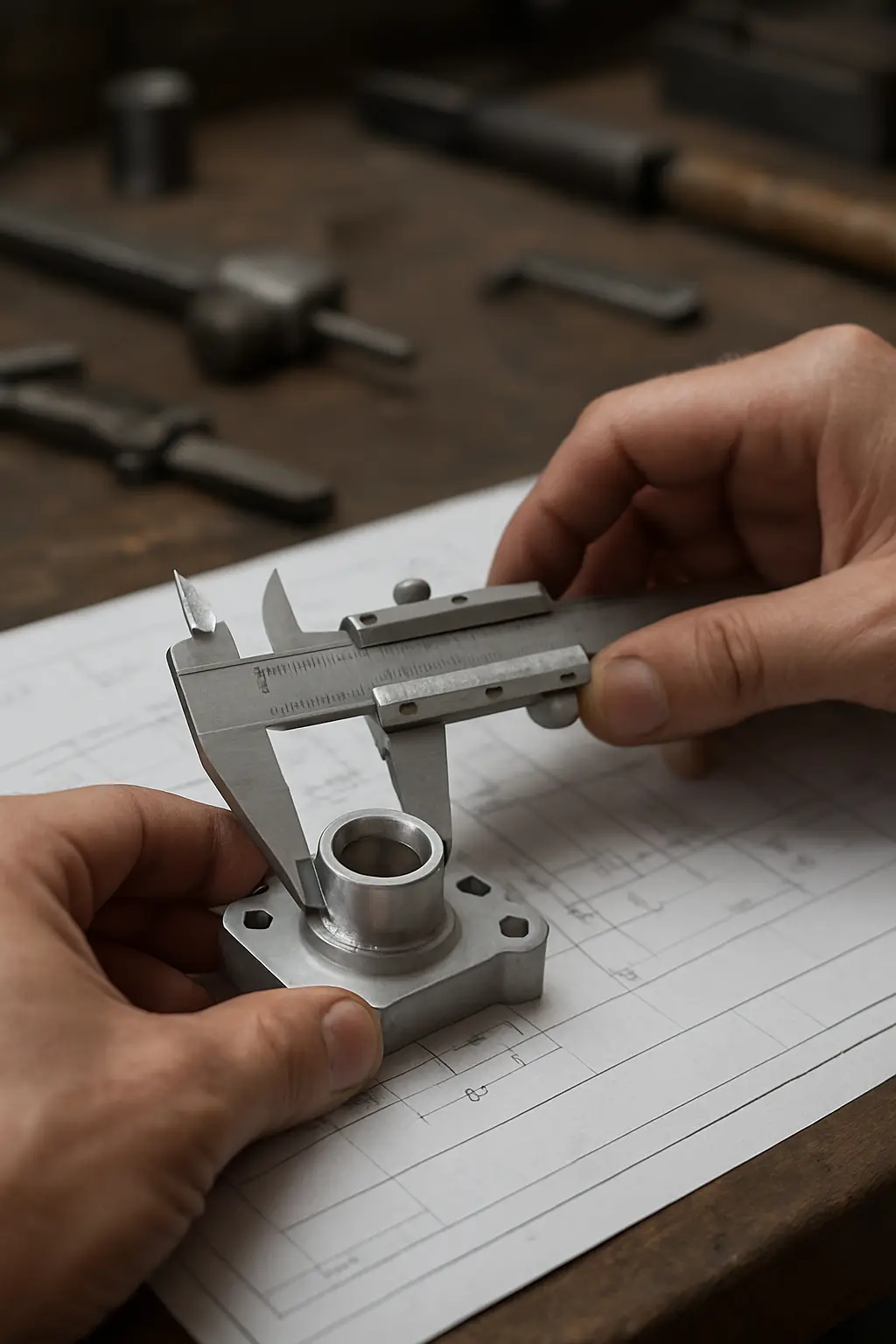
State why each major component uses the material and process it does — a material-selection table (candidate materials, relevant property, cost per unit, availability) is expected wherever the choice is not obvious, and the manufacturing process (casting, machining, welding, 3D printing, sheet-metal forming) needs a one-line justification tied to the quantity, tolerance and cost constraints from Step 1, not just “this process was used because it was available in the workshop.”
Step 7: Document fabrication with photographs at each stage
A fabrication chapter that shows only the finished prototype invites the question of what problems arose along the way. Photograph and briefly describe each major fabrication stage — raw material, machining or forming operation, sub-assembly, final assembly — and note any deviation from the CAD design that fabrication forced (a dimension changed for manufacturability, a substituted fastener) along with why. Examiners read an honestly documented deviation as evidence of real hands-on work, not as a weakness.
Step 8: Test against the Step 1 constraint and report the number
Return to the measurable constraint from your problem statement and report the tested result against it directly — the solar dryer that was supposed to take chillies from 80% to 10% moisture in 48 hours either did or did not, and the results chapter states the achieved figure, the test conditions, and the gap (if any) with a stated reason. State the number of test runs or replicates, since a single untested trial invites the same “how do you know this is repeatable” question a statistical thesis draws on sample size.
Step 9: Report cost and give an honest limitations section
A bill-of-materials-based cost table (component, quantity, unit cost, source) closes most Indian mechanical design theses, often followed by a comparison against a commercial equivalent if one exists. Close the results chapter with limitations stated plainly — what the prototype does not yet do, what a production version would need to address (durability testing, larger-scale manufacturing, certification) — since a design thesis that claims no limitations reads as less credible, not more, to an examiner who has built things themselves.
How is a design thesis different from an M.Tech research dissertation?
A research-focused M.Tech dissertation is judged on the novelty and rigour of an investigation — a new algorithm, a new material characterisation, a new analytical model. A design-and-fabrication thesis is judged differently: novelty matters less than whether every design decision is justified and every performance claim is validated against a test or a hand calculation. Students who treat a design thesis as if it needs a literature-review-style “research gap” often struggle, because the actual gap being closed is the difference between the existing solution’s stated limitation and your design’s measured performance against it — a narrower, more concrete kind of contribution than a research dissertation’s.
What belongs in the appendices of a design thesis?
Full-size dimensioned drawings that would clutter the main chapters, the complete FEA or simulation report (mesh convergence tables, full stress plots beyond the one figure discussed in-text), datasheets for any purchased components, and raw test data behind the summarised results table in Chapter 4 all belong in appendices rather than the main body. Reference each appendix by number at the point in the main text where the underlying claim is made, so an examiner who wants to check your work can find the source data without searching.
Who typically evaluates a mechanical design thesis?
Most Indian mechanical departments assign a project guide, one or two internal examiners from the department, and — for final-year B.Tech projects especially — an external examiner from industry or another institution who is likely to ask practical manufacturing and cost questions a purely academic examiner might not. Prepare a version of your presentation that can answer both kinds of questions: the theoretical validation an academic examiner probes, and the “would this actually get made this way in a workshop” question an industry examiner is more likely to raise.
Once your design chapters are structured this way, the front matter and citation mechanics follow the same conventions as any Indian engineering dissertation; how to write an M.Tech dissertation report covers the overall document structure and how to cite in APA style for an Indian university thesis covers referencing the standards and prior work you compared against. If your viva is coming up and you want to anticipate the code-and-validation questions a design thesis draws, what examiners ask at an engineering thesis viva covers the same validation-first questioning pattern in a parallel discipline. If your project instead centres on evaluating a material property or a manufacturing process statistically rather than a single design, which statistical test should you use covers the decision table for that kind of comparison. Tesify’s AI thesis assistant can turn your design log, CAD exports and test data into a structured thesis chapter that keeps the engineering-decision trail examiners look for intact, rather than a narrative account of what was built — see how to choose a research topic by discipline for how the same evidence-first standard applies from the proposal stage onward.
Frequently asked questions
Does every mechanical design thesis need finite element analysis?
No — FEA is expected where a structural or thermal performance claim needs validation, but a purely mechanism-based design (a linkage, a fixture) is more often validated through kinematic analysis and physical testing. Match the analysis method to the actual engineering question your design raises.
How many prototypes should I build?
One functioning prototype is standard for most Indian B.Tech and M.Tech design theses, but document any earlier iteration that failed or was revised — a design log showing iteration is stronger evidence of engineering process than a single successful build presented without its history.
What if my fabricated prototype does not meet the design target?
Report the actual result honestly and analyse why — a gap between design and tested performance, explained with a credible engineering reason (manufacturing tolerance, material substitution, an assumption in the analysis that did not hold), is a legitimate and often stronger thesis finding than an unexplained perfect match to target.
Can a simulation-only project (no physical fabrication) count as a design thesis?
Some Indian departments accept a simulation-only design project, particularly at M.Tech level, but check your own department’s guidelines first — many undergraduate design-and-fabrication courses specifically require a physical prototype, and a simulation-only submission against that requirement can be rejected outright regardless of analysis quality.
How do I cite the standards I designed against?
Cite the specific Indian Standard (or international standard, if no IS equivalent exists) by number and year in the same reference-list format as any other source, and quote the specific clause you designed to rather than the standard as a whole.
Should I include failed design iterations in the thesis itself, or only the final design?
Include a brief account of at least one earlier iteration and why it was rejected — this is exactly the evidence the weighted-decision-matrix step is meant to produce, and omitting it leaves your final design looking arbitrary rather than selected.
What is the most common examiner objection to a mechanical design thesis?
An analysis result — usually an FEA stress or deflection figure — presented without any hand-calculation or textbook check against it is the most frequently cited objection, closely followed by a cost table with no source cited for the unit prices used.