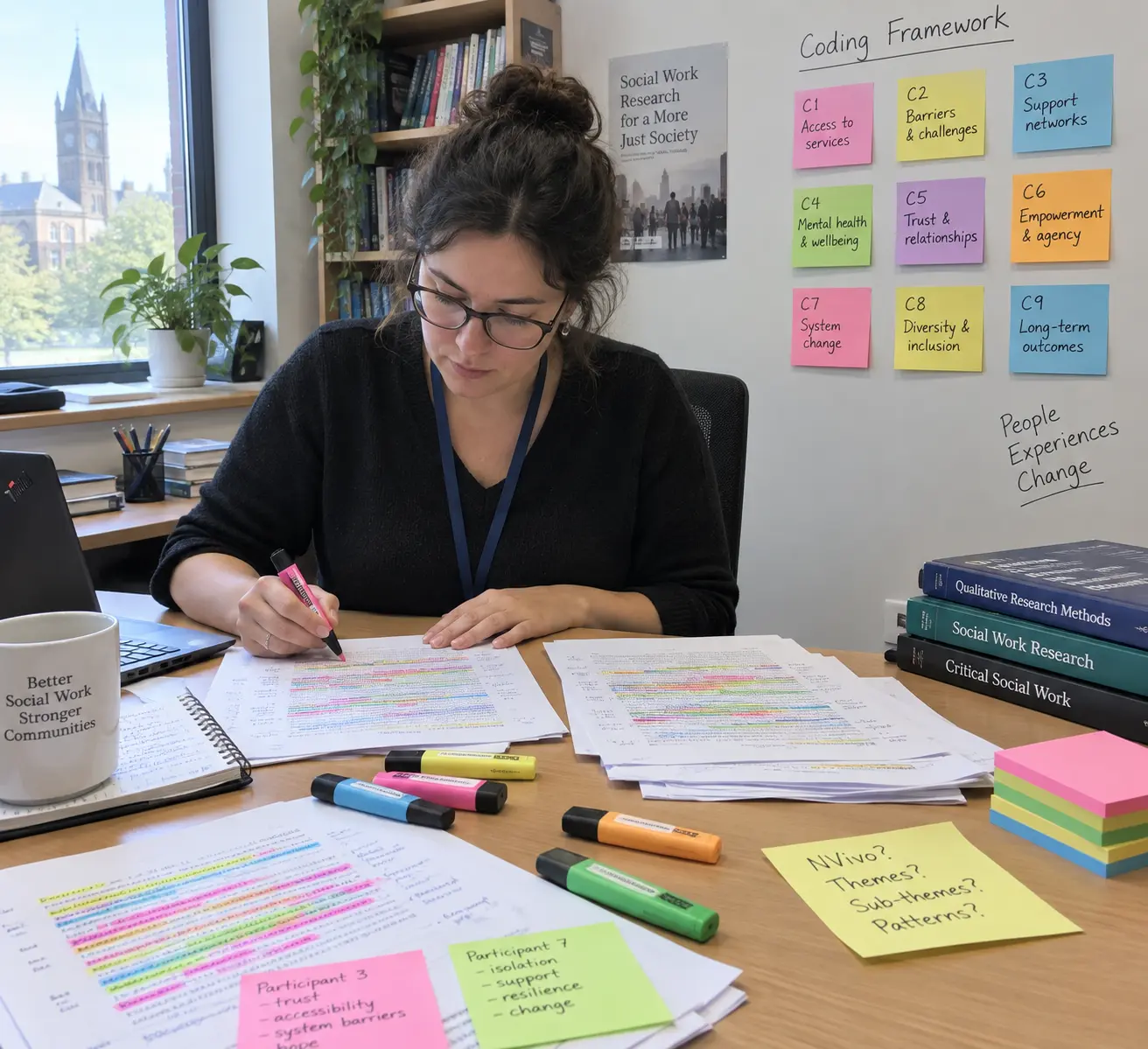
Thematic analysis is one of the most common qualitative methods for a social work thesis in India because it works with almost any interview or focus-group data without requiring a specialised theoretical stance. This guide walks through Braun and Clarke’s six-phase framework step by step, with a worked, fully fictional example built from an illustrative interview about frontline social work practice, so you can see exactly what each phase produces.
What Is Thematic Analysis, and Why Does It Fit Social Work Research?
Thematic analysis identifies, analyses and reports patterns — themes — across a qualitative data set, most often interview transcripts or focus-group discussions. Unlike some qualitative methods, it does not require you to commit to a specific theoretical framework (unlike, say, grounded theory’s commitment to building theory from the ground up, or interpretative phenomenological analysis’s specific focus on lived experience), which is part of why it is so widely used in social work dissertations: it is flexible enough to fit ethics-of-care interviews, service-user narratives, caseworker reflections or policy-implementation studies alike. The method used across the six-step process below follows Braun and Clarke’s 2006 framework, published in Qualitative Research in Psychology, one of the most widely cited thematic-analysis frameworks in the social sciences.
Braun and Clarke’s Six Phases, Applied to a Social Work Thesis
Step 1: Familiarising Yourself With the Data
Transcribe every interview verbatim (or have it transcribed), then read the full transcript set at least twice before coding anything — once for overall content, once making informal margin notes. For a social work thesis, this is also the stage to note your own reactions and assumptions as the researcher, since social work interviews often touch material (child protection, domestic violence, poverty) that can shape how you read the data if left unexamined; a brief reflexive note at this stage strengthens your methodology chapter’s credibility.
Step 2: Generating Initial Codes
Work systematically through the entire data set, labelling segments of text with short descriptive codes — a code names what is happening in that segment, not your interpretation of why. Coding can be done manually (highlighting and margin labels on printed transcripts) or with qualitative software; either is acceptable for a dissertation, provided you document which you used and how. Code every transcript against the full list of codes generated so far, revisiting earlier transcripts as new codes emerge from later ones.
Step 3: Searching for Themes
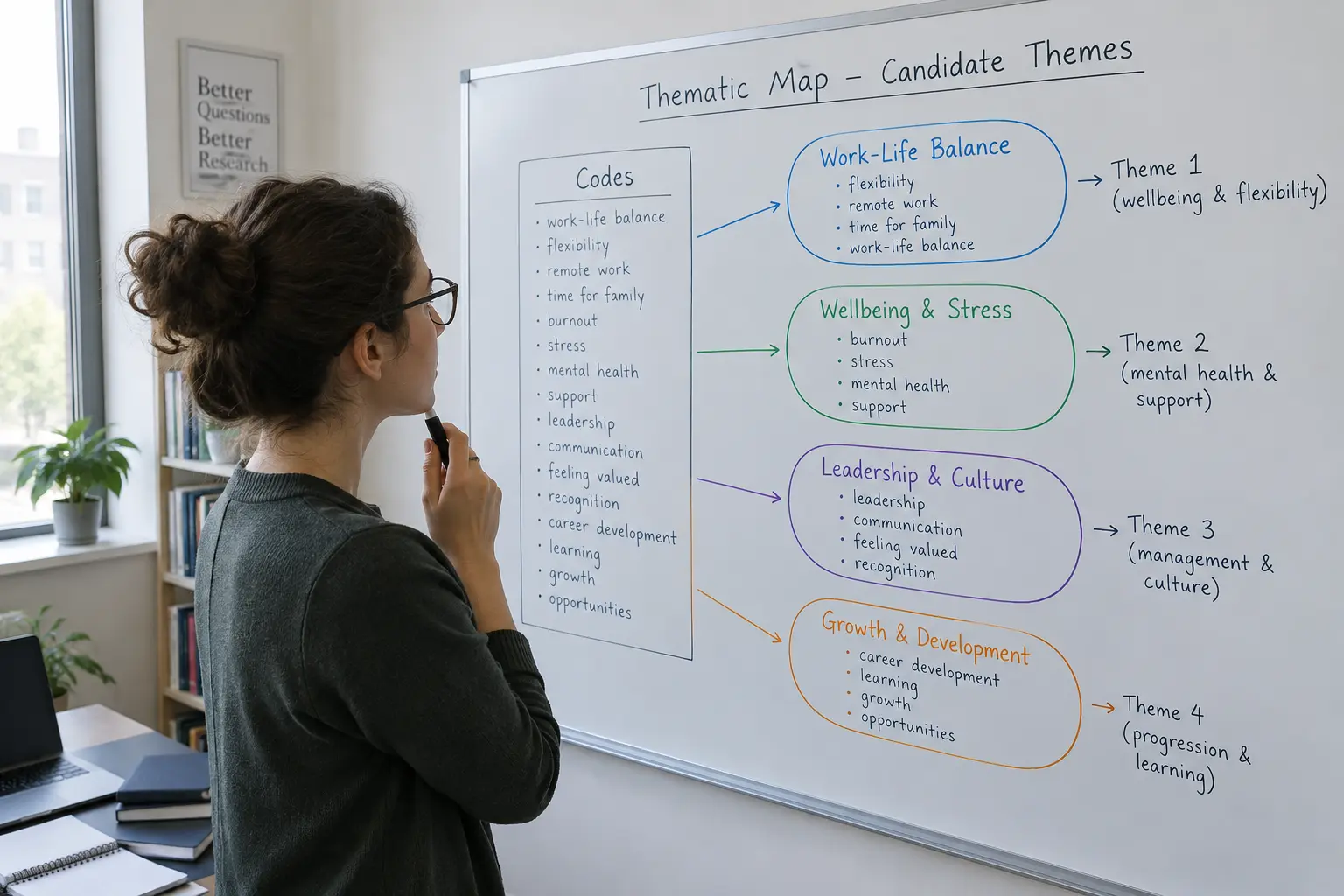
Sort your codes into candidate themes — a theme captures something meaningful about the research question across multiple codes, not a single code renamed. At this stage, some codes may not fit any theme yet; keep a “miscellaneous” category rather than forcing a fit, since a code that does not belong anywhere at this stage often becomes important later or is genuinely a one-off worth reporting separately.
Step 4: Reviewing Themes
Check each candidate theme against two levels: first, against its own coded extracts (does the theme actually hold together, or does it split into two distinct ideas?), and second, against the entire data set (does the theme accurately represent the whole set of transcripts, or only the one or two interviews that first suggested it?). This is usually where a first-draft thematic map gets revised — themes get merged, split, or dropped.
Step 5: Defining and Naming Themes
Write a clear definition for each final theme — what it captures, what it does not, and how it relates to your other themes — then choose a concise, descriptive name. A theme named after a direct quote from a participant is common in social work qualitative research and can be powerful, provided the quote genuinely represents the theme’s core rather than being chosen for rhetorical effect alone.
Step 6: Producing the Report
Write the findings chapter around your themes, weaving in illustrative quotes from multiple participants per theme (not just one voice per theme), and connect each theme back to your research question and the literature reviewed in Chapter 2. This is also where you make the analytic argument — themes presented as a list without connecting analysis read as description, not analysis, which is a common committee comment on qualitative social work dissertations.

A Worked, Fully Fictional Example
The excerpt, codes and theme below are entirely invented for illustration — not a real interview, and not to be cited as data.
Illustrative transcript excerpt (fictional frontline social worker, describing a child-protection home visit): “By the time I actually reach the family, I’ve usually spent two hours on transport and paperwork just to get the visit approved. Then I have maybe twenty minutes with the family before I have to leave for the next case. It’s not that I don’t care about the outcome — it’s that the system gives me twenty minutes to make a judgement that will affect a child’s life.”
Illustrative initial codes: “time pressure before visit,” “administrative burden,” “limited direct contact time,” “high-stakes decision in short window,” “tension between care and system constraints.”
Illustrative candidate theme: “Structural time poverty” — the systemic gap between the administrative and travel time a caseworker’s role demands and the actual face-to-face time available for the judgement the role requires them to make.
Notice how the theme is not simply “workload is high” (a restated observation) but names a specific structural tension the excerpt reveals — the difference between a description and an analytic theme is exactly this move from what was said to what pattern it reveals about the underlying structure being studied.
Thematic Analysis Alongside Your Interview Guide
If you have not yet built the interview protocol that will produce your transcripts, the two tasks connect directly: the objectives and question bank you design upfront shape what kind of codes and themes are even possible to find later. A protocol built around vague, closed questions tends to produce data too thin to support rich thematic development, while a protocol with genuinely open, probing questions tied to your specific objectives gives Step 2 (generating codes) much more to work with. See our companion guide on building an interview protocol and question bank for a social work thesis if you are still at the design stage rather than already holding transcripts.
Common Mistakes in Thematic Analysis for Social Work Theses
- Treating codes as themes. A code is a label for one segment; a theme is a pattern across many segments and often many participants. A results chapter organised around 20 individual codes rather than 4-6 developed themes usually needs another pass through Steps 3-4.
- Cherry-picking quotes. Using only the most articulate or dramatic participant’s words for every theme, rather than showing the theme’s presence across multiple participants, weakens the claim that the theme genuinely represents the data set.
- Skipping the reflexivity note. Especially in social work research, where the researcher’s own professional or personal position can shape interpretation, omitting any reflexive statement about the researcher’s stance is a common and avoidable gap.
- Reporting themes without connecting them to the research question. A theme is only useful in your dissertation if you explain what it tells the reader about the question you set out to answer — themes floating unconnected from the objectives are read as description, not analysis.
Frequently Asked Questions
Do I need qualitative software (NVivo, Atlas.ti) to do a thematic analysis?
No — manual coding on printed or digital transcripts is a completely acceptable method for a dissertation-scale data set, and many published social work qualitative studies use manual coding. Software becomes more useful as your data set grows larger, but it does not itself make the analysis more rigorous; the rigour comes from following the six phases carefully.
How many interview transcripts do I need for a thematic analysis?
There is no single fixed number in Braun and Clarke’s original framework; what matters more than a target count is reaching a point where new transcripts are no longer producing genuinely new codes or themes (often called saturation). See our guide on how many interviews are enough for a qualitative thesis for the fuller discussion.
Can I use thematic analysis alongside a quantitative survey in the same dissertation?
Yes — this is a common mixed-methods design in Indian social work dissertations, provided you are clear in your methodology chapter about how the two data types relate (sequential, concurrent, one explaining the other) rather than simply presenting both without connecting them.
Is thematic analysis the same as content analysis?
No, though the two are often confused. Content analysis typically involves counting the frequency of categories across the data (a more quantitative logic), while thematic analysis focuses on identifying and interpreting patterns of meaning rather than frequency counts, though the boundary between the two is genuinely debated in the qualitative methods literature.
Do I need to get my themes checked by a second coder?
A second coder or “inter-rater” check is not required by Braun and Clarke’s original framework, which treats the researcher’s interpretive judgement as central rather than something to be independently verified for agreement — some departments still ask for it as an added rigour check, so confirm your own department’s expectation rather than assuming it is universally required.
How do I present themes if my Hindi or regional-language transcripts were translated to English?
State clearly in your methodology chapter when translation occurred in the process (before or after coding — coding in the original language first is generally considered stronger practice), who did the translation, and quote the original-language excerpt alongside the English translation in your findings chapter where space allows.
Can my themes change after I’ve already started writing the findings chapter?
Yes, and this is normal — thematic analysis is iterative, and writing itself is often part of Steps 4-6, where attempting to write about a theme can reveal it needs to be split, merged or renamed. Build revision time into your writing schedule rather than treating the theme list as fixed the moment Step 3 is done.
What ethics approval do I need for interviews about sensitive social work topics?
Follow your institution’s ethics-committee requirement for research involving human participants and sensitive topics (child protection, abuse, mental health), which typically includes a distress protocol for participants and, where relevant, mandatory-reporting obligations you must disclose to participants before they consent — see our guide to ethics approval and informed consent for a social work thesis for the fuller requirements.
Should I report themes that contradict each other across participants?
Yes — a well-developed thematic analysis often reports genuine variation or tension between participants rather than forcing a single unified narrative. A theme can legitimately capture disagreement itself (for example, “divergent views on caseload limits between senior and junior caseworkers”) rather than only capturing consensus.
Can I use thematic analysis for focus-group data, not just individual interviews?
Yes, though note in your methodology chapter that focus-group data has a distinct feature individual interviews do not: participants respond to and build on each other’s statements, which is itself sometimes worth analysing (group dynamics) in addition to the content of what was said.
Build your thematic analysis with confidence
Tesify helps you work through each of the six phases against your own transcripts, check that a candidate theme is genuinely a pattern rather than a restated code, and write the methodology-chapter paragraph that documents your process the way an examiner expects.
Build your social work dissertation methodology chapter in Tesify