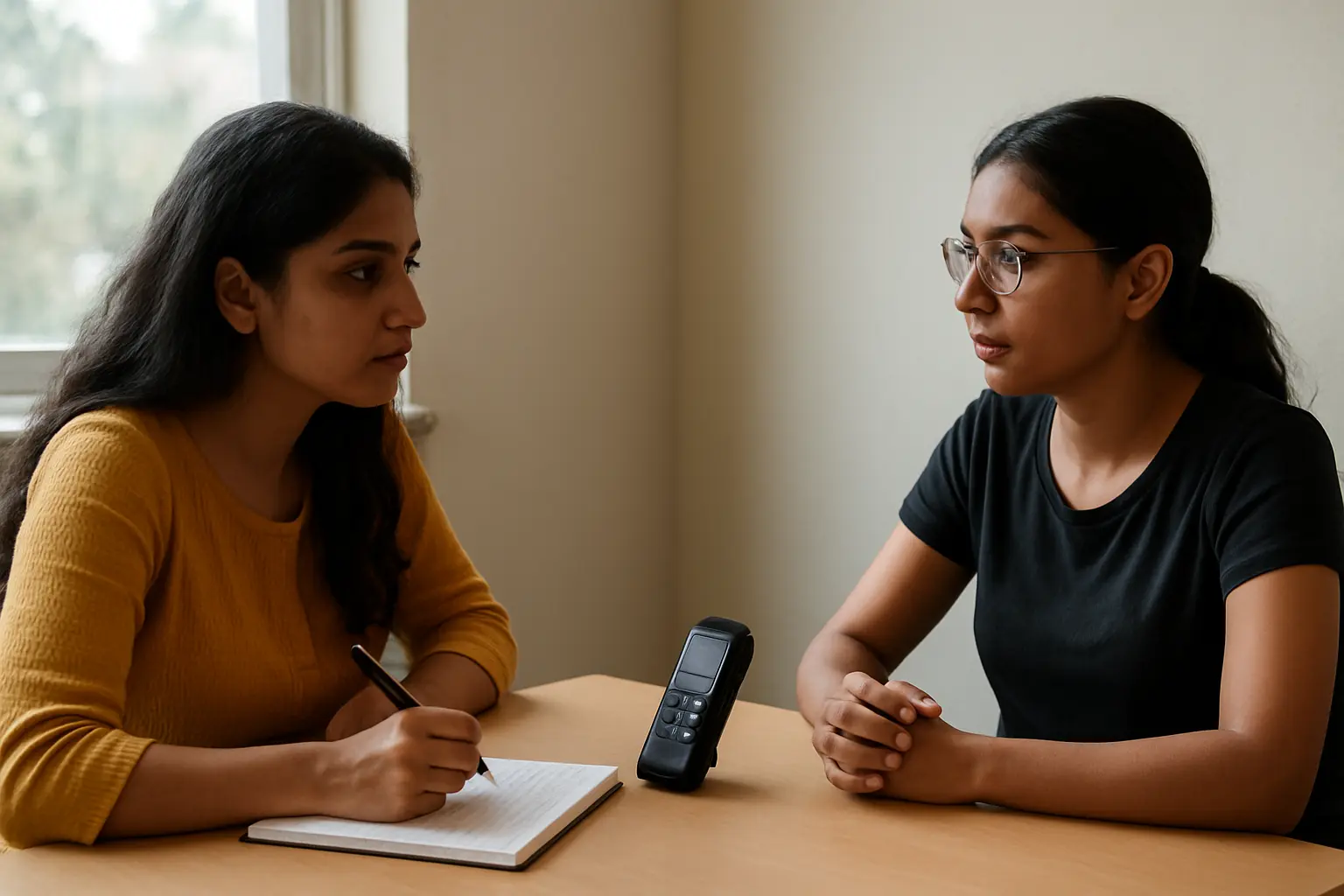
It is eleven at night, your first pilot interview is at ten tomorrow morning, and the question list you have is either six generic prompts copied from a methods textbook or forty questions that will turn a forty-five-minute interview into two hours. A social work thesis lives or dies on the quality of its qualitative data, and that data is only as good as the guide that produced it. Here is a protocol you can build tonight, and a question bank organised by objective rather than by topic, so every question earns its place.
Build your interview guide with Tesify — free to start
Why a Weak Interview Guide Costs You a Whole Semester
An interview guide is not a formality your committee asks for and forgets. It is the instrument of a qualitative social work thesis in the same way a questionnaire is the instrument of a quantitative one, and a weak one produces exactly the same downstream damage: transcripts full of yes-or-no answers, participants who talk about something adjacent to your research question instead of the question itself, and a coding stage where you discover, three weeks in, that half your data cannot actually answer any of your objectives. Fixing that after data collection means going back into the field — a second round of interviews with the same or a fresh sample, a second round of ethics paperwork, and a submission deadline that has not moved. The guide is cheap to fix now and expensive to fix later.

The Protocol, Section by Section
- Opening and rapport. A brief, warm introduction restating the study’s purpose in plain language, confirming consent and recording permission, and one easy, non-threatening opening question that gets the participant talking before anything sensitive is asked.
- Core questions, organised by objective. One block of questions per research objective, not per “topic” — this is the single change that most improves a first-draft guide, because it forces every question to trace back to something the thesis actually needs to answer.
- Probes beneath each core question. Two or three follow-up prompts per core question, written in advance, for when an answer is thin: “Can you tell me more about that?”, “What did that look like in practice?”, “How did that make you feel at the time?”.
- Sensitive-topic questions, placed mid-to-late. Questions touching trauma, family conflict, financial hardship or abuse sit after rapport is established, never in the opening block, and are flagged in the guide itself so an inexperienced interviewer does not open with them by accident.
- Closing and debrief. A question inviting anything the participant wants to add that was not asked, a thank-you, and — critically for social work research — a reminder of the referral or support information promised in your consent form if the topic was distressing.
A Worked Question Bank
Below is an illustrative bank for a study on social workers’ experience of burnout in frontline child-protection roles. The objectives are illustrative; replace them with your own, and every question below should trace back to one of yours.
Objective 1: To explore how frontline social workers describe the sources of stress in their daily practice
- Can you walk me through what a typical difficult day looks like for you?
- What parts of your caseload feel heaviest right now, and why?
- Probe: When you say [participant’s own word for the stressor], what does that actually involve day to day?
Objective 2: To examine the coping strategies workers use, formal and informal
- When a case has really stayed with you, what do you do afterward?
- Is there anyone at work you talk to about that, and what does that conversation usually look like?
- Probe: Has that changed since you started in this role, or has it stayed the same?
Objective 3: To understand how institutional support (or its absence) is experienced
- What kind of support does your organisation offer around this, if any?
- Have you used it? What made you use it, or what kept you from using it?
- Probe: If you could change one thing about how your organisation handles this, what would it be?
What makes this bank work: every question is open (no yes/no phrasing), every question is tied to exactly one objective, and the probes are written before the interview rather than improvised under pressure — which matters most for a first-time interviewer, who is also managing consent forms, a recorder and their own nerves.
Piloting the Guide Before It Matters
Pilot the guide with one or two people who resemble your actual participants but are not part of your final sample — a classmate with relevant field experience, or a practitioner outside your recruitment pool. Two things to listen for in the pilot: whether a question is misunderstood the way you did not intend, and whether the interview runs meaningfully longer or shorter than planned. Revise the wording, not the objective, and note the revision and its reason — a pilot that is mentioned but not described in any detail is a common gap examiners flag in the methodology chapter.
Consent, Confidentiality and the IFSW Standard
Every question above assumes informed consent has already been obtained and recorded, ideally in writing and confirmed again verbally at the start of the interview. The International Federation of Social Workers’ Global Social Work Statement of Ethical Principles is explicit that social workers should respect people’s right to make their own choices, including participation in research, and should protect the confidentiality of information shared — both principles apply directly to a research interview, not only to practice. If your interview touches a topic that could cause distress, your consent form and your guide’s closing section should both name the support or referral option available, and your ethics committee will usually require this explicitly before approving the study. The full ethics and consent process for an Indian social work thesis, including how consent differs for children and survivors, is covered in our guide to ethics approval and informed consent for a social work thesis.
From Recording to Codeable Transcript
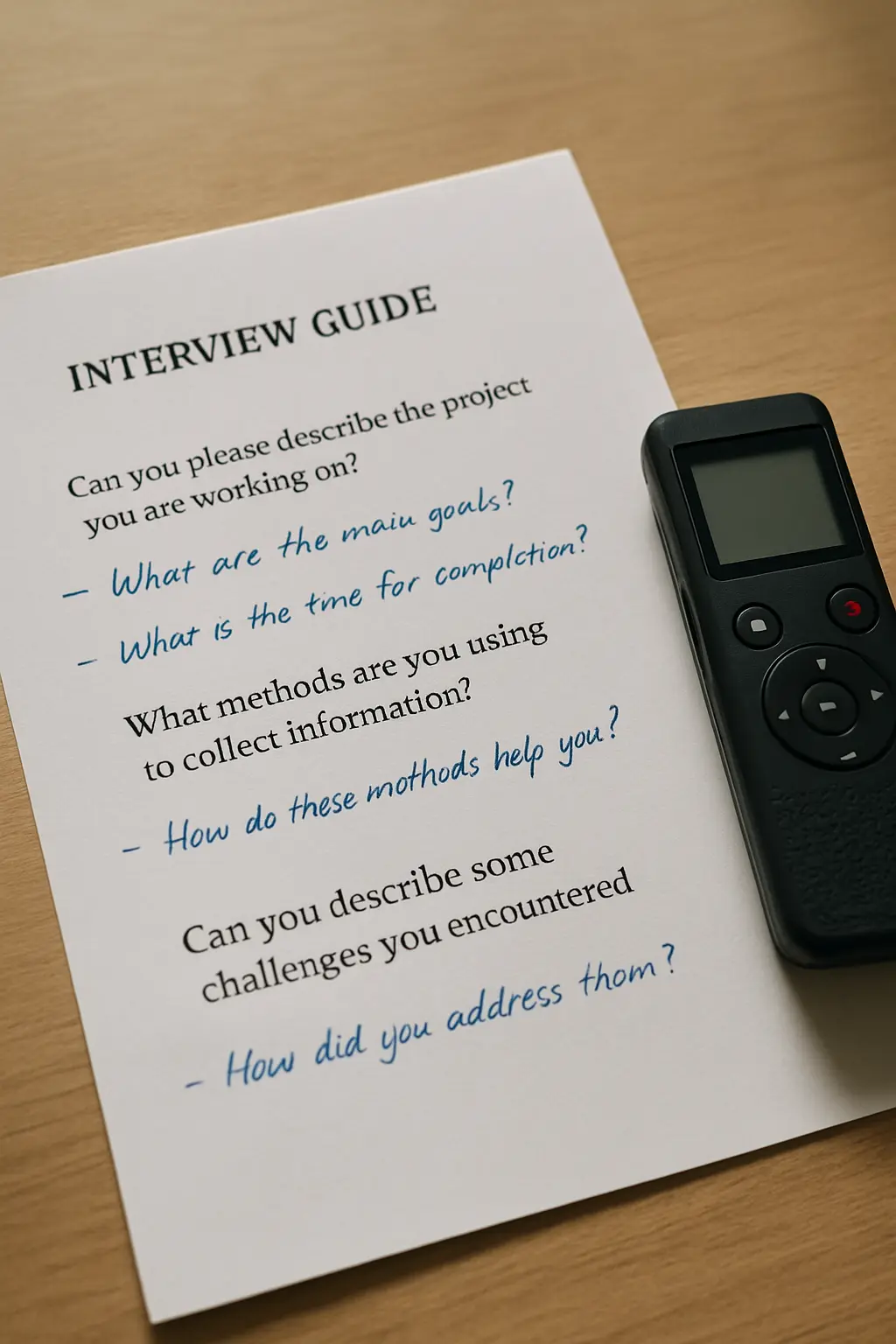
Transcribe verbatim, including hesitations and false starts where they carry meaning (a participant who starts and restarts an answer about a distressing topic is telling you something the clean version would not), and anonymise names, organisations and identifying details at the transcription stage itself rather than leaving that step for later. A transcript that sits un-anonymised on a laptop for weeks is a data-protection risk your ethics approval almost certainly did not authorise. Once transcribed, a first read-through with open, line-by-line notes — before any formal coding scheme is applied — is what turns a stack of transcripts into the beginning of an analysis; the fuller coding and synthesis process is covered in our written-out Chapter 3 example, which includes a qualitative coding section.
Common Mistakes That Weaken a Social Work Interview Guide
- Leading questions. “Don’t you think the caseload is too heavy?” tells the participant what answer you want. “How would you describe your caseload right now?” does not.
- Stacked questions. Asking two things at once — “How do you cope, and does your supervisor help?” — leaves the participant answering only the second half, and your transcript loses the first answer entirely.
- No probes written in advance. A guide with core questions only, and nothing to fall back on when an answer is one sentence long, produces thin transcripts from even willing participants.
- Objectives with no matching question block. If an objective in Chapter 1 has no corresponding block in the guide, that objective will have no data to answer it in Chapter 4 — check this correspondence before the first interview, not after the last one.
- Treating the guide as fixed once written. A guide is allowed to evolve slightly across early interviews as you learn what works, provided the change is documented and does not alter what each objective is actually asking.
How Many Interviews Do You Actually Need?
There is no fixed number set by any Indian regulation, and the honest answer depends on how homogeneous your sample is and how tightly your objectives are drawn — the published evidence and the saturation method you can actually report, rather than guess at, are covered in our guide to how many interviews are enough for a qualitative thesis. What matters more than the count is that every interview you conduct is guided by an instrument as deliberately built as the one above, so each one produces data you can actually use.
Get Your Guide Built Tonight
The version of tonight’s problem that actually costs you time is not “I don’t have any questions” — it is having the wrong questions, discovering it three interviews in, and needing to reopen your ethics approval to fix it. Tesify builds an objective-by-objective interview guide from your own research questions, with probes for each core question and the consent and confidentiality language your ethics committee expects, so the instrument you walk into tomorrow’s pilot with is one built for your actual study.
Start building your interview guide in Tesify
Frequently Asked Questions
How much does Tesify cost?
There is a free tier, so you can build a guide and see the output before paying anything. Paid plans are billed in rupees for Indian users; check the current pricing page for the exact figure, since plans change.
Is it acceptable to use an AI tool to help draft interview questions for a social work thesis?
Most Indian institutions increasingly permit AI assistance for drafting and structuring, provided the research design, the data and the analysis remain the researcher’s own, and an increasing number expect a declaration of what assistance was used. The rule that governs you is your own institution’s policy — read it before you start, and disclose if disclosure is required.
Will my interview data and drafts be kept private?
Your project content is visible only in your own account. Check your institution’s data-handling rules before uploading any identifying participant information to any tool, including transcription software and cloud storage — anonymise first wherever you can.
How many core questions should my guide actually have?
Enough to cover every objective and no more — for most social work theses, three to six core questions with two or three probes each keeps a 45 to 60 minute interview focused rather than rushed.
Do I need a different guide for every participant group?
If your study interviews more than one stakeholder group (for example, both practitioners and service users), each group typically needs its own guide, built from the same objectives but phrased for that group’s vantage point on the question.
What if a participant becomes distressed during the interview?
Pause the interview, check on the participant, and offer the referral information named in your consent form; most ethics committees require this plan to be stated explicitly in your protocol before approval, not improvised in the moment.
Can I change my interview guide after I have already conducted a few interviews?
Minor wording refinements based on what you learned in early interviews are normal and expected; a change to what an objective is actually asking is a design change and should go back to your guide or ethics committee for a quick check before you continue.
Should probes be shown to the participant in advance?
No. Probes are for the interviewer’s use during the conversation, not a document to hand over beforehand — sharing the full guide, including probes, in advance can flatten spontaneous answers into rehearsed ones.