
Chapter 3 of a physiotherapy dissertation in India has to prove one thing above all else: that your design, sample and outcome measures can actually answer the question you set out in Chapter 1. Below is a section-by-section written-out sample for a physiotherapy dissertation using a common quasi-experimental design, with every numeric detail explicitly labelled illustrative — adapt the structure, not the fictional numbers, to your own study.
What Chapter 3 of a Physiotherapy Dissertation Needs to Contain
Across Indian physiotherapy programmes (BPT and MPT), Chapter 3 typically covers, in order: research design, study setting and duration, population and sampling (with inclusion and exclusion criteria), the intervention or procedure, outcome measures and their scoring, the data-collection procedure, and the statistical analysis plan, closing with ethical considerations. Confirm your own university’s exact chapter template before writing, since some departments split ethical considerations into a separate short chapter or appendix rather than folding it into Chapter 3.
A Worked, Section-by-Section Sample
The illustrative study below examines a fictional intervention (a home-exercise programme) for a fictional condition (chronic non-specific low back pain) — the design, structure and outcome-measure citations are genuine and reusable; every number is explicitly labelled illustrative and invented for this example only.
3.1 Research Design
This study employed a quasi-experimental, single-group pre-test post-test design to evaluate the effect of a structured home-exercise programme on pain and functional disability among adults with chronic non-specific low back pain attending the outpatient physiotherapy department of [name of hospital/institute].
State plainly whether your design is a true randomised controlled trial, a quasi-experimental design (as above), a single-case design, or an observational/correlational design — and be honest about why. A single-group pre-test post-test design is common in undergraduate and postgraduate physiotherapy dissertations specifically because a true RCT needs resources (a control group, randomisation infrastructure, a larger sample) that a one-year dissertation timeline rarely supports; state this constraint as a limitation rather than implying a stronger design than what was actually used.
3.2 Study Setting and Duration
The study was conducted at the outpatient physiotherapy department of [name of institute] over a period of [n] weeks (illustrative), from participant recruitment through final outcome assessment.
Name your actual setting and give the real duration your ethics approval and data-collection window allow — do not borrow a duration from a published study or another dissertation without confirming it matches your own timeline.
3.3 Population and Sampling
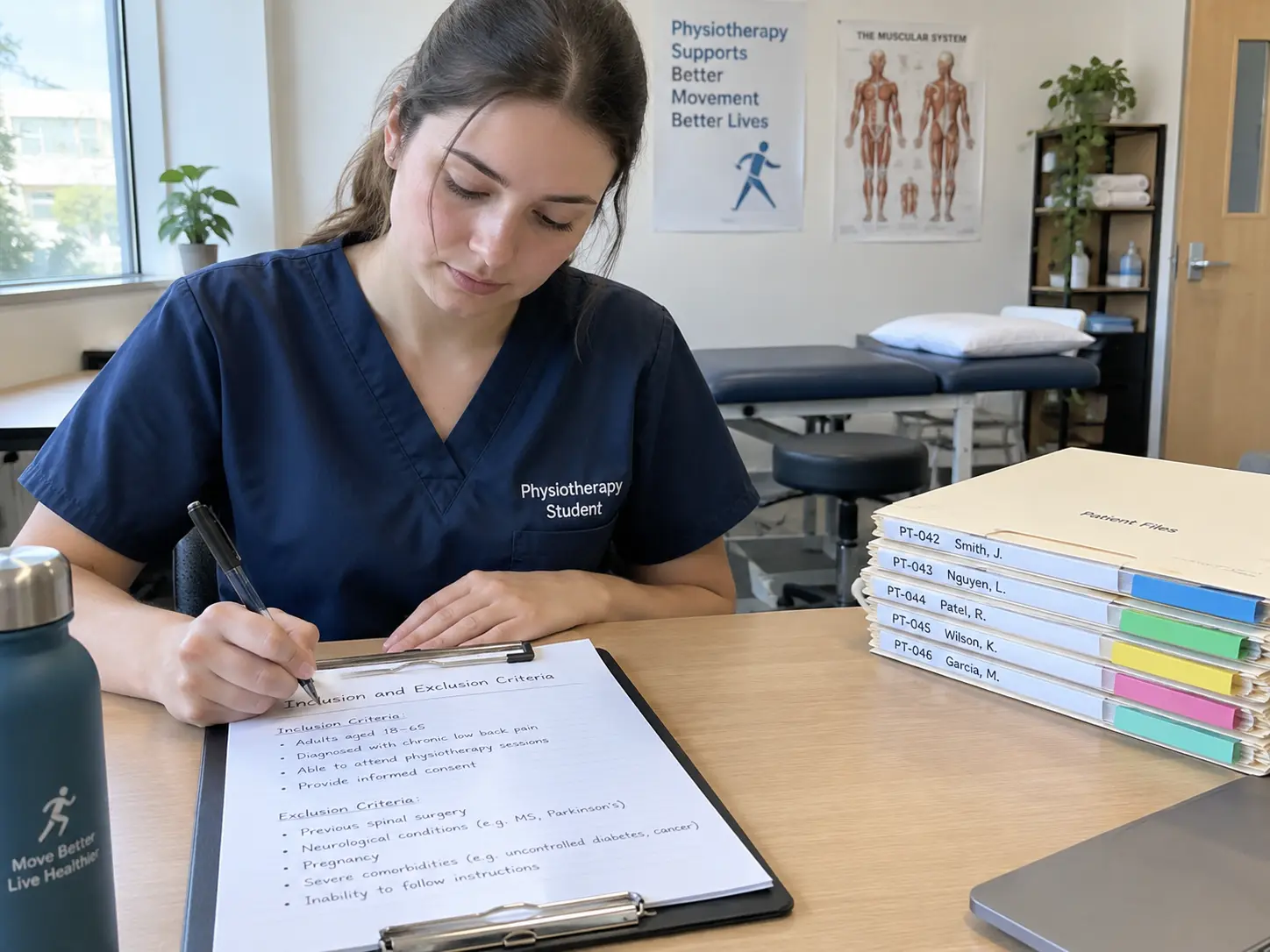
Inclusion criteria (illustrative): adults aged 18-60 years with chronic non-specific low back pain of more than 12 weeks’ duration, able to give informed consent, able to participate in a home-exercise programme.
Exclusion criteria (illustrative): specific spinal pathology (fracture, tumour, infection, cauda equina syndrome), pregnancy, prior spinal surgery, uncontrolled comorbidity that would contraindicate exercise.
Sampling technique: convenience sampling of patients presenting to the outpatient department during the recruitment window (illustrative), until the target sample size of [n] (illustrative) was reached.
Your own inclusion and exclusion criteria must be clinically justified, not copied from a published study without checking whether the same exclusions genuinely apply to your setting. For the sample-size figure itself, run (or have your guide check) a proper calculation rather than choosing a round number — see our guide to calculating sample size for a thesis for the standard approaches (G*Power, the Krejcie-Morgan table, Cochran’s formula).
3.4 Outcome Measures
Pain intensity was measured using the Visual Analogue Scale (VAS), and functional disability was measured using the Oswestry Disability Index (ODI), administered at baseline and at [n] weeks (illustrative) post-intervention.
Name every outcome measure precisely, cite its original source, and state its scoring range and interpretation — do not simply write “a validated scale was used” without naming it. Our comparison of outcome-measure scales for a physiotherapy dissertation (VAS, ODI, Berg Balance Scale, Modified Ashworth, Fugl-Meyer, WOMAC, the Six-Minute Walk Test) covers the condition each scale fits and what an examiner checks in this section. If your literature review is still in progress, our guide to searching and synthesising physiotherapy literature, including how to grade study quality with the PEDro scale, feeds directly into justifying why you chose these particular outcome measures over alternatives.
3.5 Intervention / Procedure
Participants received a structured home-exercise programme consisting of [n] exercises (illustrative) targeting core stability and lumbar mobility, to be performed [n] times per week for [n] weeks (illustrative), with weekly phone or in-person check-ins to monitor adherence and correct technique.
Describe the intervention in enough detail that another researcher could replicate it exactly — the specific exercises, sets, repetitions, frequency and duration, and how adherence was monitored and recorded. A vague intervention description (“a set of exercises was given”) is one of the more common reasons this section is sent back for revision.
3.6 Data Analysis
Descriptive statistics (mean, standard deviation) summarised baseline characteristics. Pre- and post-intervention VAS and ODI scores were compared using a paired t-test (for normally distributed data, confirmed via the Shapiro-Wilk test) or the Wilcoxon signed-rank test (if the normality assumption was not met), with statistical significance set at p < 0.05.
State your significance threshold, the specific test for each comparison, and how you checked the assumptions (normality, in this example) before choosing between a parametric and non-parametric test — see our decision-table guide on choosing a statistical test for a thesis if you are still deciding which test fits your own design.

3.7 Ethical Considerations
Ethical clearance was obtained from the Institutional Ethics Committee of [name of institute] (approval reference, illustrative) prior to recruitment. Written informed consent was obtained from all participants after explaining the study’s purpose, procedures, and their right to withdraw at any time without affecting their ongoing clinical care.
Name the actual committee that approved your study and its real approval reference — never invent or reuse a reference number from another study. State the participant’s right to withdraw explicitly, since clinical physiotherapy research involves patients who may fear that declining or withdrawing will affect their ongoing treatment; making this right explicit in both your consent form and your methodology write-up is standard ethical practice.
Writing the Section-Opening Sentences an Examiner Reads First
Each subsection above opens with a single declarative sentence that states, in plain terms, what was done — the design, the setting, the criteria, the measure, the procedure, the test, the approval. Examiners reading Chapter 3 for the first time typically scan these opening sentences before reading the full paragraph, so make sure each one is complete and specific on its own rather than requiring the rest of the paragraph to make sense of it. A section opening with “various exercises were used” forces the reader to hunt for the actual detail further down; a section opening with the exercise programme’s exact name, frequency and duration answers the question immediately.
How This Sample Differs From a Generic Chapter 3
A generic, cross-discipline Chapter 3 sample (the kind that covers management or education research) typically does not address clinical outcome measures, intervention-fidelity monitoring, or the specific ethical considerations of research involving patients receiving ongoing treatment — all genuinely distinct concerns in clinical physiotherapy research. Our broader guide to a written-out Chapter 3 for a social science, education or management dissertation covers the cross-discipline structural logic if you need it for comparison, but the clinical-trial-specific sections above (outcome measures, intervention fidelity, patient-withdrawal rights) are what a physiotherapy Chapter 3 needs beyond that generic template.
Frequently Asked Questions
Do I need a control group for my physiotherapy dissertation?
Not necessarily — a single-group pre-test post-test design (as in the worked sample above) is common and acceptable for a one-year BPT or MPT dissertation, though a true randomised controlled trial with a control group is methodologically stronger where feasible. State honestly which design you used and its limitations rather than implying a stronger design than the one actually run.
Can I use a published outcome measure without permission?
Not automatically. Many physiotherapy outcome measures are reproduced in journal articles, but some widely used questionnaires are copyrighted and distributed under their own terms of use, which can differ for academic, funded and commercial studies. Cite the original source and check the current permission terms for every measure you use before assuming it is unrestricted, and record in Chapter 3 that permission was obtained where it was required.
How do I decide on my sample size for a physiotherapy dissertation?
Use a formal calculation method (G*Power for an effect-size-based calculation, or a standard table like Krejcie-Morgan for a survey-based design) rather than a round number chosen for convenience — see our guide to calculating sample size for a thesis for the mechanics.
What if my intervention is a manual therapy technique rather than exercise?
The same Chapter 3 structure applies — describe the manual therapy technique in enough procedural detail (hand placement, force, duration, number of sessions) that another physiotherapist could replicate it, and state who administered it and their qualification level, since this affects the study’s reproducibility and the examiner’s assessment of internal validity.
Do I need to report adverse events in a physiotherapy dissertation?
Yes — even a minor adverse event (increased pain, a fall during a balance-training session) should be recorded and reported, since omitting adverse events undermines the credibility of your safety and feasibility claims about the intervention.
How specific does my statistical analysis plan need to be before I collect data?
As specific as reasonably possible — deciding your primary analysis, significance threshold and how you will check test assumptions before data collection (rather than after) is standard good practice and something your guide or committee is likely to ask about directly at the synopsis stage.
Can I combine two outcome measures that assess overlapping constructs?
Yes, provided you can justify why each adds distinct information (for example, VAS for pain intensity alongside ODI for the functional impact of that pain, which are related but not identical constructs) rather than including redundant measures without a clear rationale for each.
How much detail does the intervention section need if I am replicating a published protocol exactly?
Even when replicating a published protocol, restate the full procedure in your own Chapter 3 rather than only citing the source — an examiner reading your dissertation should not need to retrieve another paper to understand exactly what you did. Cite the original protocol’s source alongside your restated procedure.
What if my recruitment falls short of my planned sample size?
Report the actual number recruited honestly, discuss why the target was not reached (recruitment window, eligibility rate, dropout), and address the implications for your study’s statistical power in your limitations section rather than silently reporting the smaller number as if it had been the plan all along.
Should I include a flowchart of participant recruitment and dropout?
A CONSORT-style flow diagram (showing numbers screened, enrolled, allocated, followed up and analysed) is standard practice in clinical trial reporting and strengthens a physiotherapy dissertation’s methodology chapter considerably, even for a single-group design without randomisation. Include one showing your actual recruitment numbers rather than describing the flow only in prose.
Do I need to pilot-test my intervention before the main study?
A small pilot on a handful of participants before the main recruitment window is good practice, particularly for a novel or adapted intervention, since it can surface practical problems (unclear instructions, an exercise that is too difficult for the target population) before they affect your full sample. Report the pilot separately and briefly in your methodology chapter if you ran one, noting what, if anything, changed as a result.
Write your Chapter 3 with confidence
Tesify helps you build a Chapter 3 methodology section for your own physiotherapy dissertation — design, sampling, outcome measures and analysis plan — structured around the sources you cite, not a plausible-sounding template.
Build your physiotherapy dissertation methodology chapter in Tesify