
A methodology chapter is assessed on one property: could a competent stranger repeat your study from it? Everything else — the definitions of research, the taxonomy of designs, the paragraph explaining what a sample is — is padding, and padding is what makes Indian Chapter 3s long and weak at the same time.
This guide is a Chapter 3 written out section by section for a social science, education or management dissertation, with each specimen followed by a short note on what that section has to prove. Square brackets mark what only you can supply. The specimens contain no findings, no real institutions and no attributed claims; they are a shape to write into.
If your work is laboratory or formulation research, the chapter has a different anatomy — materials with grade and supplier, instruments with make and model, validation to ICH — and it is written out in our guide to the materials and methods chapter of an M.Pharm dissertation.
The nine sections, and the order Indian departments expect
Numbering conventions vary, but this running order is the one most Indian social-science and management dissertations use, and deviations from it are usually additions rather than reorderings.
- Research design
- Population of the study
- Sample and sampling technique
- Tools used for data collection
- Validity and reliability of the tools
- Procedure of data collection
- Ethical considerations
- Statistical techniques used
- Delimitations of the study
Indian departments commonly prescribe Kothari’s Research Methodology: Methods and Techniques or Ranjit Kumar’s Research Methodology for this chapter. Use them to get the terminology right, and cite them where you take a definition. Do not reproduce their taxonomies: an examiner wants to know what you did, not what a textbook says the options were.
3.1 Research design
The present study adopted a descriptive survey design with a comparative component. The design was selected because the objectives require the measurement of [construct] as it exists in the field, without manipulation, and a comparison of two naturally occurring groups defined by [criterion]. An experimental design was considered and rejected: [construct] cannot be assigned to participants, and the setting does not permit random allocation.
Data were collected at a single point in time, so the study is cross-sectional. Accordingly, the findings support statements of association and of group difference, and do not support causal inference. This limitation is carried forward in Section 3.9 and in the discussion of findings.
What this section has to prove. That the design follows from the objectives, and that you know what the design cannot do. The second paragraph is the one that earns marks and the one most scholars omit: naming the inferential limit here, before anyone asks, converts a weakness into evidence of judgement. If your objectives still carry a causal verb on a cross-sectional design, fix that first — the verb table in our guide to objectives and the design each verb commits you to shows which promises this chapter can keep.
3.2 Population of the study
The target population comprised all [units] in [defined geographical or institutional boundary] during [period]. According to [named official source], this population numbered approximately [N] at [date].
The accessible population comprised [units] in [narrower boundary], being those for which institutional permission could be obtained within the study period. The difference between the target and accessible populations is acknowledged in Section 3.9, and its implication for generalisation is stated there.
What this section has to prove. That you distinguished the population you want to talk about from the one you could actually reach. Indian examiners ask about this constantly, because the two are almost never the same and an undiscussed gap between them quietly invalidates every generalisation in Chapter 5. Name the official source for the population size; where none exists, say so.
3.3 Sample and sampling technique
A sample of [n] [units] was drawn from the accessible population using [technique]. [Technique] was chosen because [reason tied to the population structure, not to convenience].
The sampling frame was [named list or register], obtained from [source] on [date]. [Describe the mechanism: for example, the frame was stratified by [stratum variable] and units were selected from each stratum in proportion to its size, using a random number table.]
The sample size was determined using [method], with [parameters stated: confidence level, margin of error, expected proportion or effect size, power]. The computation yielded [n], which was increased to [n + x] to allow for an anticipated non-response of [percentage]. Of the [n + x] instruments distributed, [returned] were returned and [usable] were usable, giving a response rate of [percentage].
What this section has to prove. That the sample was selected by a procedure rather than by availability, and that the numbers reconcile. The last sentence is the reproducibility test in miniature: distributed, returned, usable, rate. Write it even when the rate is poor; a stated low response rate is a limitation, an unstated one is a credibility problem. The computation itself is set out in our guide to calculating sample size with G*Power, the Krejcie-Morgan table and Cochran’s formula.
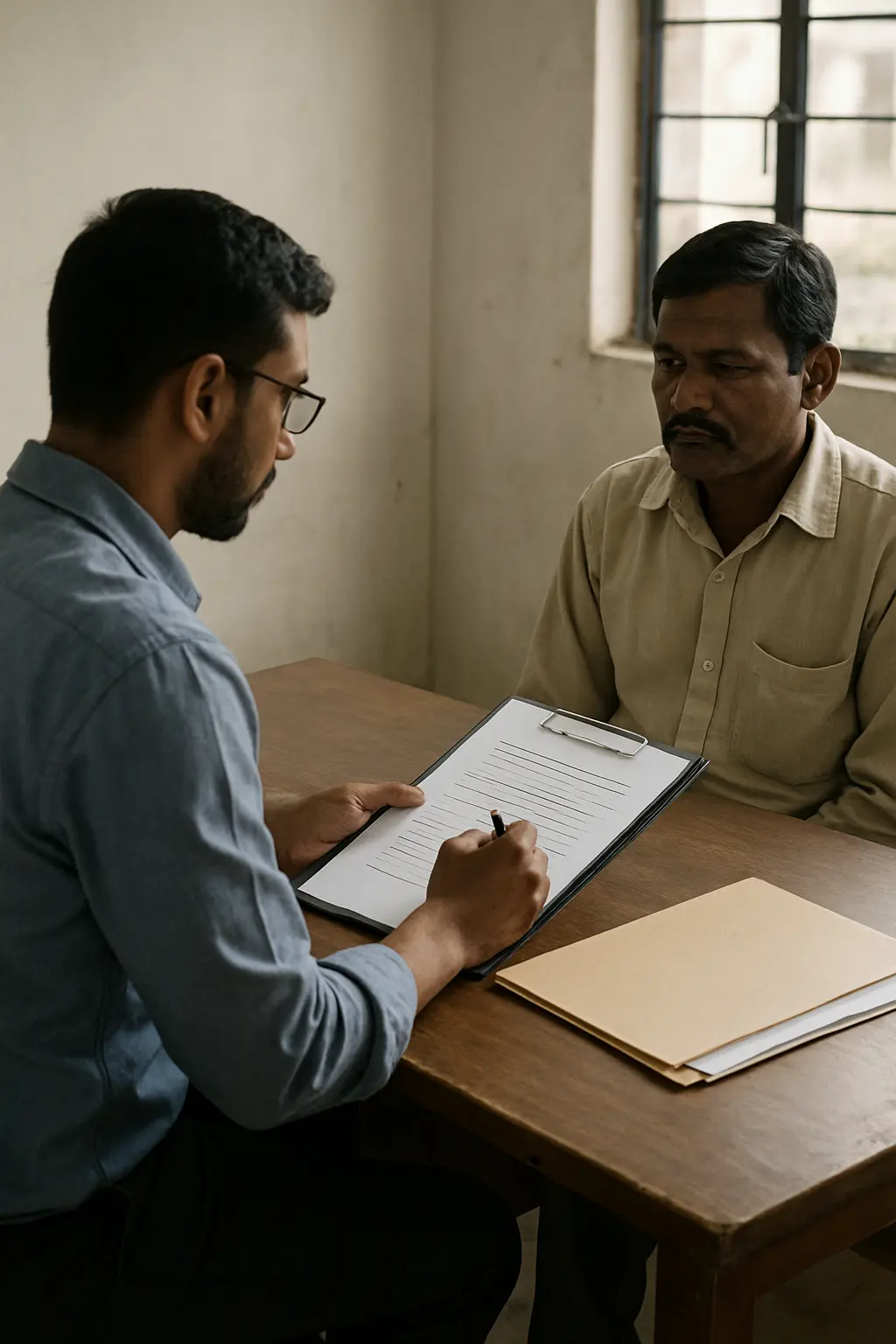
3.4 Tools used for data collection
Two instruments were used. The first, [named standardised tool] developed by [author, year], measures [construct] through [number] items on a [scale type] response format, yielding a total score ranging from [min] to [max], with higher scores indicating [direction]. Permission to use the tool was obtained from [source] on [date].
The second instrument was constructed by the investigator, because no available tool measured [construct] in the [setting] context. It comprises [number] items distributed across [number] dimensions, as set out in the blueprint at Appendix [n]. Its construction and validation are described in Section 3.5.
A demographic proforma recorded [list the variables], each of which corresponds to a variable named in Objective [n].
What this section has to prove. That each instrument measures something an objective asked for, and that you had the right to use it. The demographic proforma sentence matters more than it looks: every demographic variable you collect should be traceable to an objective, and collecting variables you never analyse invites the question of why you asked. Choosing between existing tools is covered in our guide to standardised tools for an M.Ed dissertation.
3.5 Validity and reliability
Content validity of the investigator-constructed tool was established by submitting the draft to [number] experts in [field], drawn from [institutions described generically]. Experts rated each item for relevance on a [scale], and items retained were those with [stated criterion]. [Number] items were modified and [number] deleted on the basis of expert comments; the revised blueprint is at Appendix [n].
The revised tool was administered to [number] respondents drawn from the population but not included in the main sample. Cronbach’s alpha for the total scale was [value], and for the [n] sub-scales ranged from [value] to [value].
For the standardised tool, the manual reports a reliability of [value] for [population]. Reliability was recomputed on the present sample and is reported in Chapter 4.
What this section has to prove. That you checked the instrument before you trusted it, on people who are not in your results. The third paragraph closes the question Indian examiners ask about standardised tools — whether the manual’s reliability or your own should be reported — by giving both. What counts as an acceptable value, and why deleting items to raise it is a trap, is in our guide to acceptable Cronbach’s alpha for a thesis.
3.6 Procedure of data collection
Data were collected between [start date] and [end date]. Written permission was obtained from [authority] on [date], and a copy is at Appendix [n].
The investigator visited each [unit] in person. Respondents were given the participant information sheet, and those consenting signed the consent form at Appendix [n]. The instrument was administered in a [setting description], took approximately [duration] to complete, and was collected by the investigator on the same day. No incentive was offered.
[Number] instruments were excluded from analysis: [number] were incomplete beyond [criterion] and [number] showed [pattern, for example uniform responding across all items].
What this section has to prove. That the data exist and came from where you say. This section is the reproducibility test itself: dates, permissions, who administered, how long, exclusion rules stated as rules rather than as judgements made afterwards.
3.7 Ethical considerations
The study protocol was submitted to the [named committee] of [institution] and approval was granted vide letter [reference] dated [date], a copy of which is at Appendix [n]. Participation was voluntary, and respondents were informed in writing that they could withdraw at any point without consequence.
Informed consent was obtained in writing before administration. Data were anonymised at entry, with each instrument assigned a serial code and the linking list held separately by the investigator. No identifying information appears in this dissertation or in any output from it. Data will be retained for [period] in accordance with [institutional policy], after which they will be destroyed.
What this section has to prove. That the clearance exists and is identifiable by reference number, and that anonymisation was a procedure rather than an intention. What the clearance process involves and how long it takes is set out in our guide to getting ethics committee clearance for an Indian thesis.
3.8 Statistical techniques used
Data were analysed using [software and version]. Descriptive statistics were computed for all variables. The assumption of normality was tested using [test] and examined through [graphical method]; the results are reported in Chapter 4 and determined the choice between parametric and non-parametric procedures.
Objective 1 was addressed through means, standard deviations and level classification. Objective 2 was tested using [test], with the level of significance set at [alpha]. Objective 3 was addressed through [test]. Effect sizes are reported alongside significance tests throughout.
What this section has to prove. That each test is attached to an objective by number, and that the normality decision was made by a procedure rather than assumed. Mapping the objective to the test is the single most useful table you can put in this chapter; the decision itself is in our decision table for choosing a statistical test, and what to do when the assumption fails is in our guide to recovering when your data fail the normality test.
3.9 Delimitations of the study
The study was delimited to [units] in [boundary], during [period]. It was further delimited to [construct] as measured by [instruments], and does not address [adjacent construct] except where it appears as a demographic variable.
These boundaries were set to keep data collection feasible within the time available and within the access that could be obtained. They limit generalisation to populations resembling the accessible population described in Section 3.2.
What this section has to prove. That the boundaries were chosen, with reasons, rather than discovered. Delimitations are decisions you made; limitations are constraints that acted on you. Keeping the two apart in your own head is what makes both sections short.
The four sentences an examiner looks for first
- Why this design and not another. Section 3.1, second sentence. Its absence reads as a default rather than a decision.
- The target-versus-accessible population distinction. Section 3.2. Its absence invalidates the generalisations in Chapter 5.
- Distributed, returned, usable, rate. Section 3.3. Four numbers that must reconcile with the tables in Chapter 4.
- The approval reference number and date. Section 3.7. A named committee and a letter reference, not a sentence saying ethics were considered.
Five ways an Indian Chapter 3 goes wrong
- Textbook padding. Three pages defining research, research design and the difference between primary and secondary data. Cut all of it; cite the text where you take a definition.
- Future tense. The chapter is written from the synopsis and never converted. By submission the study has happened, so the chapter is in the past tense throughout.
- Numbers that do not reconcile. Section 3.3 says 312, Chapter 4 reports 308, and nothing explains the four. Every discrepancy needs a sentence.
- A tool with no permission trail. A standardised instrument used without the author’s or publisher’s permission, unmentioned. Record the permission and the date.
- A method with no matching objective. An analysis appears in Chapter 4 that Chapter 3 never planned. Add the objective, or drop the analysis.
If your dissertation is an M.Tech report rather than a social-science one, the chapter carries the same obligations under different headings; the structure is in our guide to writing an M.Tech dissertation report.
Writing Chapter 3 while the data collection is still running
This chapter is the one you can write before the results exist, and writing it early is what makes the numbers reconcile later: the exclusion rules, the alpha level and the objective-to-test mapping are decided in advance rather than reconstructed. Tesify holds the objectives, the methodology and the results side by side as the document grows, so a change in one shows against the other while there is still time to fix it.
Frequently asked questions
How long should the methodology chapter of an Indian dissertation be?
Your ordinance or department sets the expectation, so ask. What is consistent is that length comes from specificity, not from definitions: a chapter that states dates, numbers, criteria and reference numbers is long for the right reason.
Should the methodology chapter be in the past tense?
Yes, in the submitted dissertation, because the study has been carried out. The synopsis version is in the future tense, and converting it is the step most often forgotten.
Do I need to define research and research design in Chapter 3?
No. Cite the standard text where you take a definition and move on. Textbook exposition is the most common source of padding in Indian methodology chapters.
What is the difference between the target population and the accessible population?
The target population is who you want your conclusions to apply to. The accessible population is who you could actually reach, given permissions and the study period. The gap between them limits your generalisation, and examiners expect it to be named.
Where do I report the response rate?
In the sampling section, as four reconciling numbers: distributed, returned, usable and the resulting rate. Repeat the usable figure at the head of Chapter 4 so the two chapters agree.
What is the difference between delimitations and limitations?
Delimitations are boundaries you chose, with reasons, and they belong in Chapter 3. Limitations are constraints that acted on the study, including ones you discovered afterwards, and they usually belong with the discussion.
Do I have to report reliability if I used a standardised tool?
Report both: the value the manual reports for its original population, and the value recomputed on your sample. The second is the one your results actually rest on.
How many experts should validate an investigator-made tool?
Departments differ, and there is no national rule, so follow your guide’s instruction and state the number, their field and the retention criterion you applied. What matters to an examiner is that the criterion was fixed before the ratings, not after.
Should the questionnaire go in the appendix?
In most Indian dissertations yes, along with the permission letters, the ethics approval and the consent form. Check your ordinance, because a few specify what the appendices must contain.
Can I write Chapter 3 before collecting data?
You should. Deciding the exclusion rules, the significance level and the objective-to-test mapping in advance is what prevents the appearance of decisions made after seeing the results.
What if my ethics approval came after data collection started?
State the dates accurately. A discrepancy that an examiner discovers is far worse than one you explain, and some institutions have a documented remedial procedure for it.