
| Tool | Type | Cost | Best suited to | Examiner familiarity in India |
|---|---|---|---|---|
| IBM SPSS Statistics | Quantitative | Commercial; often institution-licensed | Standard quantitative psychology dissertations (t-tests, ANOVA, correlation, regression) | High — the default expectation in most departments |
| JASP | Quantitative | Free, open source | Scholars with no institutional SPSS licence, or wanting Bayesian alternatives alongside classical tests | Moderate and rising |
| jamovi | Quantitative | Free, open source | Scholars who want an R-based engine with a menu interface and easy syntax export | Low to moderate |
| NVivo | Qualitative | Commercial; often institution-licensed | Thematic analysis, coding interview transcripts, mixed-methods psychology dissertations | High for qualitative and mixed-methods work |
| ATLAS.ti | Qualitative | Commercial, student pricing available | Qualitative coding with strong network/relationship visualisation between codes | Moderate, less common than NVivo in Indian departments |
A psychology dissertation in India most often needs one quantitative tool and, if the design has an interview or open-ended component, one qualitative tool — rarely more than two. Which pair depends on your design, your institution’s licences, and whether your guide already has a preferred coding software. This comparison covers both sides, because a growing share of Indian M.A./M.Sc Psychology and M.Phil dissertations combine a quantitative scale with qualitative interviews rather than running one method alone.
The criteria used here
- What it actually costs you, given your institution’s own licences, not the list price.
- Fit for a mixed-methods design, since a growing share of psychology dissertations combine a validated scale with semi-structured interviews.
- Examiner and guide familiarity, because unfamiliar software output invites process questions that have nothing to do with your findings.
- What survives after you graduate, when an institutional licence typically ends.
1. IBM SPSS Statistics — the quantitative default
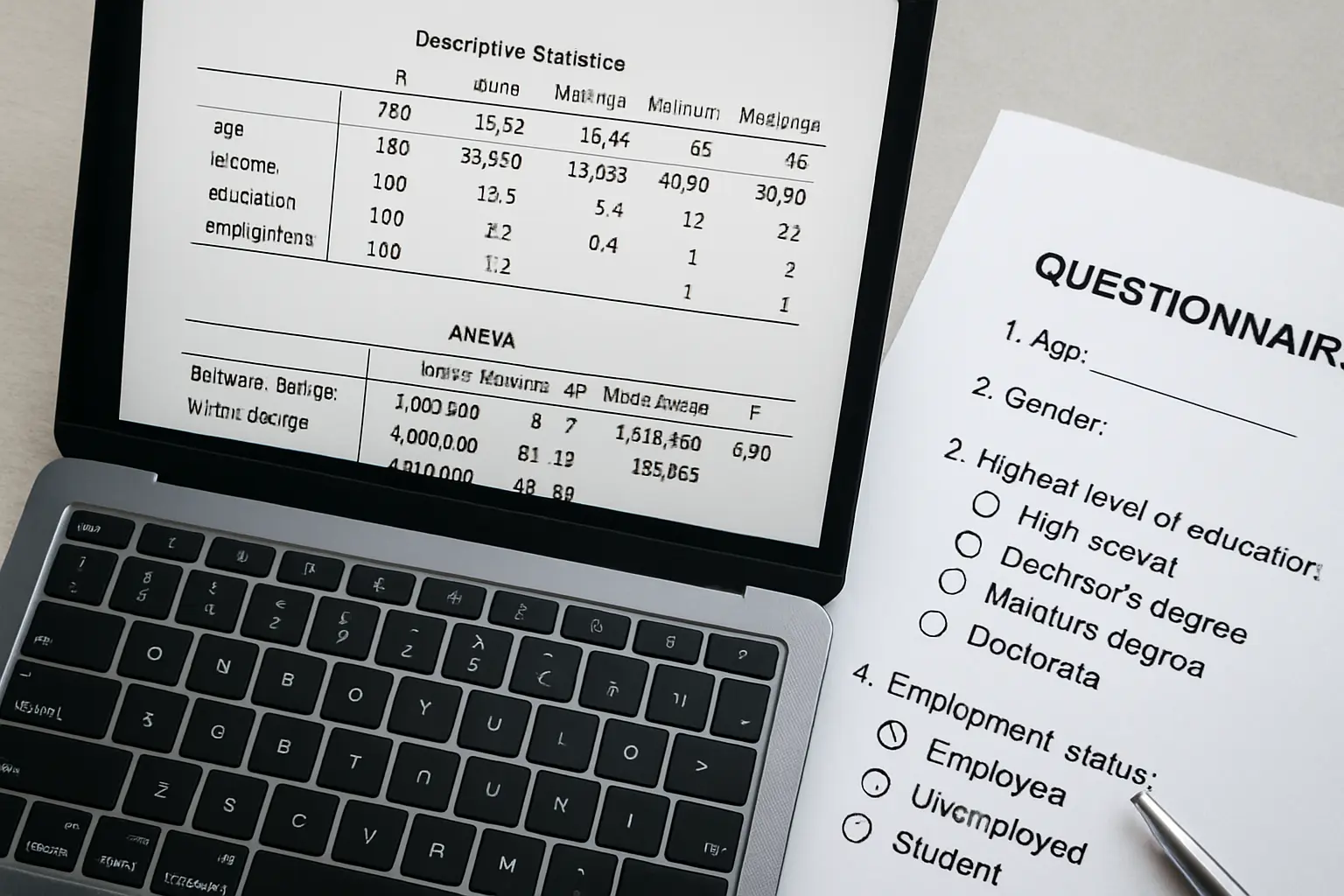
SPSS remains the most recognised quantitative package in Indian psychology departments, and for a standard scale-based design — a validated instrument, group comparisons, correlations, regression — it does everything a one-year dissertation typically needs through its menu system, with no code required.
Strengths: menu-driven access to descriptives, reliability analysis (Cronbach’s alpha), t-tests, ANOVA, correlation and regression; widely taught in Indian psychology methods courses; output format instantly recognised by guides and examiners.
Weaknesses: commercial and often expensive outside an institutional licence; access typically ends with your student status, so export your data and output before you graduate; a common early confusion is that SPSS has no single “item validity” command — item-total correlation is what most Indian methodology courses mean by this, run as an ordinary correlation and interpreted accordingly.
2. JASP — the free quantitative alternative
JASP is developed with University of Amsterdam backing, free to use, and deliberately built to resemble conventional menu-driven statistics software, so the transition from SPSS-style teaching is fast.
Strengths: completely free and legal, removing the licensing question outright; output already follows APA table conventions, needing less reformatting than SPSS; both classical and Bayesian versions of standard tests are available side by side, useful where a guide wants Bayesian evidence alongside a p-value.
Weaknesses: lower familiarity among some Indian guides and examiners than SPSS, which can prompt an extra explanatory conversation; narrower coverage than SPSS for advanced or specialised procedures a doctoral-level design might need.
3. jamovi — the R-based menu alternative
jamovi runs on the R statistical engine underneath a menu interface, and its distinguishing feature for a psychology dissertation is that it can show the R syntax behind every menu action, which is useful if you want to learn R gradually rather than commit to it outright.
Strengths: free and open source; extensible through additional modules for specialised analyses (moderation, mediation, reliability); the visible R syntax is a genuine bridge for scholars planning to continue in research.
Weaknesses: the least familiar of the three quantitative options in most Indian departments at present, so confirm your guide is comfortable reading its output before committing a dissertation to it.
4. NVivo — the qualitative default for mixed-methods work
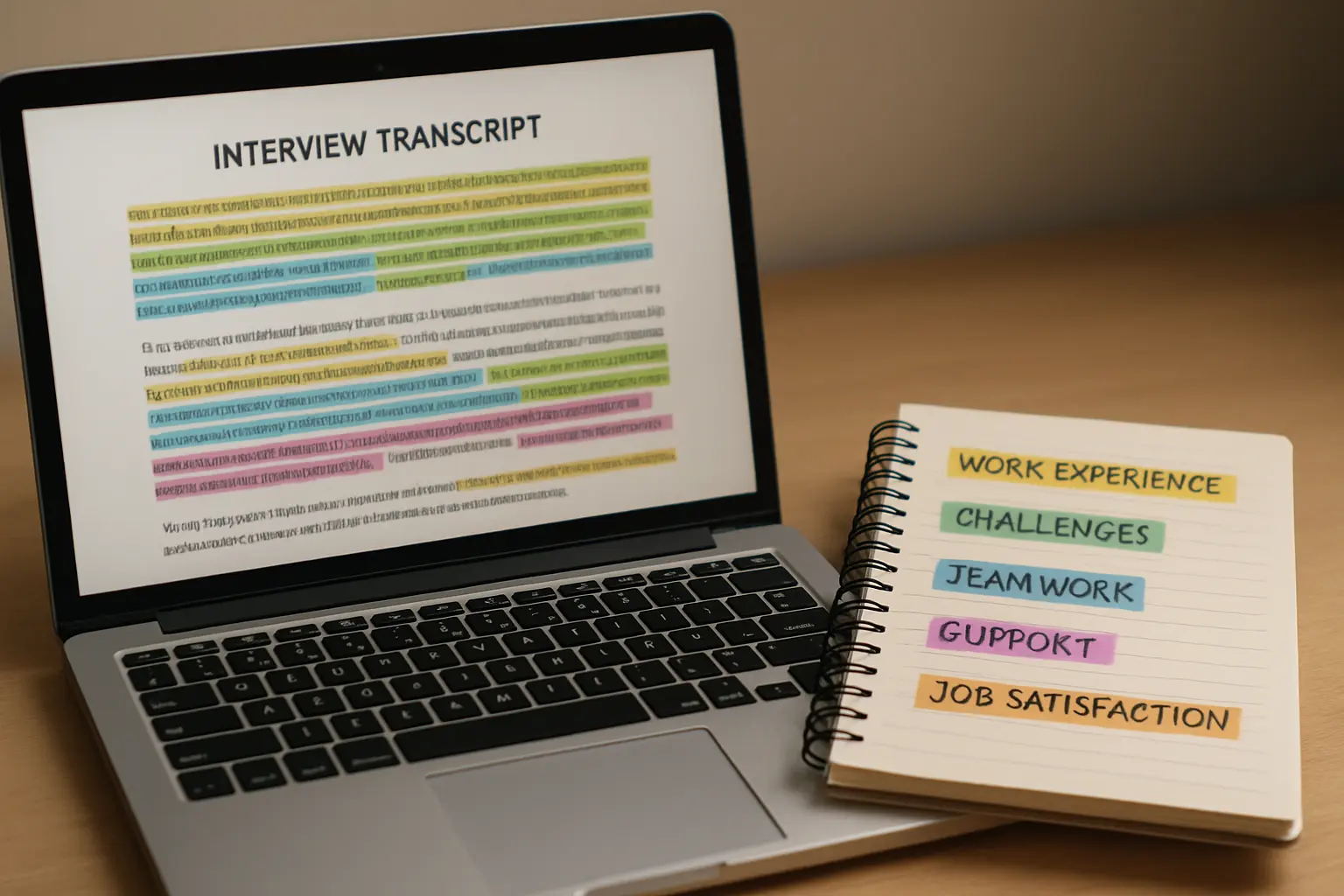
Where a psychology dissertation includes semi-structured interviews, focus groups or open-ended survey responses, NVivo is the most widely recognised qualitative coding software in Indian psychology and social-science departments, supporting thematic analysis, framework analysis and the coding-and-retrieval workflow most qualitative methods courses teach.
Strengths: organises transcripts, codes and themes in one project file; supports inter-coder comparison where a second coder is used, which strengthens a qualitative chapter’s credibility; widely taught and widely recognised by examiners reading a qualitative or mixed-methods results chapter.
Weaknesses: commercial, and a personal licence is a real cost if your institution does not provide one; the software organises and retrieves coded text, it does not perform the interpretive work of theme development, which remains the researcher’s own analytical judgement.
5. ATLAS.ti — the alternative qualitative option
ATLAS.ti performs a broadly similar core job to NVivo — coding and retrieving qualitative material — with a particular strength in visualising the network of relationships between codes, which can suit a psychology dissertation building a grounded-theory-style model from interview data.
Strengths: strong network-view visualisation of how codes relate to each other; student pricing is typically available and worth checking against your institution’s own NVivo licence before deciding.
Weaknesses: less commonly taught in Indian psychology methods courses than NVivo, so more scholars will be learning it without a departmental workshop to lean on.
Recommendation by situation
- A standard quantitative scale-based dissertation, institution licenses SPSS: use SPSS. The most recognised option is already free to you.
- No institutional SPSS licence: use JASP. Free, legal, and its output needs the least reformatting for an APA-style results chapter.
- A mixed-methods design with interviews or open-ended data: pair your quantitative tool with NVivo if your department teaches or licenses it; ATLAS.ti if your guide specifically prefers its network-view coding style.
- You intend to continue in research after this degree: jamovi’s visible R syntax is a reasonable bridge, learned alongside whichever menu tool your dissertation actually uses.
- Your guide already has a strong preference: follow it. Debating software choice is a poor use of the months before submission.
How to name the software correctly in your methodology chapter
A common gap in Indian psychology methodology chapters is naming the analysis (“data were analysed using SPSS”) without the version, and for qualitative work, without stating the coding approach the software supported. A worked example that avoids both gaps:
“Quantitative data were analysed using IBM SPSS Statistics (version 29). Descriptive statistics, reliability analysis (Cronbach’s alpha), and an independent-samples t-test were computed to address Objectives 1 to 3. Qualitative interview data were transcribed verbatim and coded in NVivo (version 14) using a reflexive thematic analysis approach, with an initial coding pass followed by theme development and a second-coder check on 20% of transcripts to support coding consistency.”
Notice what this paragraph commits to beyond the software name: the version number, exactly which procedures were run in which tool, the analytic approach the qualitative software supported (reflexive thematic analysis, not just “coded in NVivo”), and the inter-coder check. An examiner reading a methodology chapter checks whether the software paragraph and the results chapter actually match — a mention of NVivo with no coding approach named, or a t-test reported that was never mentioned in the software paragraph, is the kind of small inconsistency that draws a longer line of questioning at the viva than the substance deserves.
Data retention after your student licence ends
Whichever tools you use, plan for the licence ending before the data does. Export quantitative datasets as CSV, which every package on this list reads; export SPSS or jamovi output as PDF; and for qualitative work, export your coded project as a standalone file format the software itself supports for archiving, along with a plain-text codebook describing what each code means, since a coding scheme that lives only inside a licensed project file becomes unreadable once the licence lapses. Your ethics approval will also specify a data-retention period and format — check it before you decide what to keep and for how long, since a psychology dissertation’s raw interview data is usually more sensitive than a numeric dataset and may carry stricter retention and destruction rules.
What the tool does not decide for you
Software choice never substitutes for the two decisions that actually shape a psychology dissertation’s methodology chapter: which validated scale measures your construct, and which statistical test or coding approach actually answers your hypothesis or research question. Which validated instrument to choose, and the permission question that comes with it, is covered in our comparison of validated scales for a psychology dissertation in India. Which statistical test fits which hypothesis, independent of which software runs it, is set out in our decision table for choosing a statistical test. For qualitative sample sizing — how many interviews is enough — see our guide on how many interviews are enough for a qualitative thesis.
Where Tesify sits, and where it does not
Tesify is not a statistics or qualitative-coding package. It does not compute reliability coefficients, run your regression, or code your transcripts — use the tools above for that, and remain responsible for every number and every code you report. What Tesify handles is the writing around the analysis: describing your procedure in the methodology chapter, narrating quantitative results or qualitative themes in your own words, and keeping what you said you would measure consistent with what you report finding.
Draft your methodology and results chapters in Tesify
Frequently asked questions
Do I need both a quantitative and a qualitative tool?
Only if your design is mixed-methods or purely qualitative. A standard quantitative, scale-based dissertation needs only SPSS, JASP or jamovi; add NVivo or ATLAS.ti only where interviews, focus groups or open-ended data are actually part of the design.
Is JASP accepted by Indian universities?
Universities assess your analysis and reasoning, not your software brand, and JASP output is legitimate for a psychology dissertation. The practical question is whether your guide is comfortable reading it, worth confirming before you commit.
Can I switch from SPSS to JASP partway through?
Yes, if you export your data as a CSV or SPSS .sav file, which both tools read. Rerun any completed analysis in the new tool so every reported figure comes from one consistent source.
Which qualitative tool is more commonly taught in Indian psychology departments?
NVivo is more widely taught and licensed at present, making it the safer default where your department has no stated preference; ATLAS.ti remains a legitimate alternative, particularly where a guide favours its code-network visualisation.
Can I code qualitative data by hand instead of using software?
Yes, and for a small number of interviews (roughly under ten to fifteen) manual coding in a spreadsheet or on paper is a defensible, examiner-accepted approach. Software becomes more valuable as the number of transcripts and codes grows.
Do I need to name the software and version in my thesis?
Yes. Naming the tool and its version number in the methodology chapter is standard practice and lets a reader understand exactly how your analysis was produced.
Will SPSS and JASP give different results on the same data?
For the same test on the same data, no; the underlying statistical formulas are identical. Small differences in decimal places usually come from rounding or default settings, not the software itself.
What happens if my institution’s licence expires before I finish?
Export your dataset and output in open formats (CSV for data, PDF for output) as soon as possible, then move to a free tool such as JASP or jamovi and rerun your analysis to confirm the results match.
Is it worth paying for NVivo personally if my institution does not license it?
Weigh the number of transcripts against the cost and the free alternative of structured manual coding in a spreadsheet. For a small qualitative component within a mostly quantitative dissertation, manual coding is often the more proportionate choice.
Do examiners ask why a particular tool was chosen?
Sometimes, particularly if the tool is unfamiliar to them. Being able to state plainly why the tool fit the analysis — not just that it was available — is worth preparing before the viva regardless of which tool you used.