
A Civil Engineering dissertation in India draws on three distinct official sources depending on what the chapter needs: CPWD’s Schedule of Rates for cost estimation, IRC codes for design standards, and CWC for hydrological data. None of the three substitutes for another — a thesis that needs a design load specification, a construction cost figure and a river discharge value in the same chapter has to cite all three separately, correctly.
| Source | What it provides | Access / cost | Best use in your thesis |
|---|---|---|---|
| CPWD Delhi Schedule of Rates (DSR) | Item-wise construction cost rates (earthwork, masonry, concrete, steel work, drainage and more), backed by the Delhi Analysis of Rates showing the rate build-up | Published by CPWD — check cpwd.gov.in for the current edition; printed editions are also sold. Current edition DSR 2023, updated by correction slips | Cost estimation, tender/BOQ chapters, comparative costing analysis |
| IRC (Indian Roads Congress) codes | Design standards, specifications, guidelines and codes of practice for roads, bridges, tunnels and traffic (the IRC catalogue lists well over 200 publications) | Individual codes purchased from IRC; some referenced and summarised in academic and government sources | Citing an exact design standard (loads, pavement design, bridge design) by code number |
| CWC (Central Water Commission) | Hydrological data — river gauge, discharge, silt, sedimentation and water-quality records, published as Water/Sediment/Water Quality Year Books | Unclassified data free via the India-WRIS portal | Hydrology, irrigation, flood-control and water-resource-engineering dissertations |
Why Citing the Right Source Matters More in Civil Engineering Than in Some Other Disciplines
Civil engineering research sits closer to regulated practice than many academic disciplines — a design assumption, a cost figure or a hydrological value in your dissertation is being judged not only for academic rigour but implicitly against the standard a practising engineer would be expected to follow. An examiner reading a bridge-design chapter checks not just whether your load calculation is internally consistent, but whether the load values themselves trace back to the correct, current IRC code; a costing chapter is checked not just for arithmetic accuracy but against whether the DSR edition cited is the one actually in force during your stated project period. This is part of why the three sources in this guide cannot be treated interchangeably or cited loosely — each answers a distinct question your examiner is trained to check separately.
CPWD’s Delhi Schedule of Rates — Cost Estimation Data
The Central Public Works Department’s Delhi Schedule of Rates (DSR) is the most widely cited rate document in Indian public works, used not only by CPWD but also by other departments, public-sector undertakings, private builders, contractors and architects as a benchmark for tender estimation, Bill of Quantities (BOQ) validation and item-rate analysis. The current edition, DSR 2023, is published in two volumes — Volume I covering items such as basic rates, carriage of materials, earthwork, mortars, concrete and reinforced cement concrete, masonry, stone work, cladding, wood and PVC work, steel work, flooring and roofing, and Volume II covering finishing, repairs to buildings, dismantling and demolition, road work, sanitary installations, water supply and drainage. Each DSR item rate is backed by the companion Delhi Analysis of Rates showing the underlying build-up of material quantities, labour, plant and contractor overheads, which a costing-focused dissertation chapter should cite alongside the headline rate rather than quoting the rate in isolation. Always state which edition and which correction slips you used, since rates change between editions and through corrections, and an outdated rate cited as current is a common error.
IRC Codes — Design Standards for Roads, Bridges and Traffic
The Indian Roads Congress (IRC) traces its origin to the first Highway Engineers’ Meeting convened in New Delhi on 10 December 1934, acting on a recommendation of the Jayakar Committee set up in 1927, and it is the professional body of highway engineers in India. Its publications catalogue lists well over 200 standards, guidelines, specifications and codes of practice covering road, bridge, tunnel and traffic engineering — commonly cited examples include IRC:6 (loads and load combinations for road bridges), IRC:37 (design of flexible pavements), IRC:58 (design of plain jointed rigid pavements) and IRC:112 (concrete road bridges), each periodically revised, so the citation must include both the code number and the specific edition year you consulted. A pavement-design or bridge-design dissertation should cite the exact IRC code and clause relevant to the specific calculation or assumption being made, not a generic reference to “IRC codes” as a category. Individual IRC codes are sold rather than freely downloaded; check whether your institute’s civil engineering department already holds copies of the codes most relevant to your specific sub-field before assuming you need to buy one.

CWC — Hydrological Data for Water-Resource Engineering
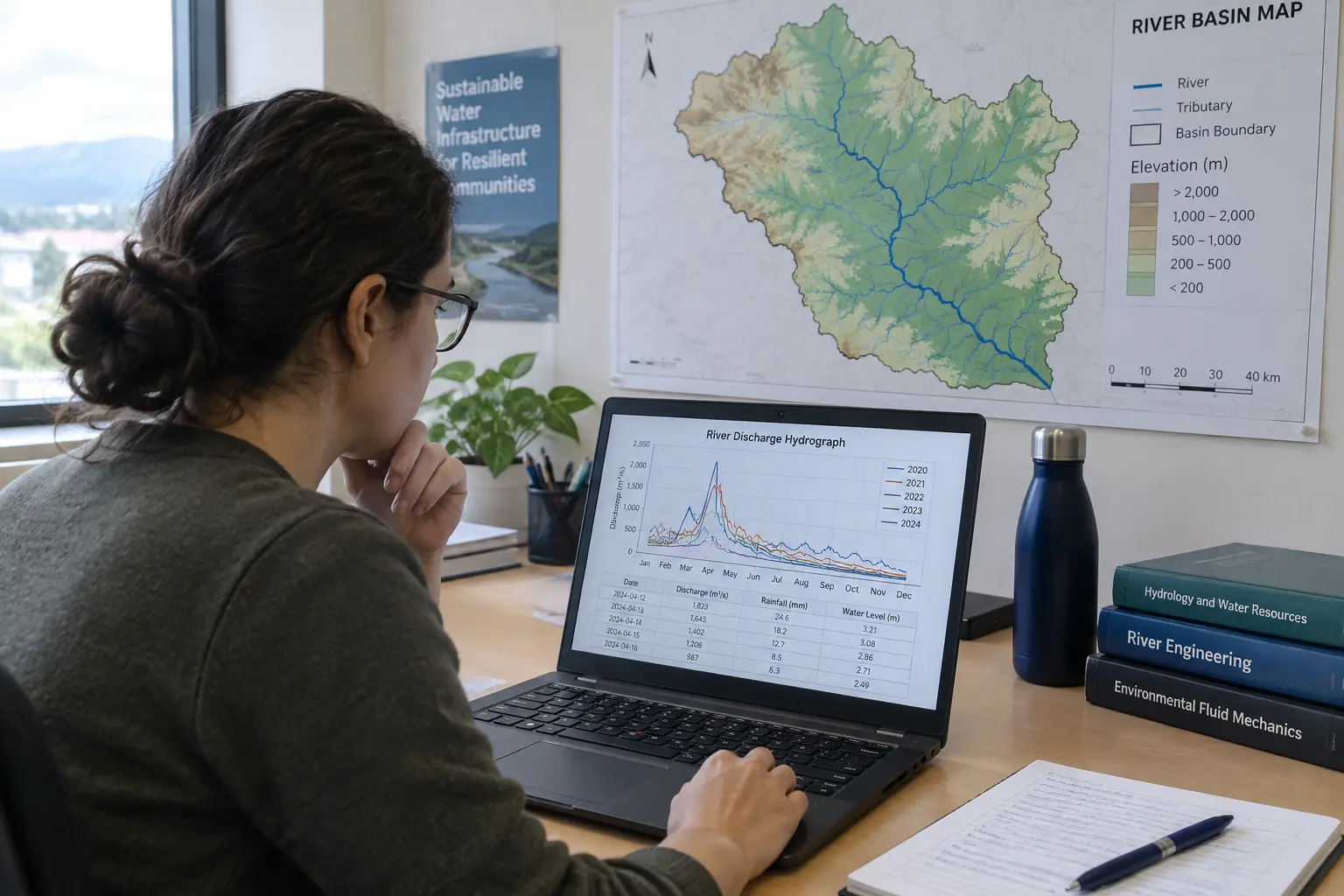
The Central Water Commission (CWC), an attached office of the Department of Water Resources, River Development and Ganga Rejuvenation under the Ministry of Jal Shakti, is India’s national technical body for water-resource data, operating a network of hydrological observation stations across the country’s river basins. CWC collects, compiles and publishes hydrological data — gauge, discharge, silt, sedimentation and water-quality records — issued as Water Year Books, Sediment Year Books and Water Quality Year Books, and CWC states that all unclassified data from its hydrological observation stations is available for free download through the India Water Resources Information System (India-WRIS) portal. For a dissertation on flood forecasting, irrigation design, dam or reservoir studies, or river-basin hydrology, CWC’s published discharge and gauge records are the standard citable primary data source — state the specific gauge station, date range and Year Book edition you drew figures from, since a river’s discharge record is meaningless without the station and period it refers to.
Which Source Fits Which Kind of Civil Engineering Dissertation
- Construction management / costing dissertations: CPWD DSR for rates, with IRC codes cited only where the specific work item (a road or bridge component) has its own design standard beyond a generic costing line.
- Structural / transportation engineering dissertations: IRC codes for design loads and standards, with CPWD DSR cited only if a costing or feasibility comparison is part of the scope.
- Water resources / hydrology dissertations: CWC for hydrological data, with IRC codes cited if the study also touches drainage or bridge-hydraulics design standards that intersect with CWC’s discharge data.
A dissertation spanning more than one of these areas (for example, a bridge-design thesis that also estimates construction cost and checks flood-discharge design assumptions) may legitimately cite all three — state clearly in your methodology chapter which source supports which specific claim, rather than blending them into an undifferentiated data-sources paragraph.
Writing Up Your Data Sources in Chapter 3
Whichever combination of CPWD, IRC and CWC data your thesis draws on, name each source precisely in your methodology chapter — the exact schedule edition, code number and year, or gauge station and Year Book edition — rather than a vague reference to “government rates” or “IRC standards” as an undifferentiated category. Where your thesis also needs a statistical test to analyse hydrological or cost data you have collected, see our decision-table guide on choosing a statistical test for a thesis, and for the sample-size question in a survey-based civil engineering study (for example, surveying practising engineers about a design practice), our guide to calculating sample size for a thesis covers the standard approaches. If you are still building your overall Chapter 3 structure, our written-out Chapter 3 example shows where a data-sources subsection sits within the fuller chapter.
Frequently Asked Questions
Is the CPWD Schedule of Rates the same across all Indian states?
No — the Delhi Schedule of Rates (DSR) is the CPWD’s own rate book, primarily reflecting Delhi/NCR market conditions; many state Public Works Departments publish their own state-specific schedules with different rates. State clearly which schedule (CPWD DSR or a named state PWD schedule) you are citing, since the two are not interchangeable.
How do I know which IRC code applies to my specific design problem?
Start from your literature review’s most closely related published studies to see which specific IRC codes they cite for a comparable design problem, then confirm with your guide, since IRC’s catalogue spans hundreds of publications across sub-disciplines and identifying the exact applicable one requires domain-specific knowledge your supervisor can confirm quickly.
Is CWC hydrological data free for all rivers and all years?
Unclassified data is free via India-WRIS, but data for classified basins (such as those of international rivers) is restricted, and coverage varies by river, station and year — older records may not be digitised. Check availability for your specific river and period before committing your methodology to a particular data source.
Can I use IRC code values in a calculation without citing the code directly?
No — any design load, safety factor or specification value drawn from an IRC code must be cited by the code’s number and edition year at the point it is used in your calculation, not only listed once in a general references section.
What if the DSR rate for my specific work item does not exist in the schedule?
For a non-scheduled item, CPWD practice is to derive a rate through a documented “rate analysis” using the same cost components (material, labour, plant, overhead) as the scheduled items — document your own derivation transparently in an appendix if you have to do this for your dissertation’s costing chapter.
Do I need permission to use CWC hydrological data in my thesis?
Unclassified data published through India-WRIS is offered for free download; cite the source and the specific station/dataset, but no separate permission request is typically needed for unclassified, publicly published records.
How current should my cited DSR edition be?
Use the most recent edition available to you and state its correction level explicitly (DSR editions are periodically updated with correction slips); if your data-collection period spans an edition change, note which edition applied to which part of your analysis.
Can I compare CPWD DSR rates against a private-sector cost database?
Yes, this is a legitimate comparison for a costing dissertation, provided you name the private database precisely and note that private-sector cost data may reflect different overhead, profit and regional assumptions than CPWD’s public-works basis — state this methodological difference explicitly rather than treating the two as directly equivalent figures.
Do IRC codes apply to state-highway and rural-road projects, or only national highways?
Most IRC codes are written as general design standards intended for application across national highways, state highways and, in many cases, rural roads, though some codes and special publications specifically target rural or low-volume roads. Check the specific code’s stated scope rather than assuming a single code covers every road category uniformly.
What if my dissertation covers a river with very limited CWC monitoring stations?
State this data limitation honestly in your methodology chapter, and consider whether a nearby station on the same river system, or a shorter available record period, can substitute with an explicitly stated caveat about reduced spatial or temporal resolution — do not interpolate or estimate missing station data without clearly labelling the estimate as such.
Should I cite the printed DSR book or the online PDF version?
Cite the specific edition and correction level regardless of format, but prefer CPWD’s own official publication over a third-party reprint where you can access it, since it is the authoritative source and easiest for an examiner to independently verify against your citation.
Build your data-sources section with confidence
Tesify helps you write the data-sources paragraph of your Civil Engineering dissertation, naming every cited source — CPWD, IRC or CWC — with its exact edition, code number or station and date, and flags where a claim needs a citation you have not yet provided.
Build your Civil Engineering dissertation data-sources section in Tesify