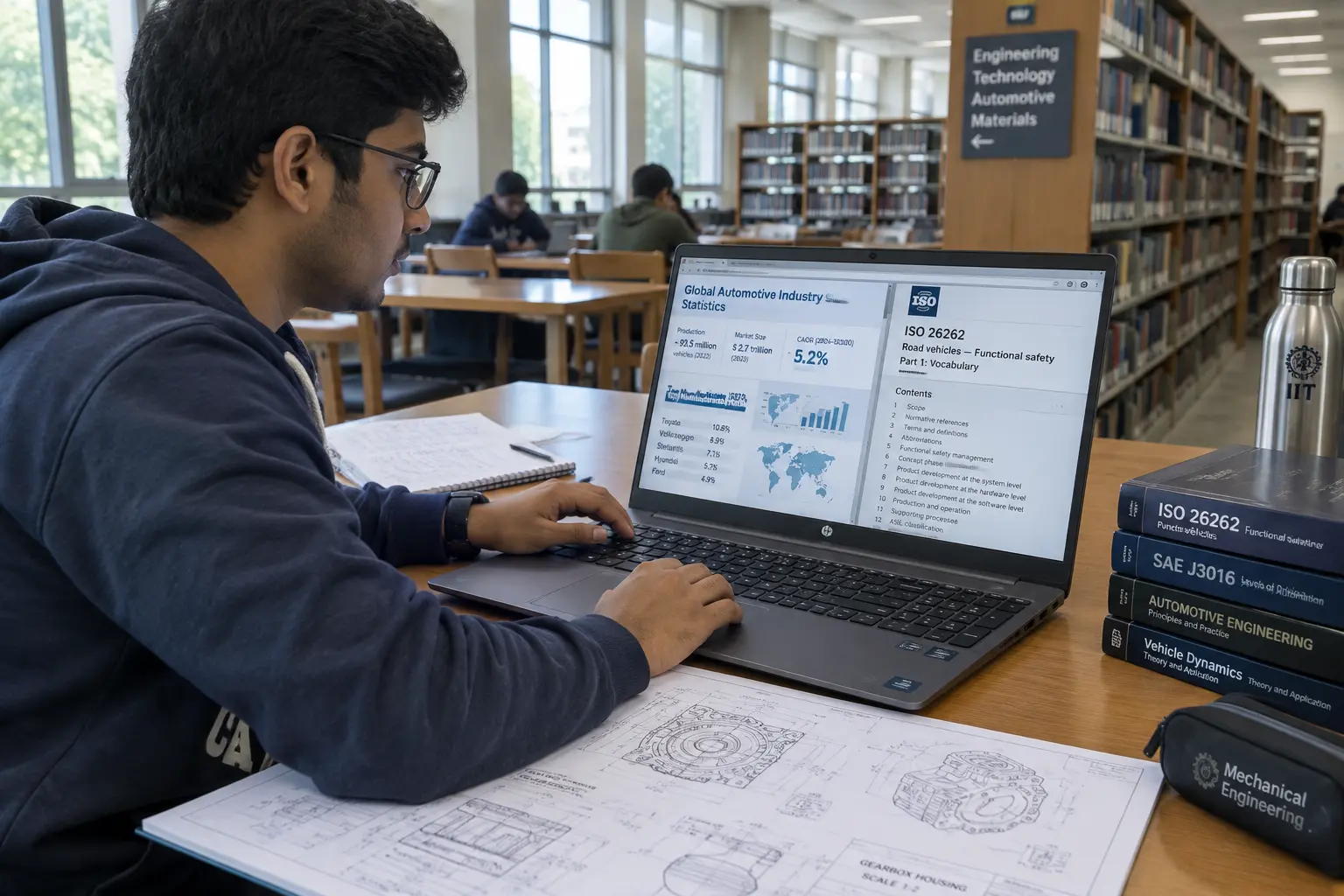
Three official sources cover almost every Mechanical Engineering thesis data need in India: ARAI for vehicle testing and homologation data, SIAM for automotive industry production and sales statistics, and BIS for the engineering standards (IS codes) a design or materials thesis must cite correctly. None of these is a single one-click dataset download — each requires a specific request, a registration, or a report purchase or subscription, and this guide states plainly what is actually available at no cost versus what needs an application or a fee.
| Source | What it provides | Access / cost | Best use in your thesis |
|---|---|---|---|
| ARAI (Automotive Research Association of India) | Vehicle testing, homologation and type-approval standards; technical R&D papers | Technical papers generally accessible via academic search; certification/test records confidential to the manufacturer | Citing the regulatory testing standard or procedure a design must meet |
| SIAM (Society of Indian Automobile Manufacturers) | Monthly and annual production, domestic sales and export statistics, including model-wise reports | Sold as published reports or by subscription; SIAM’s terms bar redistribution without its written permission — check your library first, and cite the specific report and month/year | Market-size, adoption-rate and segment-trend figures for the literature review |
| BIS (Bureau of Indian Standards) | IS codes: dimensional, materials and testing-procedure standards | BIS offers indigenous Indian Standards as free downloads through its BSB Edge portal (standardsbis.bsbedge.com) after registration; check whether your standard is in the free set | Citing an exact standard number and edition year for a design, materials or testing specification |
ARAI — Vehicle Testing, Certification and R&D
The Automotive Research Association of India (ARAI), established in 1966 and operating under the administrative control of the Ministry of Heavy Industries, is India’s primary vehicle testing and certification body. ARAI is one of the agencies notified under Rule 126 of the Central Motor Vehicle Rules, 1989 to issue type-approval and homologation certificates, and it conducts compliance testing for vehicles, automotive components and engines. For a Mechanical Engineering thesis on automotive systems, ARAI is most useful as a source of the regulatory testing standards and procedures a design must meet (referenced by name and standard number in your literature review) rather than as a source of raw vehicle performance data, which is generally not published for individual models. ARAI also publishes technical papers and hosts symposia through its R&D wing — search these for peer-reviewed technical content relevant to your specific sub-topic (engine emissions, crash safety, EV battery testing) rather than assuming a general dataset exists. ARAI states that it is certified to ISO 9001 (alongside other ISO management standards) and accredited by the National Accreditation Board for Testing and Calibration Laboratories (NABL) for its testing and calibration scope under ISO/IEC 17025 — a detail worth citing if your thesis discusses laboratory accreditation or testing credibility.
SIAM — Industry Production, Sales and Export Statistics
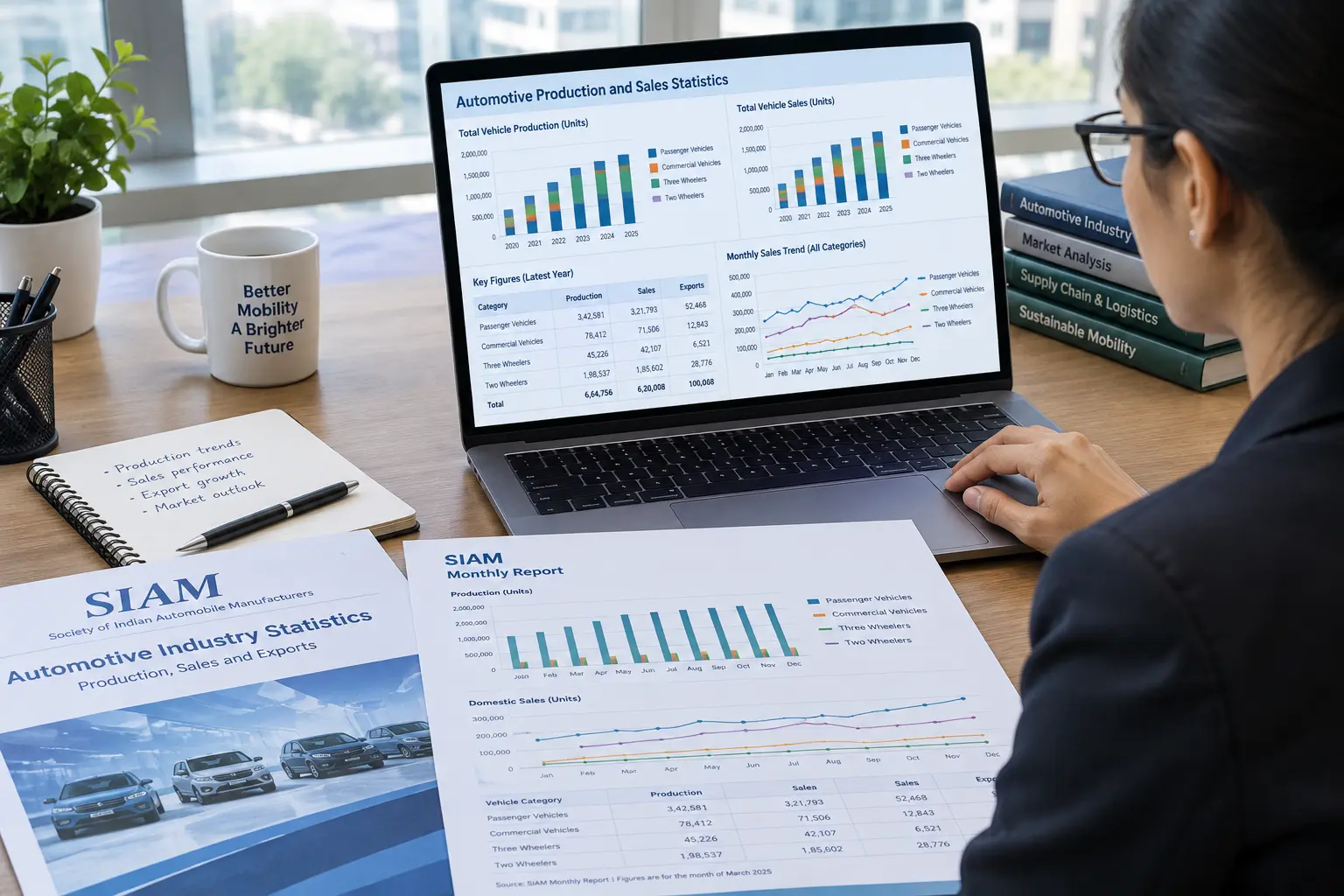
The Society of Indian Automobile Manufacturers (SIAM) is the apex national body representing vehicle and vehicular-engine manufacturers in India. Its statistical services include a monthly flash report (production, domestic sales and exports), monthly and annual model-wise reports for passenger vehicles and two-wheelers, and annual state-wise sales data. These are sold as published reports or by subscription, under terms that bar sharing or reproducing the compiled statistics without SIAM’s written permission — so check whether your institute’s library already holds them before buying, and quote only the figures you need, with attribution. For a thesis examining automotive market trends, EV adoption rates, or the economic scale of a specific vehicle segment, SIAM’s statistics are the standard citable source — always cite the specific report and its publication month/year, since SIAM’s figures are updated monthly and a number from an old report may no longer be current. SIAM also represents the Indian automotive sector in international forums (APEC Automotive Dialogue, WTO, UN ECE WP29), which is useful context if your thesis compares Indian standards or market structure against an international benchmark.
BIS — Engineering Standards and IS Codes
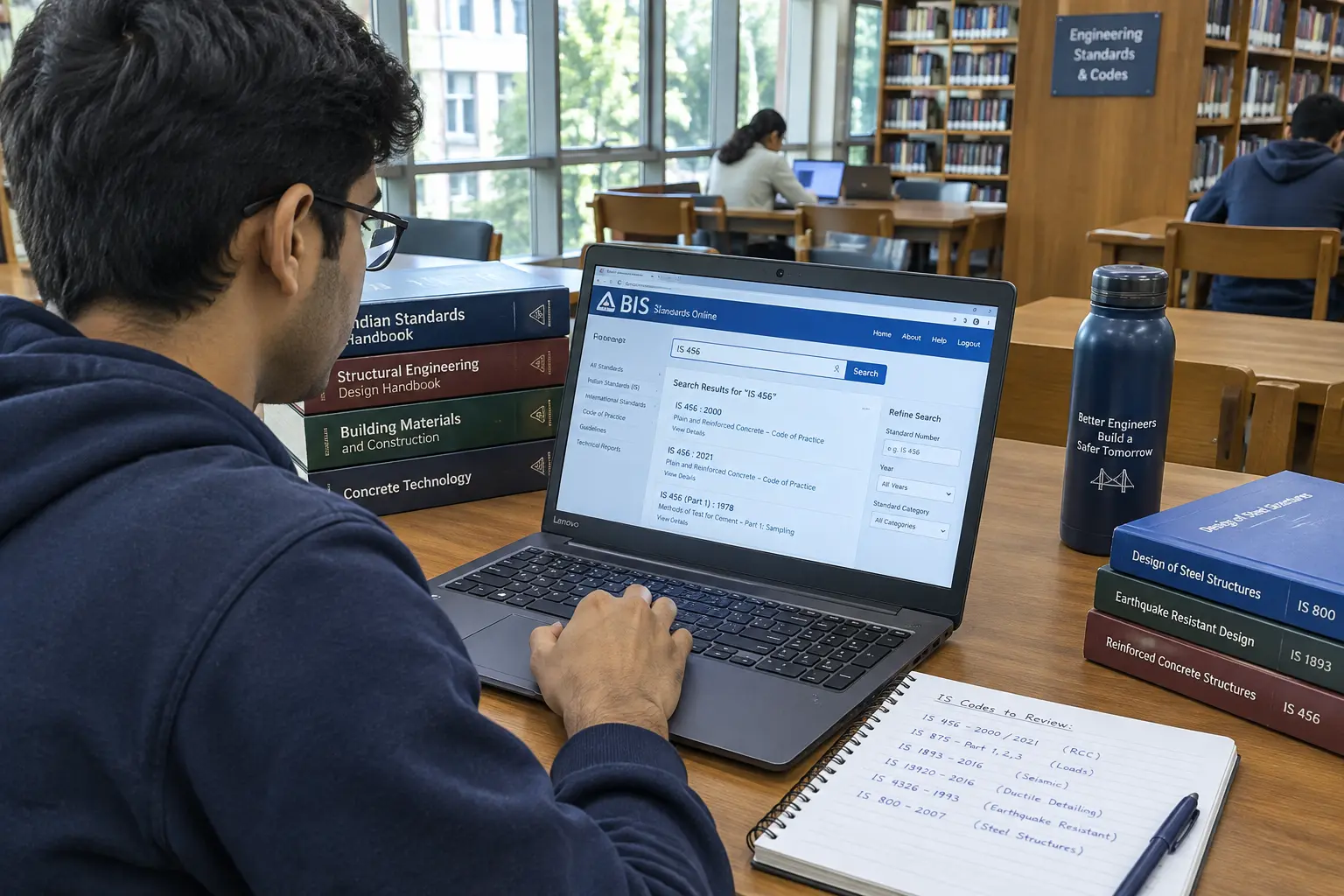
The Bureau of Indian Standards (BIS) is India’s National Standards Body, publishing Indian Standards (IS codes) across engineering, construction, materials and manufacturing, searchable through its portal at standards.bis.gov.in. A Mechanical Engineering design, materials-testing or manufacturing-process thesis that references a dimensional tolerance, a material specification or a testing procedure should cite the exact IS code by number and year — “as per relevant BIS standards” without a code number is not a citable claim. BIS publicises free downloads of indigenous Indian Standards through its BSB Edge portal (standardsbis.bsbedge.com), which requires a free registration; if the standard you need is not in the free set, check whether your institution’s library already holds an institutional subscription before buying it individually.
Where These Three Sources Fall Short
None of ARAI, SIAM or BIS publishes a ready-to-analyse raw dataset the way some agricultural or public-health portals do. If your thesis needs primary numeric data — sensor readings, material test results, simulation outputs — you will generate this yourself in a lab or workshop setting, not download it from a national source. Where you need contextual industry figures (market size, production volumes, standards compliance requirements) rather than your own experimental data, the three sources above are what an examiner expects you to cite; where you need actual experimental data, your own testing and simulation work is the data, and these sources instead supply the standards your testing must be validated against.
This distinction matters for how you write your Chapter 3 data-sources section: a thesis validating a new bracket design against fatigue-loading standards cites BIS for the applicable standard and reports its own lab-generated stress-test results as the data; a thesis analysing EV-adoption trends cites SIAM for the market figures and does not need to generate any primary data of its own. Confusing the two — citing a standards body as if it supplied your experimental results, or presenting your own lab data as if it came from a national source — is a methodological error an examiner will catch quickly.
A Fourth Route: Open Datasets and Institutional Repositories
For Mechanical Engineering sub-fields with a strong computational or materials-informatics component (finite element analysis validation data, materials property databases, CAD model libraries), check whether your own institute’s central library or a national repository (such as Shodhganga for prior Indian theses working on comparable problems) already holds comparable validated data or prior student work you can build on or explicitly compare against — always with proper citation, never presented as your own newly collected data. A thesis proposing a new design also typically needs to benchmark against at least one existing commercial or published design; treat a competitor’s or prior researcher’s published specification as literature to cite, not as a dataset to silently absorb into your own results. International open-dataset platforms occasionally host materials-property or manufacturing-process datasets relevant to a computational sub-field, but access and download mechanics vary by platform and by dataset licence — check each dataset’s own stated licence and citation requirement individually rather than assuming a blanket permission across an entire platform.
Writing Up Your Data Sources in Chapter 3
Whichever combination of sources your thesis draws on, name each one precisely in your methodology chapter — the exact report, standard number or dataset, its publication date, and what specific figure or specification you drew from it. A vague reference to “government data” or “industry sources” without naming the specific body, report and date is one of the more common reasons a Chapter 3 data-sources subsection is sent back for revision. Where your thesis needs a specific statistical test to analyse whatever data you do collect, see our decision-table guide on choosing a statistical test for a thesis once your data-collection plan is settled, and if you are still designing your overall Chapter 3 structure, our written-out Chapter 3 example covers the section-by-section logic a data-sources subsection sits within.
Frequently Asked Questions
Is ARAI data free to access for a student thesis?
ARAI’s published technical papers and symposium proceedings are generally accessible through standard academic search, but vehicle-specific test data and certification records are not publicly published — these remain confidential between ARAI and the manufacturer. Cite ARAI for the standards and testing procedures it administers, not for a specific vehicle’s raw test results.
Do I need to pay for BIS standards?
Not necessarily. BIS offers indigenous Indian Standards as free downloads through its BSB Edge portal (standardsbis.bsbedge.com) after a free registration. For any standard outside that free set, check your institution’s library first, since many engineering college libraries provide institutional access to Indian Standards.
Can I cite SIAM figures for a thesis on electric vehicles specifically?
Yes — cite the specific SIAM report and reporting period you used, and check whether that report breaks out electric vehicles as a separate category, since classification can differ between reports and years and an older report may not separate EVs at all.
Where do I find data on a specific manufacturing process rather than a vehicle?
For manufacturing-process research (machining, welding, additive manufacturing) outside the automotive-specific scope of ARAI and SIAM, check your own institute’s workshop and lab facilities as your primary data source, supplemented by BIS process standards and peer-reviewed journal literature for comparative benchmarks — a national manufacturing-process dataset comparable to ARAI or SIAM’s automotive-specific coverage does not exist in the same centralised form.
Is there an Indian government open-data portal with mechanical-engineering-relevant datasets?
data.gov.in hosts a range of government datasets, some of which touch industrial and manufacturing statistics, but coverage for mechanical-engineering-specific technical data is thin compared to sector-specific portals; search it as a supplementary source, not a primary one, and verify any dataset’s currency and methodology before citing it.
Can I use a competitor’s published specification sheet as a data source?
A manufacturer’s own published specification sheet is a legitimate citable source for that specific product’s stated specifications, but state clearly that the figures are manufacturer-published (not independently verified test data) and cite the specific document and its publication date.
How do I cite a BIS standard correctly in my references?
Cite by the standard’s IS number, title and year of the edition you used (BIS periodically revises standards, so the year matters) — check how to cite in APA style for an Indian university thesis for the general citation mechanics and adapt the organisational-author pattern to BIS as the issuing body.
Should I contact ARAI directly for my thesis data needs?
For a genuinely novel technical question ARAI’s published material does not answer, a direct enquiry is reasonable, but set realistic expectations for response time and be specific about exactly what you are asking for — a vague request for “automotive data” is unlikely to get a useful reply, while a specific question about a named standard or testing procedure has a better chance.
Can I use international standards (ISO, SAE) instead of BIS standards?
Many BIS standards are harmonised with or adapted from international standards (ISO, SAE), but check whether your specific application requires the Indian standard for regulatory compliance in an Indian context, or whether the international standard is an acceptable substitute — state clearly which you used and why.
How current does an ARAI, SIAM or BIS citation need to be?
As current as the report or standard edition you actually opened — state the exact publication year or edition, and note in your literature review if a more recent edition or report exists but was not accessible to you, rather than silently citing an outdated figure as if it were current.
What if my institute’s library does not have the specific BIS standard I need?
First check whether it is in the free download set on standardsbis.bsbedge.com. If it is not, ask your library about inter-library access or a consortium subscription before purchasing individually, since library consortia often hold broader standards access than a single department realises; buying an individual standard should be a last resort after these checks.
Build your data-sources section with confidence
Tesify helps you write the data-sources paragraph of your Mechanical Engineering dissertation, naming every cited source with its access route, and flags where your thesis genuinely needs its own experimental data rather than a citable secondary source.
Build your Mechanical Engineering dissertation data-sources section in Tesify