
Everyone in your batch is suggesting fintech for the finance dissertation this year — your guide included — and “fintech” alone is exactly as unresearchable as “AI” or “sustainability” alone. Below are five specific, researchable ways to frame a fintech topic for an Accounting and Finance dissertation, a worked example carried to a full data-collection plan, and the two questions to ask before you commit.
Why “Fintech” Alone Is Too Broad to Research
Fintech spans UPI payments, digital lending, robo-advisory, insurtech, embedded finance and cryptocurrency-adjacent products — a thesis titled simply “a study of fintech in India” cannot be researched because it names an entire industry, not a question. This is the same narrowing problem covered for a different trend in our guide to trending 2026 MBA thesis topics on AI and sustainability; the fix here is identical — attach the trend to one specific product, one specific population and one measurable outcome.
Five Ways to Frame a Fintech Topic That Actually Works
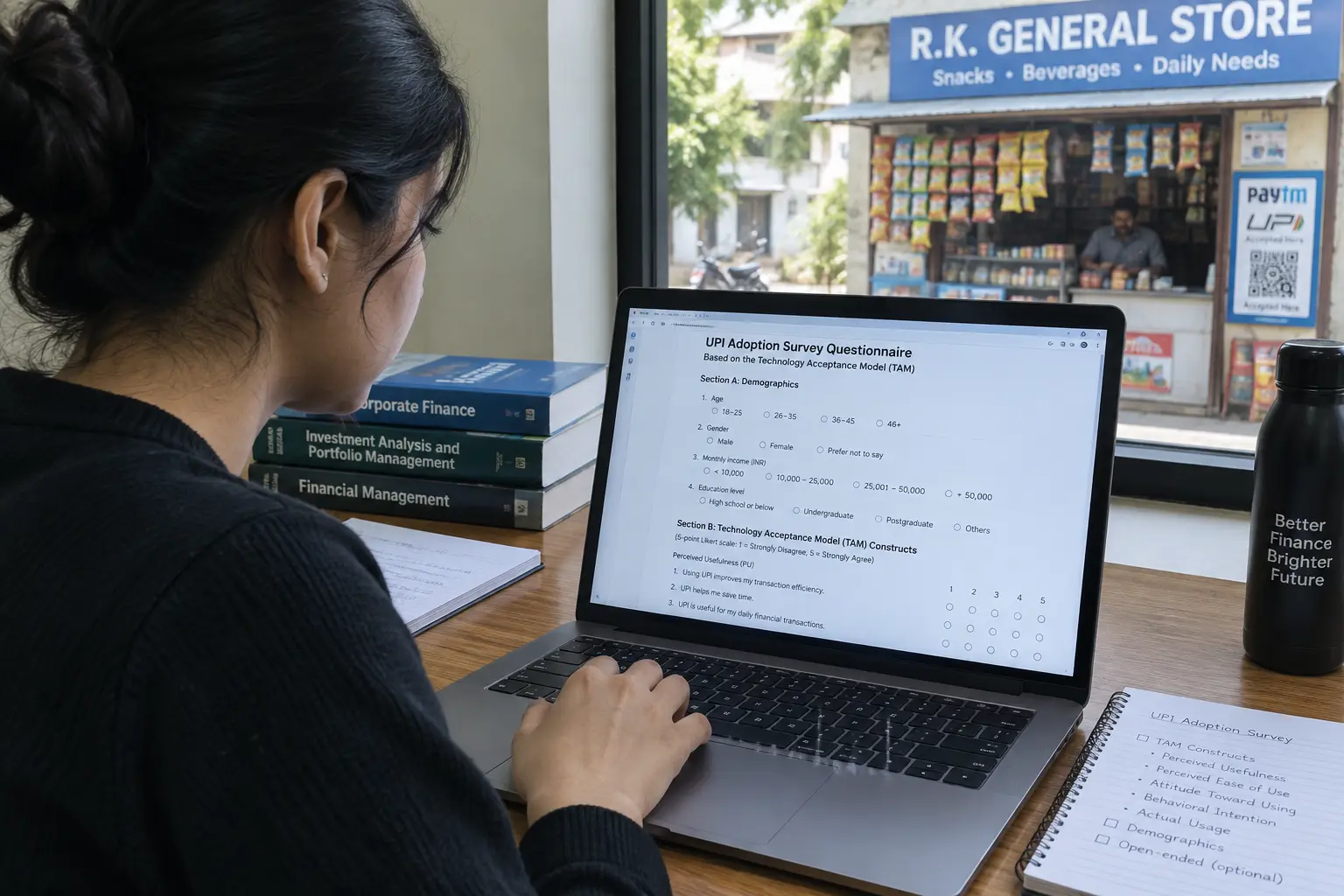
- Factors influencing UPI adoption among a specific demographic — first-time users, small retailers, or a specific age band, rather than “consumers” broadly, using a named technology-acceptance framework.
- Awareness of digital lending risks among first-time borrowers on lending apps — what borrowers understand (or misunderstand) about interest rates, recovery practices and data-sharing terms before taking a digital loan.
- Small retailer adoption of embedded finance and quick-commerce-linked payment tools — how a specific class of small business (kirana stores, for example) is adopting integrated payment and micro-lending tools bundled into e-commerce platforms.
- Trust in robo-advisory platforms among first-time retail investors — a survey-based study on what drives (or blocks) a first-time investor’s willingness to follow an automated investment recommendation.
- Cybersecurity concern as a barrier to mobile banking adoption among a specific population — older adults, rural bank customers, or another group where digital trust is a documented adoption barrier.
Each framing names a specific fintech product, a specific population, and a measurable outcome (adoption, awareness, trust, or a stated barrier) — the three elements a committee needs before approving a fintech topic.
A Worked Framing Example, Start to Finish
Take option 1 above — factors influencing UPI adoption among a specific demographic — and carry it through to a plan:
- Problem: UPI adoption among younger, digitally native consumers is well documented, but the specific factors driving or blocking adoption among first-time small-retailer users — who face different risk, cost and customer-trust considerations than individual consumers — are comparatively under-examined in the Indian context.
- Objective: To examine the factors influencing UPI adoption among small retailers in [your city/region] using the Technology Acceptance Model.
- Variables: Independent — perceived usefulness, perceived ease of use, perceived security, peer/customer influence; Dependent — UPI adoption intention or actual usage frequency.
- Method: A cross-sectional survey using a structured questionnaire adapted from established Technology Acceptance Model instruments, administered to a convenience sample of small retailers in a defined market area.
- Data source: Your own survey — supplemented by published UPI transaction-volume context (NPCI’s own published data) for the literature review, not as your primary data.
Notice the problem statement states plainly what is documented (general UPI adoption research) versus what is not yet documented for this specific population (small-retailer-specific adoption factors) — the same gap-statement discipline covered in our guide to writing a real research gap statement, applied here to a finance topic instead of nursing.

What Data Can You Actually Collect?
All five framings above are deliberately built around data you can collect yourself: a survey of a defined, reachable population (retailers in a local market, first-time borrowers you can recruit through a lending app’s user community or your own network, retail investors accessible through a broker or investment club). None requires access to a bank’s or fintech company’s internal transaction data, which is confidential and effectively unobtainable for a student dissertation. If your initial idea did depend on a company’s internal data — a specific app’s user retention figures, a lender’s default rate by borrower segment — treat this as an early warning sign to pivot toward one of the survey-based framings above rather than spending weeks chasing a data-access request that is unlikely to succeed within your dissertation timeline. Where you need market-level context — total UPI transaction volumes, digital lending market size, fintech funding trends — cite a named published source (NPCI for UPI volumes, RBI publications for regulatory context) and clearly separate that cited context from your own primary survey data in your methodology chapter.
Anchoring Your Framing to a Named Theory
Each framing above benefits from a named theoretical anchor, not just a plausible-sounding survey. Adoption-focused framings (UPI adoption, mobile-banking adoption, embedded-finance adoption) fit naturally with the Technology Acceptance Model or the Unified Theory of Acceptance and Use of Technology, both widely used in Indian fintech-adoption research. Trust-focused framings (robo-advisory trust, digital-lending risk awareness) draw on trust and risk-perception literature in financial technology adoption specifically, which is a distinct but related body of work from general technology acceptance. Naming your theoretical anchor in the proposal stage — not retrofitting one after data collection — is what a committee expects to see in your literature review chapter, and it also tells you in advance which constructs your survey instrument actually needs to measure.
A Note on Regulatory Context
India’s fintech regulatory environment is genuinely active — the RBI has run a regulatory sandbox for fintech innovation since 2019 (its Enabling Framework for Regulatory Sandbox was updated in February 2024) and periodically issues guidelines on digital lending — but cite any specific regulatory claim (a scheme name, a guideline’s date, a specific rule) only from the RBI’s own published circular or another source you have actually read yourself, never from general familiarity with “fintech regulation” as a topic. Regulatory guidelines in this space change often enough that a citation from even two or three years ago may already be superseded, so check the RBI’s current publication list for the specific area your framing touches before finalising your literature review. A finance dissertation that gets a regulatory detail wrong in its literature review undermines the credibility of the rest of the chapter.
Choosing Between the Five Framings for Your Own Situation
If you already have access to a specific population — you work part-time at a retail shop, a family member runs a small business that has adopted UPI, you know first-time investors through a broker or investment club — start from the framing that matches the access you already have, rather than picking the most academically fashionable option and then struggling to find respondents. Access to a reachable, willing sample is one of the biggest practical determinants of whether a survey-based finance dissertation finishes on time; a theoretically elegant framing with no realistic respondent pool is a weaker choice than a simpler framing you can actually execute within your timeline.
Where This Sits Relative to the Site’s Other Finance Content
This guide is about choosing and framing a hot-topic fintech thesis — a different job from our guides to building the Accounting and Finance dissertation consistency matrix once your objectives are set, and choosing the right statistical test once your data is collected. Use this guide first to land on a genuinely researchable fintech angle, then move to those two for the methodology mechanics.
Frequently Asked Questions
Is a fintech topic acceptable for an M.Com dissertation, or only MBA-Finance?
Both — the five framings above work for M.Com, MBA-Finance or a B.Com(Hons) final project, scaled to the depth your specific programme expects. Confirm the required analytical sophistication (a simple descriptive survey versus a full TAM-based regression model) with your guide, since programme-level expectations for statistical depth vary more in this area than students often assume.
Can I study a specific fintech company directly?
Studying a named company’s publicly available information (its published reports, app-store reviews, public statements) is fine, but you generally cannot access its internal transaction or customer data without a formal partnership — most of the five framings above sidestep this by surveying users rather than requesting company data.
Is cryptocurrency an acceptable fintech sub-topic for an Indian finance dissertation?
It can be, though India’s regulatory treatment of cryptocurrency has shifted over recent years — verify the current regulatory status directly from an RBI or government source before framing a topic that assumes a specific legal status, since an outdated regulatory assumption is a common and avoidable error in this sub-area.
How much does Tesify cost, and is it worth it for one dissertation?
Current pricing and plans are shown on the Tesify site when you sign up; Tesify is used by 9,000+ students who have generated 15,000+ chapters, and every chapter is 100% written by you, with Tesify helping you structure, cite and refine your own work.
Will an AI tool helping me frame this topic count as academic misconduct?
Using AI assistance to structure your problem statement, objectives and methodology plan around your own chosen topic is generally defensible under Indian academic-integrity norms, provided the underlying research idea and final write-up are your own — see our guide on AI and thesis writing in India for the full reasoning.
Is fintech too competitive a topic — will my dissertation just repeat what others have done?
Narrowing to a specific product, population and outcome (as in the five framings above) is exactly what prevents this — a generic “fintech adoption in India” study risks duplicating existing work, but “UPI adoption among small retailers in [your specific city]” or “trust in robo-advisory among first-time investors” is specific enough to be genuinely your own contribution.
Do I need ethics committee approval for a fintech survey?
Yes — surveying human respondents (retailers, borrowers, investors) is human-subjects research requiring your institution’s standard ethics clearance, regardless of the topic being about finance rather than health or psychology.
What if my chosen fintech product changes its features before I finish my dissertation?
State the specific version or feature set you studied and the date of your data collection explicitly in your methodology chapter — a fast-moving product changing after your study is a normal limitation to note, not a reason to abandon the topic.
Can I compare two fintech products directly, such as two lending apps?
Yes, a comparative design (comparing user experience, trust, or a specific outcome across two named products) is a legitimate variation on several of the framings above, provided you can reach respondents who have genuinely used both products, not respondents guessing about one they have never tried.
Should I include the fintech company’s own marketing claims as literature?
A company’s own published claims are citable as the company’s stated position, but label them clearly as marketing or self-reported material rather than independent evidence, and do not present them as if they were peer-reviewed findings about the product’s actual effectiveness.
Frame your fintech dissertation topic today
Tesify takes the specific framing you choose from this guide and helps you build out the full problem statement, objectives, variables and a feasible data-collection plan — so your synopsis reflects a fintech angle you actually chose and can defend.